

April 1, 2012 | Read Time: 4 minutes
A white-haired lady wearing tennis shoes and carrying binoculars: That’s what typically comes to mind when conjuring up an image of a bird lover. And members of the National Audubon Society are not likely to disappoint. The group doesn’t keep data on the ages and ethnic backgrounds of its half-million members, but its officials acknowledge kernels of truth in the stereotype of the average birdwatcher: Many of them are indeed older white people.
Now Audubon—which got its start in 1905— is seeking to attract a younger, more diverse crowd.
“We are dedicated to all our supporters,” says Jessica Green, an Audubon vice president who works on marketing and development. “We want to continue to engage them, plus bring in the next generation of supporters and conservation leaders.”
To do that, it is stepping up with innovative Internet games, hip social events, and other efforts designed to skew young. Says David Yarnold, Audubon’s president: “This is not your grandmother’s Audubon anymore, and we think she’d be pretty happy about that, because she wants Audubon to look to the future.”
Mr. Yarnold, who took over in late 2010, says the future of Audubon, like that of many other environmental groups, will be in part determined by the group’s ability to attract a new generation of potential supporters with an affinity for animals and for conservation.
With a changing American population, that also means reaching out to minorities, who are not traditionally tied to the cause.
Pointing to a finding by the U.S. Fish and Wildlife Service that 48 million Americans identify themselves as bird watchers, Mr. Yarnold says that Audubon has a vast potential audience.
‘She’s Hooked’
In its push to attract supporters from different backgrounds, Audubon is hoping to foster interest in birds and conservation among the hundreds of thousands of schoolchildren, many of whom are from low-income families, who visit one of the organization’s 50 or so nature-education centers each year.
And an Audubon fellowship program to foster leadership in conservation encourages participation by environmental activists from all walks of life, especially those whose work involves reaching out to young people and minorities.
Young adults are a big part of the audience Audubon hopes to reach. To further that goal, the charity has expanded its online presence, which now includes a monthly e-mail newsletter, Wingspan, and a Web tool about to be introduced, called myAudubon.com, that will allow users to customize the news, Twitter feeds, and other content Audubon provides.
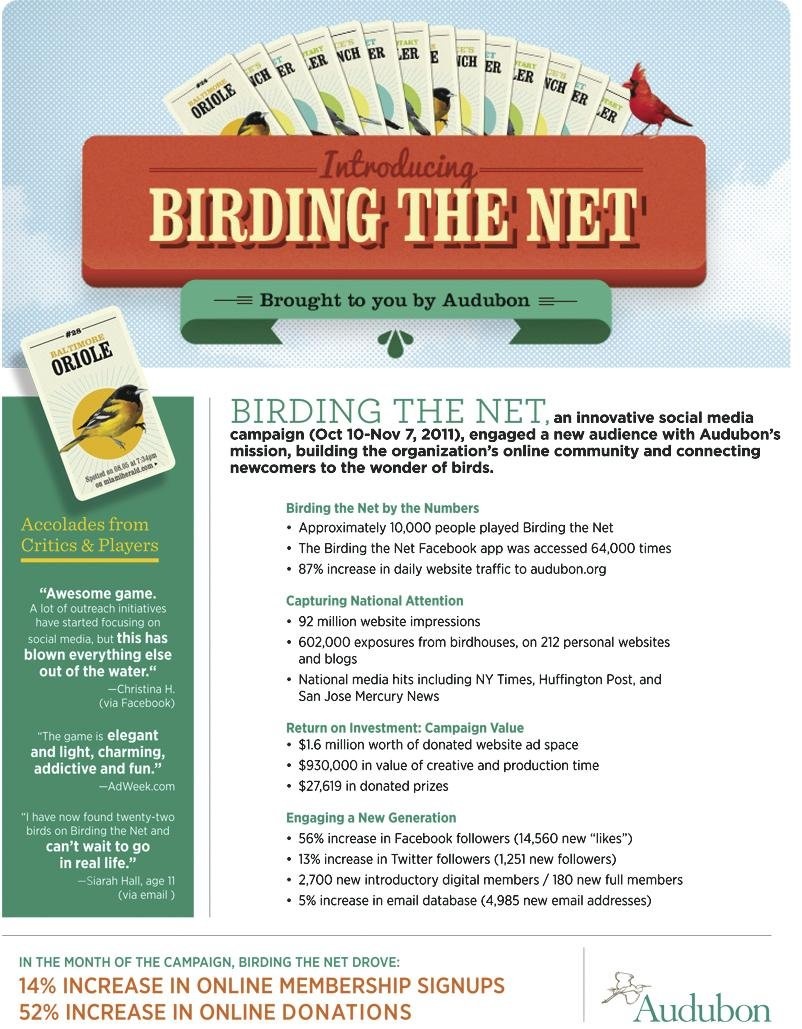
Last fall, the organization introduced a novel online game, a virtual bird-watching contest called Birding the Net. During the monthlong game, which featured a grand-prize trip to the Galapagos Islands, players were prompted through Facebook and other social-media outlets to visit participating Web sites and spot different species of birds flying across the screen. The object was to “collect” as many species as possible. The winner: a Boston woman in her late 20s, who was not an Audubon member.
“Now she’s hooked,” Ms. Green says of the winner, who told Audubon officials that during the contest she fell in love with birds, including the blue-footed booby, which she is likely to see in the Galapagos. Birding the Net “was all about reaching a new audience, and we achieved that.”
About 10,000 people registered to play the game, and of those, about half joined Audubon’s e-mail list, Ms. Green says. Many of them also made a donation in December during the organization’s first end-of-year online fundraising campaign, which raised $50,000 and was matched by members of the governing board.
Gallery Parties
Twentysomethings are learning about the National Audubon Society in other ways, too.
Two events held last year at a photography gallery in a trendy Venice Beach, Calif., neighborhood drew a few hundred young adults who may have seen Audubon’s invitations posted at local coffeehouses or around the campus of the University of California at Los Angeles. The events featured beer tasting, local wines, and vegan food. A local recording artist provided entertainment at one event, while the host of the television show “Birding Adventures” made an appearance at the other.
“The parties were a fun, casual way to introduce people to Audubon,” says Susan Gottlieb, a co-owner of the gallery and an Audubon California board member. “We had college-aged kids through people in their early 30s, and we had them thinking about birds as they were just enjoying themselves.”




