Organization Designs Healthier Hospitals for Patients in Poor Countries

By NICOLE WALLACE
Features Editor
April 7, 2013 | Read Time: 4 minutes
MASS Design Group has an unusual mission: using architecture to save lives. The organization designs and builds hospitals and clinics that prevent the spread of disease and bolster economic vitality in developing countries.
“We want to build exceptional projects to show that it’s possible to improve lives through better built environments,” says Michael Murphy, co-founder of MASS Design.
The organization, which has applied for nonprofit status, got its start designing and overseeing construction of a hospital in Rwanda with Partners in Health, a charity that brings modern medical care to some of the poorest places in the world.
Managing Air Flow
One of the biggest challenges architects designing hospitals face is how to keep patients who have airborne diseases like tuberculosis from infecting other people. The solution is to make sure there’s enough air circulation to keep rooms from becoming contaminated.
Hospitals in the United States rely on large mechanical systems to create the necessary airflow. But while that’s not an approach that works in poor countries that lack a reliable electrical grid, many hospitals in the developing world are still built on a Western model of indoor hallways and the expectation of large ventilation systems, says Mr. Murphy.
“That kind of disconnect actually causes the perfect building to help incubate disease instead of prevent them,” he says.
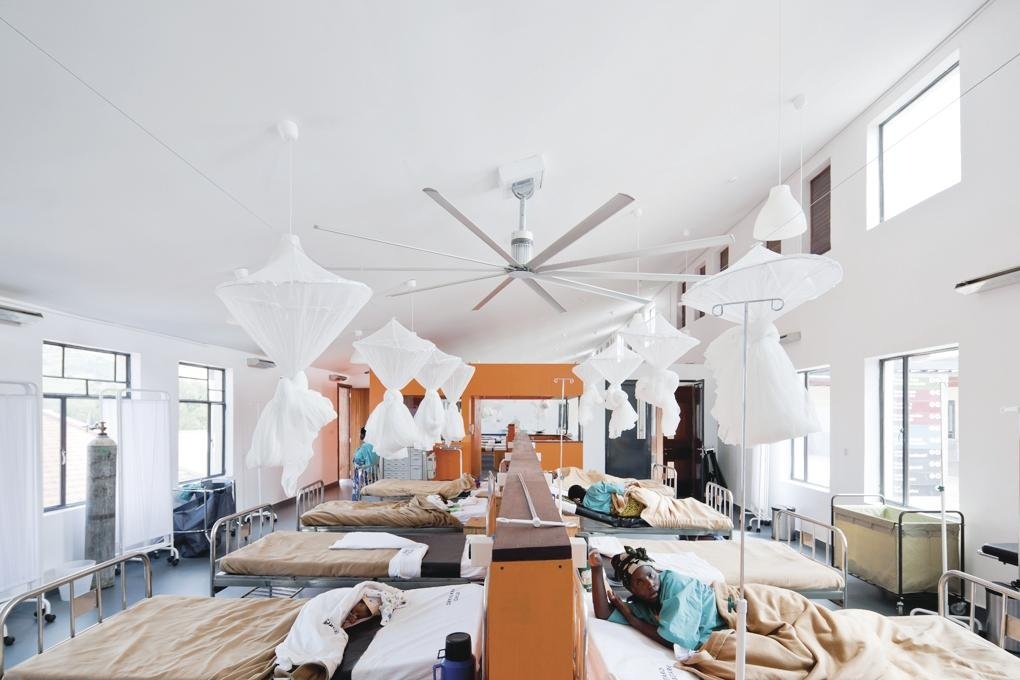
The organization’s design for Butaro Hospital, in northern Rwanda, features outdoor hallways and waiting rooms, as well as a natural ventilation system.
In addition to fans and high ceilings, patient wards have low windows on one wall and high windows on the opposite wall, which creates air flow effect because air moves from areas of high pressure (the low windows) to areas of low pressure (the higher ones).
“It’s like a chimney,” says Mr. Murphy. “The reason chimneys poke out of buildings and extend beyond the roofline of a building is because at the top of the chimney you have the lowest pressure, and so it encourages air to move faster.”
Facing Skepticism
Partners in Health was skeptical at first about the relevance of architecture in health care. When Mr. Murphy met Paul Farmer, the Harvard Medical School professor who co-founded Partners in Health, he asked Dr. Farmer who the group’s architects were.
“He said, ‘Architects? Why would I ever use architects?’” recalls Mr. Murphy. “‘I just do this stuff myself.’”
But Mr. Murphy and his colleagues won the group over. Butaro Hospital opened in 2011, and MASS Design is currently overseeing the construction of houses for doctors on the campus. Partners in Health also serves as the group’s fiscal sponsor while it awaits the Internal Revenue Service’s decision on its application for nonprofit status. MASS Design charges a fee for its design work and raises money from foundations and individuals to pay for efforts to involve local residents in the construction of the buildings.
Working in Haiti
In Haiti, MASS Design is working with Gheskio, an international health group, on the design and construction of hospitals to treat people with multi-drug-resistant tuberculosis and cholera. Because all of the patients at those facilities will already be infected with the same disease, the design challenge is how to protect doctors and other staff members from infection.
The plan for the tuberculosis hospital features isolation rooms and outdoor spaces where doctors can meet with patients safely.
The cholera treatment center, located in Port-au-Prince, will include a wastewater treatment system to decontaminate waste on site, to break the cycle of the disease being reintroduced into the water supply.
“We think this is a model that can be replicated throughout the city,” says Mr. Murphy.
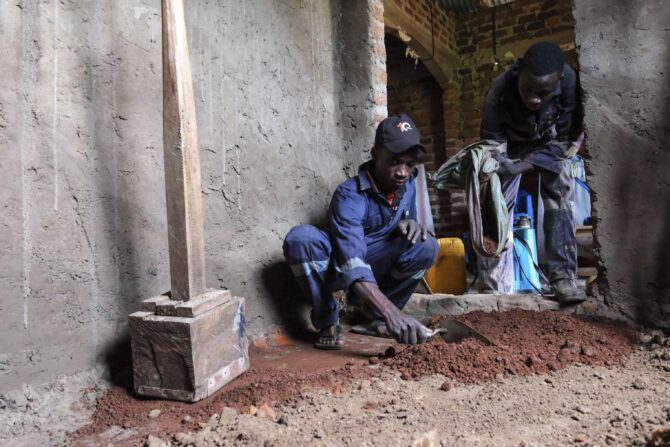
To increase the economic impact of its projects, MASS Design hires and trains local workers to build the facilities and incorporates local building materials into its designs.
Working with residents and seeking their input also helps build a sense of ownership and keeps the clinic or hospital from becoming just another aid project that sits unused, says Mr. Murphy.
The proof, he says, is clear in Butaro each Umaganda, the monthly community-service day that takes place throughout Rwanda.
Says Mr. Murphy: “Every Umaganda, the community comes out in droves to work on the hospital, because they feel like it’s their hospital.”