Partners in Health Moves Ahead on Expansion Plans Following Haiti Tragedy

By Caroline Preston
Contributor
February 21, 2010 | Read Time: 6 minutes
Partners in Health, a Boston charity that has been providing medical care in rural Haiti since the 1980s, has in the past month seen its supporters increase more than tenfold.
The deadly earthquake that rattled Haiti last month, killing at least 200,000 people and wiping out many of Port-au-Prince’s buildings, has prompted an outpouring of generosity.
The group had anticipated raising $64-million this year, with 24 percent earmarked for Haiti. But in the last month, it has brought in more than $56-million from donors who want to help the island nation recover.
That growth brings some new management challenges to the organization.
“How do you spend the money responsibly and effectively at a rate higher than what you’re used to, and don’t get carried away with having to spend too fast,” says Peter Walker, director of the Feinstein International Center at Tufts University. A second concern, he says, “is that when you bring in a lot of money, organizations’ infrastructure grows to spend it, and that can create cash-flow problems.”
But Partners in Health’s leaders are confident that its Haitian sister organization, Zanmi Lasante, can use the money wisely—and that it will need that infusion of cash and much more to respond to the public-health disaster wrought by the earthquake. The organization estimates it will need at least $100-million over the next two-and-a-half years to meet Haiti’s needs.
The charity’s medical director, Joia Mukherjee, says Partners in Health has long had more plans than money to carry them out. It also has experience expanding its programs after other disasters like the hurricanes in Haiti two years ago.
“Never in my 11 years at Partners in Health have we had a problem with absorption,” she says. “What we’ll do is add to the programs that already exist; it’s much less of a challenge than starting afresh.”
Pioneering Work
Indeed, Partners in Health is hardly starting from scratch. Paul Farmer, a doctor and Harvard professor, co-founded the organization at Boston’s Brigham and Women’s Hospital in 1987 after years of working in Haiti. The group is credited with pioneering a grass-roots approach to health care and has since expanded to nine other countries.
With no facilities in Port-au-Prince, the group was in one sense relatively unscathed by last month’s earthquake. Some of the nine facilities it operates elsewhere in the country suffered cracks, but they are all intact, and the organization was fortunate that all but three of its nearly 5,000 Haitian staff members survived the disaster.
That good fortune in some sense heightens the charity’s role in Haiti’s recovery. Dr. Farmer says that the organization is engaged in “soul searching about how to respond to a cataclysmic event that has shaken and brought down much of the health-care infrastructure.”
That soul searching includes grappling with how it might assume a national role when its strength has been providing care in villages. Its leaders also plan to be more involved in helping the government train doctors and other medical professionals; the country’s main teaching hospital was destroyed in the earthquake. It expects to help build at least one new hospital.
Mental health needs, too, have been exacerbated by the disaster. Dr. Mukherjee says the government has asked for help to devise a strategy to meet those needs.
The massive migration of people from Port-au-Prince to areas where Partners in Health works will also have profound implications. In the days after the earthquake, people walked the hour-and-a-half to the charity’s clinic nearest the capital. Dr. Mukherjee says some staff members are now sharing their homes with as many as 17 friends and relatives who left the city. Estimates suggest that 300,000 people are moving into the Artibonite region, which could double the number of people served by Partners in Health there.
For Now, a Trauma Group
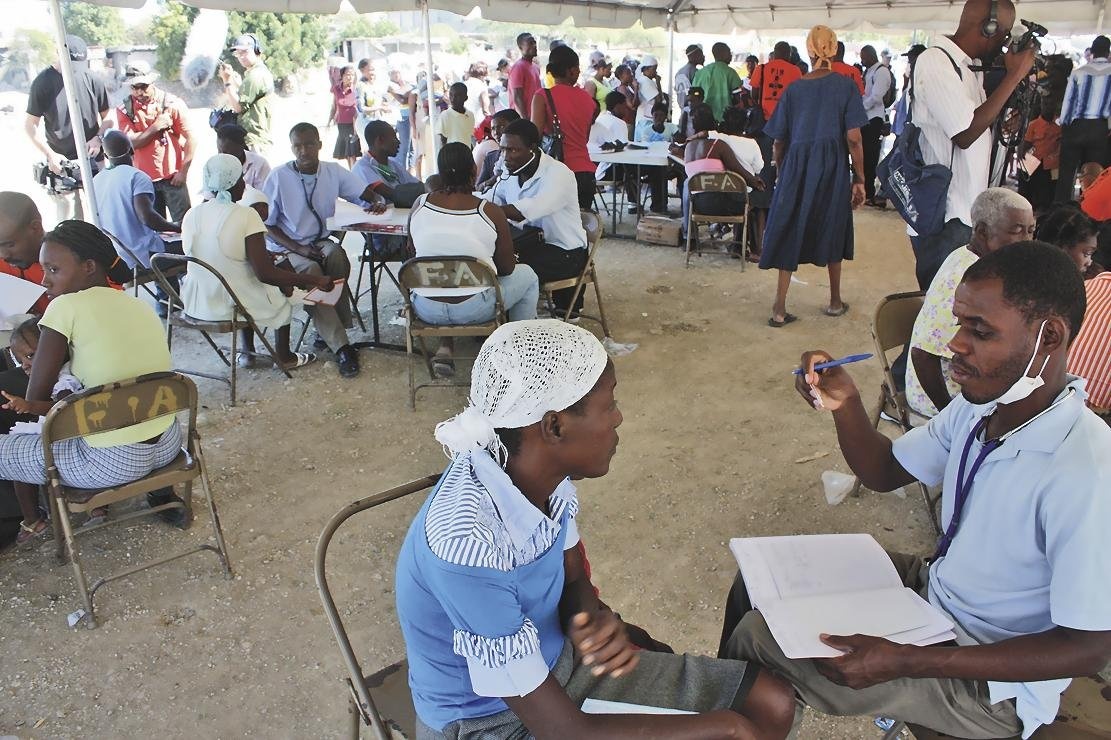
Partners in Health is refining its longer-term plans for Haiti, but for now, it has been transformed into a trauma organization. The group quickly hired more than 300 Haitians to help provide care at Port-au-Prince’s General Hospital and via mobile clinics.
Doctors and local workers hired by the group on short-term contracts are helping people in the camps created for those who lost their homes.
The camps are a breeding ground for tuberculosis, measles, and other diseases. Conditions are so abysmal that Dr. Mukherjee says calling them ‘sheet camps’ is more appropriate than ‘tent camps,’ as there are so few tents.
In addition to its new Haitian employees, the organization has seen a surge of interest from volunteers with Harvard and other medical schools.
Dr. Farmer and Dr. Mukherjee hope the earthquake will result in a greater collaboration with universities over the longer term. They say the focus of such a collaboration will be to help local towns and villages work with the students to solve health concerns, not simply place American students in rural areas, as they say is too often the approach to global health.
Dr. Farmer says that charities and donors need to focus most on working with the Haitian government and Haitian people. That’s not something that philanthropy has been good at in the past, he says. “The default is to blame the Haitians and Haitian culture—might there not be something wrong with the way we’re doing it?”
Expanding Its Staff
To deal with the many challenges, Partners in Health will add employees to its 70-person staff in Boston, says Suzanne Battit, director of development. It will add people to oversee programs and manage the charity, as well as fund raisers.
In the last fiscal year, about 14,000 people gave to Partners in Health. More than 10 times that number—160,000—have given online alone since the earthquake. Efforts by the group’s fund raisers helped capture some of that newsupport. Shortly after the earthquake, the charity transformed its Web site into a “Stand With Haiti” campaign and provided donors brief updates aboutits response. It continues toupdate its Web site withHaiti reports on a near-daily basis.
The focus now will be to turn one-time Haiti donors into long-term supporters. People who have given in the recent past to Partners in Health—now some 200,000 people—will receive a spring appeal familiarizing them with the group’s other work around the world.
Dr. Farmer says that, from a personal perspective, the earthquake will be a distraction from work elsewhere. “It’s hard to concentrate on anything else right now,” he writes in an e-mail. “It’s all Haiti all the time; I am totally distracted from everything else I’ve worked on.”
And his work in Haiti is not just with Partners in Health. Last year, former President Bill Clinton appointed Dr. Farmer the U.N. deputy special envoy to Haiti. Along with Mr. Clinton, he has been coordinating the international response to the earthquake.
But Dr. Farmer and others at Partners in Health say that the Haiti disaster could bring more attention and money to the charity’s efforts elsewhere.
Before the recession, the group had been planning to grow to a $100-million organization by 2012. Then it had to significantly scale back those plans because of the economy, but the influx of new supporters is enabling it to reconsider.
The charity’s leaders also talk about the connections that have been built. Staff members in Rwanda and Lesotho have each raised $20,000 by donating part of their salaries for Haiti. Says Dr. Farmer: “That’s the sort of pragmatic solidarity that’s required.”