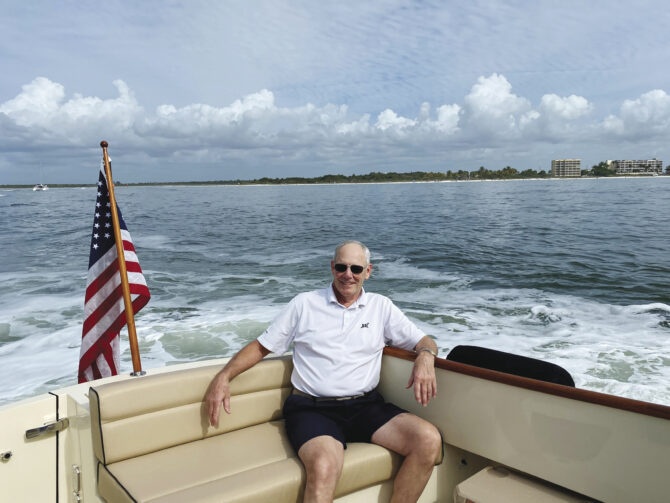
October 30, 2008 | Read Time: 11 minutes
It’s not unusual for lunch with John C. Whitehead to cost upwards of $100,000.
That’s because the retired investment banker is likely to ask his dining companions to make a generous contribution to one of the many nonprofit organizations that are close to his heart.
During his nearly 40-year tenure at the Goldman Sachs Group, in New York, Mr. Whitehead made such a practice of soliciting his friends and business associates that the spot where he often sat at a private dining club became known as the $100,000 table.
“I did bring a lot of my victims there,” Mr. Whitehead says. “But my idea was that if you don’t ask for it, you don’t get it.”
Mr. Whitehead holds to that philosophy even as the economy has turned sour.
Speaking to a visitor in the sun-filled office he still keeps in midtown Manhattan, Mr. Whitehead, 86, says he hesitated recently before sending letters to 10 prospective donors, soliciting donations to the endowment campaign for the International Rescue Committee, a New York group that serves refugees around the world. (The group raised $145.5-million in 2007, placing it at No. 134 in this year’s Philanthropy 400, The Chronicle’s annual listing of the charities that have raised the most money.)
He says he’s pessimistic that the economy will improve any time soon, but he decided to send the letters anyway because he believes that many people still do have the capacity to give, and that there are many worthy causes that warrant support.
“The need continues,” he says. “You just have to keep asking.”
$100-Million in Gifts
The campaign, which Mr. Whitehead started in 2000 when he was chairman of the group’s board, expects to wrap up by the end of this year, with nearly $110-million raised.
Mr. Whitehead himself contributed $4-million to the effort, including money earmarked for a newly created $10-million cash-reserve fund, named for him. The Whitehead Fund is to be used for unexpected crises, and then be replenished with more gifts. In the past year, money from the fund has sent emergency-response teams to Myanmar, Zimbabwe, and other countries in turmoil.
In all, Mr. Whitehead has given nearly $10-million to the International Rescue Committee over the years, and, he estimates, at least $100-million in total contributions to dozens and dozens of organizations, many of whose boards he has served on or led, including the Asia Society, the Greater New York Councils of the Boy Scouts of America, and Haverford College.
The gifts include $4.5-million he donated to nonprofit groups that, as he was, were defrauded by a charity, the Foundation for New Era Philanthropy, which promised to match donations with money from anonymous donors. New Era was exposed as a pyramid scheme and collapsed in 1995.
Despite that scandal, Mr. Whitehead’s involvement with nonprofit organizations has more often been tremendously beneficial to those groups. Yet he turns modest when talking about his charitable contributions, and says his introduction to serious philanthropy was nothing more than serendipity.
It was 1956, and he was vacationing in Vienna when he met a young Hungarian who was part of a movement resisting the Soviet invasion of Hungary. The man had escaped by boat to Austria the previous night in search of food and supplies for his fellow fighters.
Taken by the man’s passion and cause, Mr. Whitehead cut short his vacation, returning to New York to collect the goods the man had requested. A few days later, Mr. Whitehead returned to Vienna in a cargo plane filled with donated pharmaceuticals, radios, outboard motors, and other supplies.
Back at home, Mr. Whitehead sought out the International Rescue Committee, a small group that he had learned was helping Hungarian refugees resettle in the United States. The organization had been founded in the 1930s by Albert Einstein, among others, to help Jewish refugees escape Nazi Germany.
Mr. Whitehead joined the group’s board that year.
“I have great admiration for refugees and their causes,” Mr. Whitehead says. “They are people in desperate humanitarian need who have had the courage to pick up their lives to escape arrest or, worse, to leave oppression and to seek freedom.”
More than 50 years later, Mr. Whitehead is still an active member of the International Rescue Committee’s board. Among other duties, he regularly attends meetings of the board’s fund-raising subcommittee.
In February, he went on an overseas trip with the organization — his 30th, he guesses — to Jordan and Syria. The participants gathered information about the estimated 1.5 million Iraqi refugees living in poor conditions in the two countries, and pressed the governments there to do more to help.
Hands-On Philanthropy
The International Rescue Committee is Mr. Whitehead’s longest-standing board service, but he has also been associated with a range of causes and organizations throughout his busy life. His story reads like a checklist for members of the Greatest Generation.
Raised in Montclair, N.J., during the Depression, he watched his father, a telephone lineman who became a manager, lose his job and then eventually find work selling porch furniture on commission. Directly after graduating from Haverford College in 1943, Mr. Whitehead joined the Navy. He commanded a landing craft at Omaha Beach on D-Day, and watched the brutal assaults of Iwo Jima and Okinawa from the signal deck of a ship that was a target for Japanese kamikazes.
After the war, he married, earned a graduate business degree from Harvard University, and got a job as a statistician at Goldman Sachs, the Wall Street giant that he would eventually lead as co-senior partner from 1976 until his retirement in 1984.
The following year, Mr. Whitehead was asked to serve as deputy secretary of state in the Reagan administration, focusing much of his time on diplomacy in Eastern Europe in the years leading up to the fall of the Berlin Wall.
It was at the end of his government stint, upon his return to New York from Washington, that he began, in earnest, what he calls his third career — service to nonprofit organizations.
He sat on the board of dozens of groups — at one point in the 1990s, serving as chairman of 10 different organizations at once, including the Brookings Institution, the Harvard Board of Overseers, the Andrew W. Mellon Foundation, and the National Gallery of Art.
He has also held the lead post at two quasi-government organizations, serving as chairman of the Federal Reserve Bank of New York and, in 2001, as the first chairman of the board of the Lower Manhattan Development Corporation, the group responsible for rebuilding the area following the September 11 terrorist attacks.
Mr. Whitehead allows that he gets more than his share of governing-board offers, but he notes that he has turned down plenty of them over the years, including an offer in the 1990s from the Metropolitan Opera to serve on its board, a plum post in New York’s charitable circles.
He says the position didn’t capture his interest because he considered the Met a thriving institution that didn’t need his attention.
“It looked like there’d be nothing for me to do,” Mr. Whitehead says.
According to fellow board members and charity officials who have worked with Mr. Whitehead, he is a hands-on, detail-oriented manager and strategist, and a passionate, dedicated fund raiser. They call him thoughtful, ethical, and humble and say he gives generously and inspires others to give, too. They call him the consummate board member.
“He is a person of great intelligence and soulful dedication,” says Janet M. Harris, vice president for development at the International Rescue Committee. “He puts his sweat equity and his pocketbook behind what he believes in. Some have the ethics and the vision, but not the generosity. Others have the pocketbook, but not the smarts. John has it all. He is the ideal philanthropist.”
Leadership Challenges
But his record in the nonprofit world is not completely unblemished. Mr. Whitehead, who made millions as a pioneer in investment banking, was tricked into investing in the Foundation for New Era Philanthropy.
New Era took in more than $350-million from more than 1,000 nonprofit groups and dozens of donors, promising that the money would be matched by anonymous philanthropists, with the total going to the nonprofit groups. Those anonymous donors did not exist.
Mr. Whitehead declined to say how much money he gave to New Era, but he says he ended up donating an additional $4.5-million to the nonprofit groups he had tried to help through the scheme that had also gotten caught up in the scandal.
Mr. Whitehead calls the New Era episode an embarrassment, but he takes a couple other setbacks even harder. He was a board member of a New Jersey theater that folded because of financial troubles, he says. And he turned over the chairmanship of a foreign-exchange organization, called Youth for Understanding, after failing to help improve the group’s fortunes — which, he notes, have since gotten better.
Running nonprofit organizations, Mr. Whitehead says flatly, is much more difficult than running a for-profit enterprise, even one as fast-paced, complex, and global as Goldman Sachs.
Top on the list of difficulties, he says, is measuring success. Organizations are also hampered by the complications associated with recruiting and managing volunteers and constantly having to raise money to operate.
Seeing these challenges up close led Mr. Whitehead, in 1993, to give $10-million to the Harvard Business School to establish the Social Enterprise Initiative, a program that teaches students and charity and business executives how to apply effective management skills to running nonprofit groups.
“He had an insider’s view and he saw that many nonprofits were poorly managed,” says V. Kasturi Rangan, co-chair of the Harvard program. “He wanted to make a leveraged investment to address that problem, and he knew that investing in education can have that multiplier effect.”
Face to Face
The International Rescue Committee has become more sophisticated over the years as it has grown, especially through changes in its fund-raising efforts.
In the fiscal year that ended last month, the organization raised an estimated $62-million in cash gifts from American donors, three times what it garnered in 2000, and about six times what it was bringing in during most years last decade. (In all — including donated products and services — the International Rescue Committee raised about $162-million in the most recent fiscal year, up from $145.5-million in 2007.)
The endowment campaign accounts for some of the fund-raising gains, according to Ms. Harris, the charity’s chief fund raiser, but other key changes are at play, too.
The organization continues to rely on direct-mail gifts — relatively small donations from lots of supporters — but has made deliberate efforts to attract larger gifts and corporate and foundation grants. Direct-mail donations accounted for one-fifth of all cash gifts in 2008, down from one-third in 2000.
Face-to-face donor meetings have also been a successful fund-raising technique. While in the past the charity’s fund raisers used to sit down with only 20 or 30 donors each year, they have, in the last couple years, been meeting with as many as 400 supporters.
That change was largely inspired by Mr. Whitehead. “A personal visit with someone really makes a difference,” he says.
One of Mr. Whitehead’s biggest fund-raising coups came a couple of years ago, when he met with a donor for the International Rescue Committee’s endowment campaign.
The donor had been giving the organization about $5,000 each year, but the group’s fund-raising staff members, guessing the donor could probably give far more, suggested that Mr. Whitehead ask for a $100,000 donation.
He walked away with a $1-million gift.
“I’ve never seen anyone get angry when they see that you think they can afford $1-million,” Mr. Whitehead says. “They feel complimented. And either they can give that much or they can’t, but it doesn’t hurt to ask.”
Charity: International Rescue Committee
Charity’s Philanthropy 400 rank: 134
Years on the charity’s board: 52
Volunteer role: Board member, chair emeritus
Professional background: Retired as co-senior partner, Goldman Sachs Group, in New York
Why he serves on the charity’s board: He is inspired by the passion and determination of refugees, whom the organization is dedicated to helping around the world.
Total of gifts to date: Nearly $10-million to the International Rescue Committee, more than $100-million in total charitable gifts
Amount raised from others: “He’s had an untold positive effect, and is responsible directly or indirectly for raising untold millions and millions,” says Janet M. Harris, the International Rescue Committee’s vice president for development.
Other nonprofit boards: Recent and current board affliations include the Asia Society; the Greater New York Councils of the Boy Scouts of America; the Brookings Institution; Goldman Sachs Foundation; Haverford College; Harvard University’s business, divinity, and government schools; Lincoln Center Theater; the National Gallery of Art; and the National September 11th Memorial and Museum at the World Trade Center.
Advice on raising money: Ask in person; ask for a specific amount; give your own gift before you ask others to give.