

March 24, 2013 | Read Time: 3 minutes
GlobalGiving, a charity Web site that matches donors with community-development projects, has discovered that when it comes to fundraising, peer pressure can work online as well as it does in person.
The charity wanted to know what would make people give more than they initially intended, and it joined with behavioral economists from Harvard and Duke to find out.
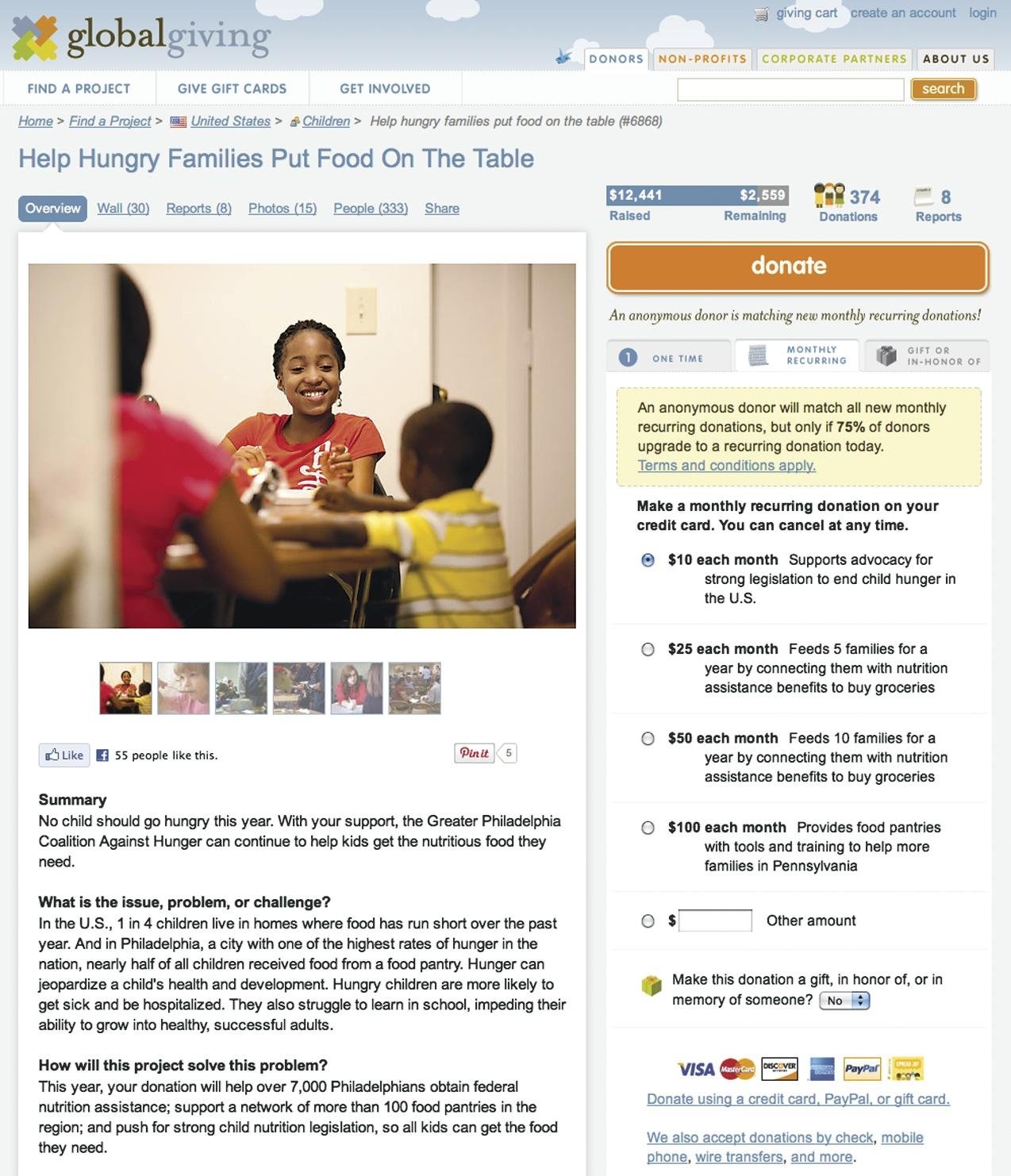
At first, GlobalGiving simply asked donors to give more or said it would match a donor’s money if he or she gave every month. But after many rounds of testing, it found what worked best: telling them how many other people were also planning to step up their donations to once a month and promising a matching gift if a lot of people gave that way regularly.
Researchers examined the results of varying approaches, saying in some cases that if a quarter of other donors gave regularly or 50 percent of other donors gave monthly, then all of their contributions would be matched.
But “75 percent” proved to be the one that pushed people to give monthly.
Twice as many donors agreed to give monthly as had before any offer was included on an online donation page. Now the charity has made the pitch a permanent feature on its Web site.
The results proved to the charity that “people like to feel part of the majority,” says Mari Kuraishi, president of GlobalGiving. “The onset of social media pushed this into prominence.”
Better Search Results
Now GlobalGiving is doing other tests to figure out how to lift fundraising results.
It recently tested 10 ways to present search results online for visitors who were using its Web site to look for projects to support.
The two that scored best: a Consumer Reports-style presentation, with statistics about the project, and a visual layout like Pinterest, in which pictures dominated the search results.
In fact, after the first round of testing ended in January, GlobalGiving scrapped its old search-results page, because it performed dismally in turning visitors into donors compared with the two test options.
Now the organization is trying to find out if a combination of the two winning search-page designs—or another design—will score even higher with Web-site visitors and turn more of them into donors. Again, peer pressure may play a role: Its data analysts are looking to see if knowing how many people contributed to a certain project pushes people to give.
Social Pressure
GlobalGiving is also conducting tests to see what incentives, such as offering matching gifts, will get visitors to tell people they know, via e-mail or social media, that they have made a donation.
And the group is conducting experiments to test whether reading about a friend’s donation on Facebook or in an e-mail makes that person more likely to give.
Such insights into the role of social pressure on philanthropy by individuals can be helpful to organizations conducting fundraising online, says Kevin Conroy, GlobalGiving’s director of user experience and product development.
But he warns other groups to be careful because “you can easily devolve your nonprofit pitch into an infomercial.”
Ms. Kuraishi says GlobalGiving shares the results of these experiments with its own peer group, three other online-based organizations, Charity: Water, DonorsChoose.org, and Kiva.
“And they share their results with us,” she says, contributing to its body of knowledge of what works in online fundraising—and what doesn’t.




