December 8, 2005 | Read Time: 11 minutes
Local and international groups working to reclaim India’s devastated coastline still face many hurdles
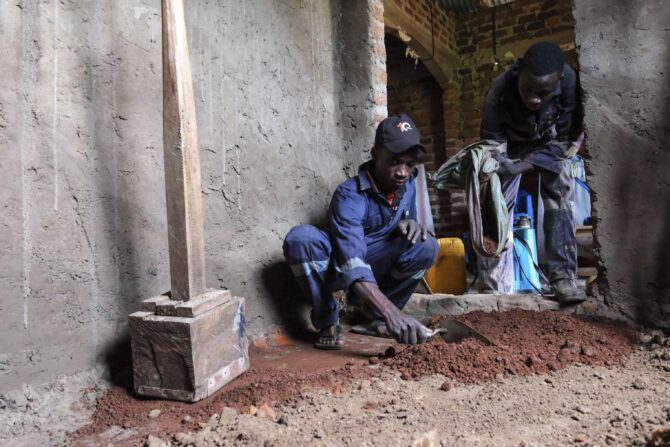
Within view of the sea, women in brightly colored saris and aprons toil in the hot afternoon sun. Some lean over low vats
ALSO SEE:
A Year of Progress, a Year of Setbacks
Caught in the Crossfire of Disaster and War
Indonesians’ Hopes for Rebuilding Recede
One-Third of the $1.6-Billion Raised by U.S. Charities Has Been Spent
to stir a heavy sand mixture, while others pack the mixture into molds, and then — after the molds have set — turn them over to release four gray bricks each.
Nearly a year after the tsunamis killed 42 people in this tiny fishing hamlet, these women are starting to rebuild their lives by learning to become brick masons.
The training program is paid for by the American India Foundation, a New York charity that raises money from Indian-Americans. But the work is overseen by Integrated Women Development Institute, a grass-roots charity in Chennai.
Such partnerships between international aid organizations and local charities have been particularly strong in this country, which has hundreds of thousands of active nonprofit organizations, many of which have a long history of responding to the natural disasters India is prone to, such as cyclones, earthquakes, and flooding.
The masonry program has several goals: to make women more economically independent, diversify an economy that depends mainly on fishing, and give families sufficient income to avoid taking out loans during the three months of the year the sea is too rough to fish. The 20 women in the program hope to sell the bricks, window frames, and other building materials to charities and government agencies rebuilding houses destroyed in the tsunamis.
Umamaheswari, who like many in South India goes by a single name, says that she and her co-workers are proud to be learning a new skill and doing “men’s work.” Before the program, she says, they were always at home, and they enjoy being able to work together as a group.
10,000 Deaths
The tsunamis struck nearly 1,000 miles of India’s coastline, an enormous expanse, killing more than 10,000 people and destroying houses and fishing boats. But most of the damage extended less than a mile in from the shore, leaving roads, schools, hospitals, and other vital operations in many areas largely untouched.
While local and international organizations working together in India have made a great deal of progress helping the country recover from the tsunamis, some problems have hindered their efforts.
The most serious shortcoming: Too many charities have focused their attention on fishermen, an excess of generosity that has had serious consequences for fishing communities. At the same time, the needs of other survivors whose livelihoods were also damaged by the disaster, such as farmers and people working in jobs that support fishing, initially were overlooked.
Experts point to the pressure that donors place on international organizations to spend money quickly after a disaster as one of the causes of the missteps. That pressure can distort the recovery work. What’s more, the influx of too much money too quickly can stretch local charities to the breaking point.
In India, it is a point of great national pride that the Indian government provided the lion’s share of immediate disaster relief, restricting nonprofit participation to indigenous charities and international organizations that were working in the country before the tsunamis.
Even with the restriction, hundreds of organizations flew into action in the affected region, with their numbers swelling further after the Indian government decided to allow additional international organizations into the country to work on long-term recovery efforts.
In the Nagapattinam district alone, the number of relief charities rose to more than 500 at its peak, with some 30 or 40 organizations still present. Before the tsunamis, very few nonprofit organizations of any kind worked in the area.
Coordination among so many new players has been complicated. In the first days of the disaster, some tsunami survivors in the city of Nagapattinam received box lunches from three or four organizations each, while more-distant villages in the district did not receive any aid at all.
The few groups that were already present quickly started the NGO Coordination and Resource Center to match the incoming supplies and assistance with the people who needed them most. Just last month, the organization had to swing back into emergency mode as torrential rains and flooding forced the evacuation of hundreds of families who had lost their homes in the tsunamis from their temporary housing.
The group has also been organizing meetings of charities dealing with specific needs — such as building permanent housing, helping children, or desalinating agricultural land — to discuss the challenges they face and to try to make sure all areas of need are being met.
The distribution of aid was a major problem initially, says Annie George, executive director of the coordinating group. “What was most visible was fisheries and shelter, so everybody jumped onto that bandwagon,” she says. “But there were many other areas which were not visible.”
In Nagapattinam and elsewhere along India’s coast, nonprofit organizations distributed far too many boats in an industry that was struggling with declining catches even before the tsunamis.
Some communities now have up to 10 times as many boats as they did before the disaster, according to Venkatesh Salagrama, director of Integrated Coastal Management, in Andhra Pradesh.
In research he is conducting on the tsunami recovery, Mr. Salagrama talked to a fisherman who received three boats from three charities, and visited other fishing villages that have yet to receive any boats. Mr. Salagrama blames the problems on outside nonprofit organizations’ desire to show donors they are doing something.
“For nonlocal NGO’s, boats were the quickest way to spend money,” he says.
In an effort to raise the standard of living of people who before the tsunamis were crew members on boats owned by others, many charities distributed boats to be jointly owned by groups of three or four former laborers.
Besides increasing the number of boats in the industry, the approach has changed the labor dynamics in fishing. Fishermen who owned boats before the tsunamis are now finding it difficult to hire crew members to man their boats.
Another problem has been that not enough charities distributed the nets that fishermen need to be able to go back to sea. One speaker at a conference where Mr. Salagrama presented his findings quipped that perhaps the reason was because an organization can’t paint its name on nets the way it can on a boat.
As a result, many fishermen are borrowing significant amounts of money to buy the necessary nets and to cover operating expenses.
‘Survival of the Fittest’
“NGO’s are dabbling in a livelihood in which they have no understanding,” says V. Vivekanandan, chief executive of the South Indian Federation of Fishermen Societies, a nonprofit organization in Trivandrum.
While Mr. Vivekanandan believes the organizations’ intentions were to help, he is worried about the long-term problems that will emerge.
“Once they leave, once this boat distribution stops and further assistance in livelihoods stops, it will be a kind of survival of the fittest,” he says.
He expects the industry will then face a natural correction, in which some new owners struggling to make a profit will sell their boats or let them sit idle while they go back to working as laborers on boats owned by others. But, says Mr. Vivekanandan, “the whole process will have been very wasteful, destructive, and painful for the individuals.”
Beyond fishing, another industry that has been hurt by the tsunamis is agriculture. Yet nonprofit organizations were slower to realize the needs and respond, observers here say.
When the waves washed over agricultural lands, they destroyed standing crops, including rice paddies that would have been ready to harvest in less than two weeks. A series of backwater canals brought the saltwater as far as 10 miles inland, and the waves deposited a layer of sand and silt on fields that was as thick as three feet in some spots.
The salinity of farmland nearly quadrupled, according to M. Revathi, executive director of the Tamil Nadu Organic Farmers Movement, an all-volunteer organization in Nagapattinam.
The elevated salt levels, she explains, prevent seeds from germinating, and make the ground hard and impermeable, almost like concrete, which prevents rainwater from seeping in to leach out the salt. The saltwater, she says, also depleted much of the organic content of the soil, essentially by “pickling” the micro-organisms that were present before the disaster.
Ms. Revathi believes the complexity of the issues farmers face deterred many nonprofit groups from getting involved. “The fishermen, anyone can help easily, by supplying boats and nets,” she says. “But in agriculture, to understand the problem, some technical background is needed.”
One challenge is that fresh water, which is typically used to bring down high salt levels, is scarce in Nagapattinam. Ms. Revathi’s organization has developed a multistep process that is less reliant on water. This includes removing sand deposits; deep plowing; digging trenches around the field and filling them with coarse natural material, like twigs, to absorb salt; and planting dancha, a fast-growing plant that after two or three months can be plowed back into the soil to increase its organic content.
Using this method, Ms. Revathi says, the Tamil Nadu Organic Farmers Movement was able to reduce the salt level significantly on a 600-acre lot in a matter of months. With that success, the organization has been able to encourage more nonprofit organizations, including Oxfam Great Britain, to sponsor similar work.
On the Margins
Another pressing issue for charities has been how best to help people who were living on the margins of society before the tsunamis, especially in remote villages. One such hamlet is in Koolaiyar, where an enclave of 50 Dalit families — members of India’s “untouchable class” — live in huts, removed from the rest of the village.
Economic opportunities for Dalits are limited. In Koolaiyar and elsewhere in the region, Dalit men typically perform agricultural or construction labor, because fishing is closed off to them. As a result, they didn’t lose any boats in the tsunamis, and because the families live in huts separate from the rest of the village and set back from the sea, their homes were spared as well. But many lost livestock in the disaster.
Now, charities such as the Church’s Auxiliary for Social Action, or CASA, a national aid and development organization whose headquarters is in New Delhi, have started to help such families. In October, CASA gave 45 goats to 15 of the most vulnerable Dalit households in Koolaiyar, such as those headed by widows. Six months later, when the female goats have given birth, each of those families will give two of the kids to another family, a process that will continue until all the families have goats. The program is being paid for by Lutheran World Relief, in Baltimore.
Such relationships between international development organizations and local charities have been crucial, but they are not always easy to build and maintain, nonprofit officials on both sides of the equation agree.
“It takes years to develop an ability to say yes and no to each other,” says Donna Derr, interim director of Church World Service’s emergency-response program. The New York organization is another one of the international groups with which CASA is collaborating to help people recover from the tsunamis.
Ms. Derr readily acknowledges that in addition to time, money also plays a role in how forthright an indigenous charity can be with its international benefactors. But the stronger the local organization, she says, the less power the purse strings hold. She points as an example to the partnership with CASA, which is a 58-year-old charity with more than 700 employees across India.
“You can bet that — even though we might bring more financial assistance to the table than they have from local sources — CASA is quite open to saying No if they feel that something we’re suggesting is inappropriate,” says Ms. Derr.
Mr. Vivekanandan, of the South Indian Federation of Fishermen Societies, says that most of the international development organizations that have given money to his group demonstrate that they trust local organizations to carry out the programs they have both agreed to. But he says that’s not always the case.
“Some of the international NGO’s have their own agenda, have their own working systems, and like to do things in a particular way,” says Mr. Vivekanandan. “They have a problem with strong local NGO’s that have a different point of view or prefer to do things in their own way.”
Mr. Vivekanandan says his charity, in the course of its tsunami rehabilitation work, has parted ways with two international groups: “There was no meeting of minds.”
Giving Too Much
The outpouring of donor dollars that often accompanies a major disaster can sometimes tempt international groups to give local charities too much money too fast.
Indigenous charities that are used to working with an annual budget of $200,000, for example, are suddenly being offered millions of dollars, and they don’t have the systems or personnel to handle that kind of money, says Raymond C. Offenheiser, president of Oxfam America, in Boston.
“The danger is that in our haste to engage local organizations as a way of empowering local populations to be part of the process, we blow up the very institutions that are critical to the outcome,” says Mr. Offenheiser. “And then, ironically, when the organizations fall apart, we blame them for our naïveté.”