Relief Groups Say 2005 Disasters Point Out Vital Technology Needs

By NICOLE WALLACE
Features Editor
October 27, 2005 | Read Time: 8 minutes
The field of international relief and development needs to find new ways to use technology to better coordinate disaster assistance, especially between large international groups and small local organizations, charity leaders told participants at a meeting here last week.
“Information is absolutely key to humanitarian response, and technology can facilitate that information sharing,” said Paul Currion, a consultant who has created information centers on humanitarian issues for the United Nations in Kosovo, Afghanistan, Iraq, and Liberia.
While the field of humanitarian relief and development has come a long way in its use of technology, he told participants, serious disparities remain, such as the gap between technology use in the field and at a headquarters office, or between civilian organizations and the military.
The most serious disparity of all, Mr. Currion said, is the gap between technology use by international organizations and the local charities with which they work.
“It’s not so much about expanding the capacity of the big international organizations to respond,” he said. “It’s actually about building local capacity.”
Other speakers said their groups encounter numerous difficulties as they try to put technology to work during humanitarian emergencies.
Mark Smith, director of disaster response at World Relief, in Baltimore, says that satellite technology has been crucial for communicating with relief workers in the Darfur region of Sudan. But the extreme difficulty and danger of working there has made it hard for the organization to get highly qualified staff members and keep them for more than a six-month contract, which in turn makes it hard to keep workers trained on how to use the satellite system, said Mr. Smith.
“With high staff turnover, it’s easy to lose the technical skills or the people who have a grasp of the intricacies of a system’s setup,” Mr.Smith said. “While it might be easy for a specialist to say, ‘Oh, you shouldn’t have any problem,’ the reality is that relatively few people have enough programming skills to correct setup anomalies that occur at the field level.”
Adding to the complexity: The satellite phones that workers use have also become the target of bandits and militias in the region.
Mr. Smith said World Relief has also worried that the Sudanese government might be monitoring the organization’s e-mail correspondence, and that the government might have the ability to block all satellite communications, if it chose to do so.
Because many governments prohibit sophisticated communications technology, like satellite systems, relief organizations often have to request special permission to bring such equipment into a country after a disaster, said Brian Everard, network and telecommunications manager for Oxfam Great Britain, in Oxford.
Such requirements have made it difficult for relief groups to use satellite phones in Kashmir, for example, following the major earthquake there earlier this month.
And even when an organization has the high-tech equipment it needs — and the permission to use it — much less sophisticated technology can get in the way, said Susan MacGregor, director of Air Serv International-Canada, in Toronto.
Air Serv International provides support to other relief organizations in disaster zones, including air transportation and, in recent years, Internet cafés and other communications technology.
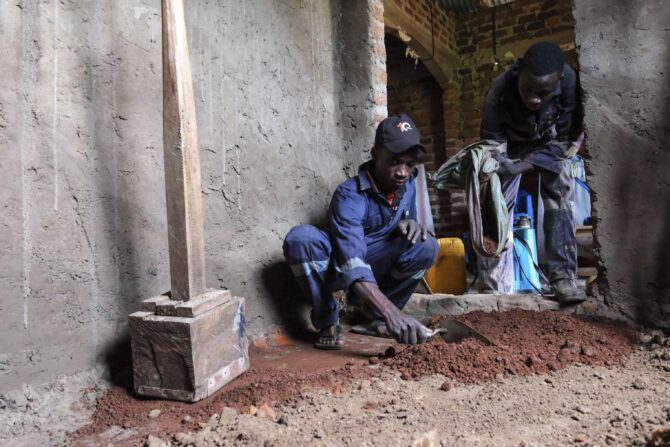
The organization was able to bring a large satellite dish into Banda Aceh, Indonesia, after last December’s tsunamis. But when the group got it there, workers realized they needed a tall pole to mount it, something that proved to be difficult to find in the devastated region.
An added complication was that much of the available sand had been covered with salt water, which meant it would not turn into the cement they needed to put up the pole.
“We actually had to bring in sand from outside the region to make cement,” said Ms. MacGregor.
***
The topic of using technology to help organizations better coordinate their work came up over and over again at the meeting. But a number of speakers pointed to human and organizational issues — rather than technological ones — that make information sharing difficult.
Since the humanitarian response to the Iraq War in 2003, the United Nations Office for the Coordination of Humanitarian Affairs has urged organizations to turn in their assessments of the needs following a disaster so the United Nations agency could feed the information into a common system.
Ms. MacGregor, of Air Serv International, said initially international relief organizations liked the idea of shared assessments.
But in Banda Aceh, after the tsunami, she says she started to hear relief groups grumbling, “We’re always putting information in, and we never get anything out.”
Ms. MacGregor said she believes that if the United Nations does not figure out how to push the collected information back out to charities within the next year or so, groups will stop bothering to turn in their data.
Noam Unger, of the Humanitarian Information Unit in the State Department, raised similar concerns. Once information is shared, he said, “somebody has to be mandated to actually analyze it. And that is not what’s happening on an international or an interagency scale.”
One problem is that competition for donor dollars can be an incentive for organizations to act on the most important information that they have about a situation and keep that knowledge to themselves.
So for Ky Luu, vice president of the International Medical Corps, in Santa Monica, Calif., the fundamental question is how to get relief organizations to share relevant information when it is often in the group’s best interest not to cooperate.
As an example, Mr. Luu pointed to an information network set up by organizations waiting in Kuwait and Jordan to respond to the war in Iraq. The idea behind the effort, said Mr. Luu, was that when an organization found out information about visas or crossing the border into Iraq, it would inform the others in the network. But, he said, it didn’t work out that way.
“We weren’t sharing relevant information,” he said, because people who figured out a way to get into the country realized “it was good to be able to be the first ones in.”
While technology holds a great deal of promise for humanitarian causes, Alfred Nakatsuma, an official at the U.S. Agency for International Development, said that organizations need to think through the potential repercussions of their technology programs.
In Banda Aceh, he said, some companies donated telecommunications equipment to set up hundreds of free Internet access points, for example. But that wiped out business opportunities for local Internet café entrepreneurs, who were struggling to get back into business after the tsunami.
“If you’re going to invest locally, try to develop locally as you carry out your program, you’re going to have a slower program,” said Mr. Nakatsuma. “There’s no question about it.”
But, he said, slow, locally based growth can be sustained by local residents and organizations themselves, while the results of a big influx of outside assistance often disappear when the resources run out.
When relief and development organizations face that kind of choice, he encouraged them to explain to their donors.
Tell them, “You know, we can have a bubble of activity in our organization, and a bubble of success, or we can simmer for a while and hope that the impact will be a lot longer lasting,” he said.
***
Solving the information-technology challenges that international relief and development organizations face won’t be easy, said Paul Meyer, chief executive officer of Voxiva, a company that provides voice and data tools to public-health groups.
Before co-founding Voxiva, Mr. Meyer worked on technology projects used for family reunification in West Africa and Kosovo and was a senior fellow at the Markle Foundation.
The information-management needs of charities responding to a complex emergency are similar to those of multinational companies, which spend years and many millions of dollars developing software systems, said Mr. Meyer. In the humanitarian field, he said, “you have all the same challenges that Exxon-Mobil has in coordinating lots of different people all over the world doing really different and complex things, but there’s no one in charge.”
Mr. Meyer said that while corporations often lend their technological expertise to relief groups, what’s needed is a sustained focus on the technology as a business, rather than as charity projects that spring up after an emergency.
But for that approach to work, charities will have to change their mindset about technology as well, he said, and be willing to think about and invest in technology before disasters strike. “The sector needs to become a better customer,” said Mr. Meyer, “because otherwise everyone is scrambling to reinvent the wheel every time.”
***
The meeting, “Answering the Call: Katrina, the Tsunami, Darfur, and Afghanistan — Lessons Learned from the Global ICT Response,” was co-sponsored by the Nonprofit Technology Enterprise Network, a national organization for individuals, charities, and businesses that provide technology assistance to nonprofit groups, and HumaniNet, a charity that provides technology assistance to aid organizations.
For more information: Go to http://www.nten.org/conferences-ict.