

March 25, 2020 | Read Time: 6 minutes
January 25, 2010
At the Doctors Without Borders La Trinité Hospital in Haiti, 5 p.m. is when medical shifts turn over. As one set of doctors and nurses replaces another, it’s the time when the number of staff people on site doubles for a brief period.
And two weeks ago, that was disastrous, as a 7.0-magnitude earthquake struck here at 4:53 p.m.
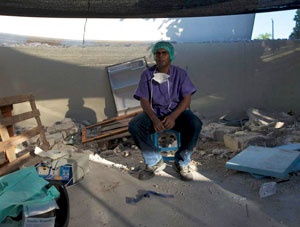
As the ground trembled, the front wall of the hospital in the Delmas neighborhood toppled to the ground, and its first floor collapsed. Some people inside the building were killed instantly. Others perished slowly, trapped for days as surviving Doctors Without Borders employees tried in vain to bring in rescue teams. Two of the charity’s staff members and countless patients were killed.
Meanwhile, hundreds of injured flocked to that very spot in desperate search for help. The 60-bed trauma center was well known in the area, regularly treating wounds from gunshots and car accidents. Within hours after the quake, Doctors Without Borders aided those pouring in with gashes, fractures, and crushed limbs.
The group’s pharmacy across the street, and the street itself, became the new hospital. Makeshift operating areas were set up in a storage container and in the open air, and patients lay on blankets on the concrete ground.
Doctors Without Borders, which lost all five of its hospitals and possibly more than 10 employees in the quake, represents a common theme: After the earthquake, aid organizations in Haiti were slammed with more demand than ever while at the same time severely crippled by damaged buildings and equipment, downed communications, transportation complications, and loss of employees, as well as homelessness, destitution, injury, and psychological trauma among the surviving employees.
“It’s just been a nightmare,” said Jean-Claude Fignolé, country director for ActionAid International in Haiti. After the organization’s office collapsed, Mr. Fignolé relocated operations to an employee’s home but struggled to reassemble staff members at the new location with no functioning phones or Internet.
The organization is now providing food, water, hygiene kits, and tents to its own staff members, as well as residents in the areas it has served for the past 14 years. Twelve of the 25 employees are now coming to work. “What’s been keeping us going is the absolute commitment of our staff to try to respond to the needs of the people,” Mr. Fignolé said.
Catholic Relief Services has employees living in a massive displaced persons camp in which it distributes food and other items. They still come to work every day.
The Petionville office of the Irish charity Concern is intact, but the organization lost a member of the cleaning staff, and 90 of the 100 employees lost their homes. Still, 85 of them are coming to work every day. The organization is providing them with water-purification tablets and other goods, and waiting for tents to be trucked in from the Dominican Republic.
All of these organizations have psychological specialists conducting staff evaluations and providing counseling.
Traumatized Workers
Members of the Doctors Without Border psychiatric staff, who previously served victims of sexual abuse, are now teaming up with international psychiatrists to help fellow staff members and others.
Martine Berret, director of anesthesiology at La Trinité Hospital, said the need is tremendous. “Everyone has something. Rich or poor. You have been touched. You have lost something, you have lost someone, you are not well in your head.” She said three of her four anesthesiologists are unable to work due to psychological trauma. “I have one who can’t even talk clearly.”
Others find that working is the only thing they can do. Ms. Berret had left Trinité shortly before the disaster struck and came back to work the next day, even though her father had died. She has been working long hours ever since. “For me, it is better to work, and after, in another phase, in a few months I hope I can take some days off.”
Ms. Berret’s sentiment is common. One staff member who escaped the collapsing Trinité building and lost her home is working and sleeping at the makeshift clinic, tending to patients, including a colleague who required an amputation.
Patrick Marc Jean-Gilles, a head and neck surgeon who works at Trinité and Haiti’s General Hospital, lost his mother-in-law and five doctor friends in the quake and is working in some of the most challenging conditions of his career, often trying to treat rotten, maggot-infested wounds in the open-air operating areas.
“I’ve never been in a war, but it’s like being in a war and doing war surgeries,” he said.
But international staff members with experience in war zones say this is even worse.
“The main difference from war zones I’ve been to, mostly in Africa, is that the infrastructure holds,” said Jordy Cox, a trauma surgeon from Phoenix who has worked with Doctors Without Borders in the Ivory Coast and Congo.
“There, hospitals that are functional stand, and the structure allows us to do our work in a relatively coordinated fashion,” he said. “Here, the earthquake devastated everything. We have nowhere to do our work. We’re just reacting to whatever comes.”
Mr. Cox also said he’s unaccustomed to seeing crush wounds, where limbs are unsalvageable, and treating so many injured children.
Logistical Nightmare
Doctors Without Borders, like many international aid groups, reacted immediately to the Haiti earthquake, procuring airplanes and permission to land at the Port-au-Prince airport, and deploying international staff members and equipment. Unfortunately, the flights of many groups did not make it in, due to a small runway and disorganization on the part of various authorities.
Half of the 10 planes from Doctors Without Borders were rerouted to the Dominican Republic. Most members of the international medical team were forced to fly into Santo Domingo, and urgently needed medical equipment and an inflatable field hospital were flown even farther away, to an airport in the northeastern part of the Dominican Republic, where they were loaded onto trucks by hand.
The rerouting caused a delay of about five days, putting additional strain on local staff members and prolonging the suffering of the injured unable to get adequate surgical treatment and on patients forced to lie on the concrete ground for days, in the heat and crowds, with the smell of death still emanating from the collapsed Trinité facility.
Situation Improving
In spite of the tremendous challenges, Francois Servranckx, a spokesman for Doctors Without Borders, reports that the charity treated some 5,000 people and performed about 1,000 surgeries in the first 10 days after the earthquake.
And operations are getting better. The medical charity has some 15 surgeons on the ground now, and its glistening, 100-bed field hospital is finally being erected in a soccer field beside a collapsed school and a refugee camp. The facility will soon take patients from the Trinité Hospital.
Attention is turning more to post-operative care, and administrators are discussing the rehabilitation phase. Aid charities say communication challenges and confusion about who is leading the relief effort have hindered collaboration among aid groups, but Doctors Without Borders hopes to establish partnerships to provide shelter for recovering patients and prosthetics and physical therapy for amputees.
In the long-run, nonprofit groups are looking at rebuilding their own presence in Haiti, as well as rebuilding much of the country itself.
The task for medical-care providers is enormous. “Basically, it’s the whole health system that collapsed,” said Mr. Servranckx. “It was already not strong before the earthquake, but now everything needs to be reconstructed.”




