Diversity, Equity, and Inclusion
Salaries of Foundation CEOs Aren’t Keeping Pace With Inflation; Racial Diversity Grows Among Grant Makers

By Alex Daniels
Senior Editor, Foundations
October 13, 2022 | Read Time: 7 minutes
Salaries for chief executives and program officers at private foundations have failed to keep up with inflation over the past five years, a new compensation study finds. The survey by the Council on Foundations, an association of grant makers, also examined gender and race of the people who work at the nation’s philanthropies, and it found a rise in staff members who are people of color.
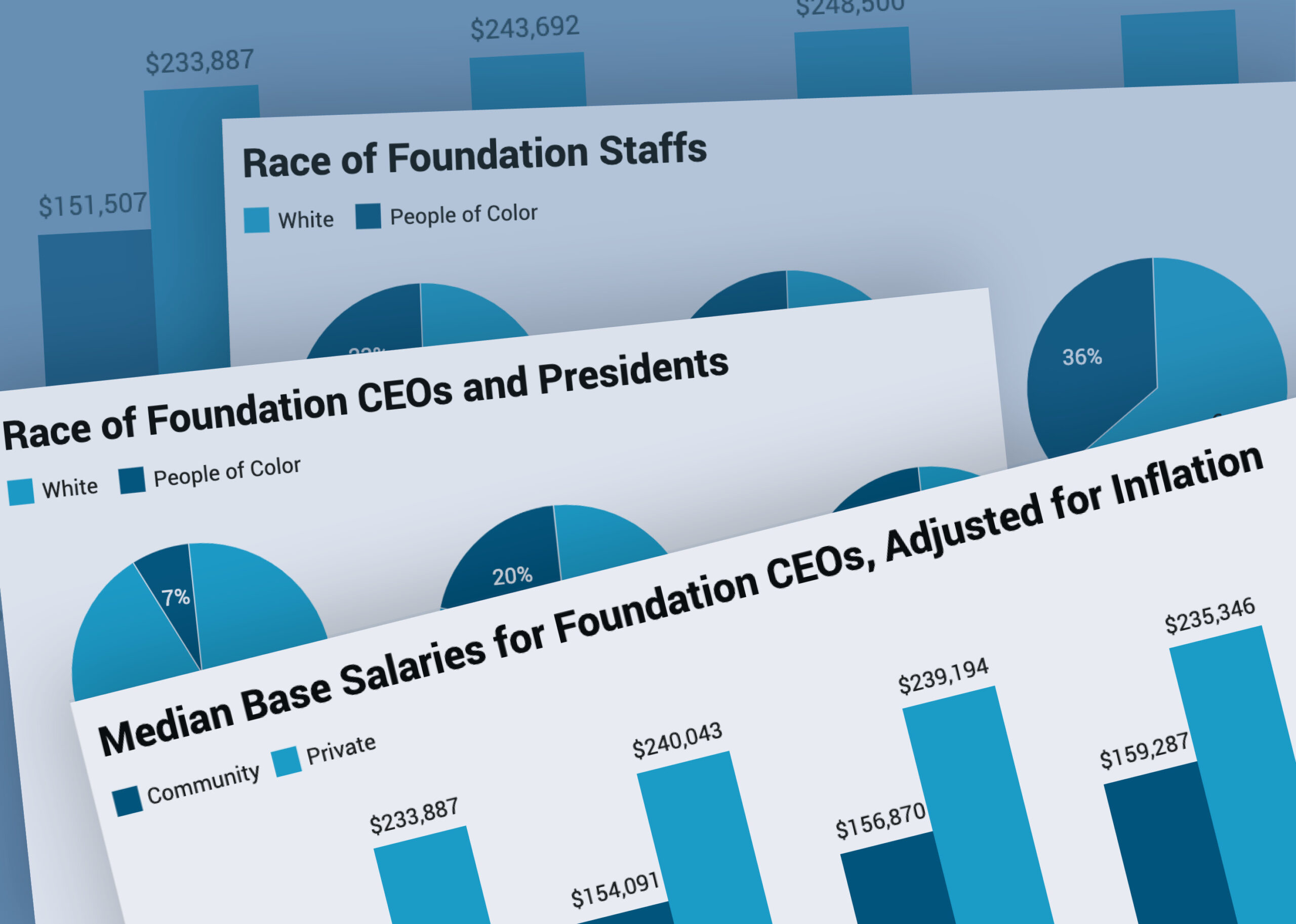
The median salary this year for chief executives at private grant makers is $260,000, a decrease of 2.4 percent from 2018 when adjusted for inflation. Salaries for program officers dropped 2.1 percent over the same period.
The survey tracked pay for 235 chief executives and 391 program officers over five years. CEO salaries at community foundations rose slightly during that time, while salaries for program officers at community foundations declined.
Foundations have increased pay, but have had a difficult time keeping up with inflation, said Nicole Bronzan, the council’s vice president for communications.
To attract talented staff, foundations have increasingly offered additional benefits, including matching-gift programs, parking allowances, membership dues for professional organizations, and reimbursement for tuition or training, Bronzan said. This year, nearly one-third of foundations offer some of these benefits, compared with one-quarter that did so two years ago.
Those added benefits reflect a growing sense that workers judge their employers by more than just a solid salary, Bronzan said.
“It is not just about the money; it’s about how you feel as an employee,” she said.
Demographic Information
The five-year salary figures are part of a larger survey of 1,003 private, community, and corporate foundations conducted in February and March. The survey captured the compensation and benefits, as well as race, gender, disability status, and other demographic information, of about 10,000 full-time foundation employees.
The study found that 62 percent of foundation chief executives are women, a figure that is relatively unchanged from 2021. Overall, about 77 percent of foundation staff are women, nearly 23 percent are men, and 0.4 percent identify as nonbinary. This year’s survey included the nonbinary option for the first time in the survey’s 42-year history.
Bigger changes are happening in the racial composition of foundation staff members. This year, people of color accounted for 31 percent of full-time staff members, up from 29 percent in 2021 and 27 percent in 2020. Fourteen percent of chief executives are people of color, an increase of two percentage points over last year.
Some of those increases are likely in response to the murder of George Floyd and racial-justice protests of 2020, Bronzan said. But foundations, she noted, have been working to diversify their staff for years, and the increases probably reflect a longer-term effort.
“Changes take a while,” she said. “We’re just finally seeing those numbers start to go in the right direction.”
The increased proportion of people of color in leadership and staff roles at foundations is welcome news, said Susan Taylor Batten, chief executive of ABFE, formerly known as the Association of Black Foundation Executives.
But given the work that grant makers and advocates have undertaken over the past two years to get foundations to diversify their workforce, she had hoped for a bigger shift. Batten said she fears the window of attention on the issue may be closing and that the true test of whether the racial reckoning of 2020 has momentum will be in how diverse foundations are in five years or so.
She said that nearly half of the midcareer professionals who have completed ABFE’s fellowship program, which is designed to sharpen the leadership skills of Black foundation professionals committed to assisting Black people, have since moved on to careers outside of philanthropy. Pay is not the problem, she says, because foundations have often provided bonuses that help mute the impact of inflation. What is driving people away from foundation work, she says, is not feeling included on the job and a lack of career-growth options.
“We don’t hear concerns about salary,” Batten said. “We don’t have a diversity issue in the sector as it relates to recruitment. We have a retention issue.”
The average turnover rate in the Council on Foundations report was 11 percent. Fifty-two percent of the foundations that responded reported staff departures during the year, up from 50 percent in 2021, but down slightly from the 55 percent figure reported in 2020.
Board Composition
The survey also included demographic and salary information about foundation boards. While foundation staff members are, on average, overwhelmingly women, more than half of community, corporate, and private foundation board members are men.
Foundation boards also have a smaller proportion of people of color than foundation staff. At private foundations, for example, nearly 79 percent of board members are white, compared with 64 percent of staff.
The survey found that the median board compensation for 164 foundations that provided data was slightly above $82,000. One private foundation that has assets of more than $2 billion, which the council did not identify, paid its board members a total of $490,000. The median payment per board member was about $17,000, and the highest payment reported to a single member was nearly $135,000.
Some foundations don’t pay board members, but provide them with a small discretionary grant budget. The Bill & Melinda Gates Foundation, for instance, has provided each of its independent board members who were named this year the ability to recommend that the foundation make charitable gifts of up to $50,000, according to Andrew Estrada, a Gates spokesman.
Foundations are expected to avoid excessive compensation of board members, but what is excessive and what is reasonable are subjective, Bronzan said. Sometimes those determinations are made by comparing board pay to similarly sized organizations. Bronzan said the council was trying to “shine a light” on the data rather than provide concrete guidance on how much, if any, to pay board members.
“We don’t as an organization tell foundations what they should be doing or what they should be paying,” she said. “But we certainly want to see organizations operating with integrity and making sure that they’re good stewards of their resources.”
Unlike charities, which actively raise money and whose spending is scrutinized by donors who want their gifts to make a difference, foundations depend on their endowments and don’t have to appeal to the public for donations. Because of this, said Gene Takagi, a San Francisco lawyer who specializes in working with nonprofits, foundations don’t have to fear the reputational black eye that may come with board compensation.
Paying board members can be problematic in some cases, Tagaki said. For instance, if a foundation decides to diversify its board by adding new members with different backgrounds, board members who are compensated may block those efforts out of fear that their compensation will be watered down by the additional board seats, he said.
But each foundation is different. Board compensation can be justified depending on the role the board plays, Tagaki said. If a board simply meets once a year to rubberstamp grant decisions made by staff, any compensation can be seen as excessive, he said. But if they spend many hours a week poring over grants, investments, or the broader strategy of the grant maker, paying trustees may be reasonable, he said.
That may particularly be the case with foundations that are going through a “rigorous journey” to ensure they respond to racial justice and other movements. That work, he said, may require a lot of time and effort on the board’s part.
“If their board members are truly deeply involved and spending a lot of time on that, then perhaps their compensation might be justified,” he said.
Sara Herschander contributed to this article.