Small Nonprofits and Social Entrepreneurs Share Work Space and Ideas

By NICOLE WALLACE
Features Editor
July 14, 2013 | Read Time: 8 minutes
New York
When Shimmy Mehta, founder of Angelwish, a charity that helps donors buy presents for chronically ill children, told a new acquaintance that he was thinking about improving the organization’s Web site, she responded by saying she could ask her boyfriend, an engineer at Google, to look at the site and offer advice.
“For small nonprofits, those are the moments you try to hunt down,” says Mr. Mehta. “But they don’t always fall in your lap.”
Angelwish is a founding member of the Centre for Social Innovation, which is working hard to make sure that Mr. Mehta’s serendipitous connection is one of many sparked here in the shared work space it opened in May. After nine years of running cutting-edge work spaces in Toronto, the scrappy Canadian charity has expanded to the Big Apple.
The Centre for Social Innovation’s mission is to create work spaces for nonprofits and social entrepreneurs that foster collaboration, new ideas, and, ultimately, social change. And the group’s leaders are excited to test their approach in New York.
“If you want to change the world, you want to find the biggest platform you can,” says Tonya Surman, chief executive of the Centre for Social Innovation.
Cool Office Design
The New York outpost boasts soaring ceilings, exposed ductwork, bright colors, and eclectic furnishings. Located in a West Chelsea building that also houses architects, designers, and Tommy Hilfiger, the work space embraces an office-cool design aesthetic more often associated with Google or Facebook than with the nonprofit world.
Unexpected features abound. An old wooden canoe sometimes doubles as a beer and wine cooler for events. There’s a gorgeous chandelier from an old New York hotel, and some members work at long tables made from old signs for an auto garage. But the playfulness of the design serves a serious purpose: getting people to connect.
“When you walk into our space, we’re not the same as a regular office,” says Eli Malinsky, executive director of the Centre’s New York branch. “We throw people off kilter, and that sends a cue that you should behave differently here.”
Groups can rent private offices or private desks reserved for their use, or they can buy packages that allow a certain number of hours each month working at shared desks.
The options put the space within reach for organizations with a wide range of budgets. While private offices rent from $1,000 to $2,800 a month, shared-desk packages start at $125 a month. So far, more than 60 organizations have signed up, and the group expects the number to rise to more than 300 in the next two years.
Bringing together nonprofits, socially minded businesses, and even some government agencies working on an array of causes, expands everyone’s horizons, says Mr. Malinsky.
“The challenges we face will not be addressed by a single point of view, a single sector, or a single set of approaches,” he says. “The better job we can do collaborating and connecting to complementary organizations and people, the better chance we have of developing real, systemic solutions.”
The organization focuses on small nonprofits, usually with four or fewer employees, groups that Mr. Malinsky says are more open to working together and creating a shared culture.
“If you have a 15-staff organization, you already have a kind of ossified culture,” he says. “You have patterns, and to collaborate with you requires a little bit more bureaucratic conversation.”
Making Introductions
Shared work spaces aren’t a new idea in the nonprofit world, says Sarah Eisinger, director of the Nonprofit Centers Network.
Their numbers have been growing as charities face greater pressure to cut costs and collaborate. She estimates there are roughly 350 nonprofit centers in the United States and Canada.
What sets the Centre for Social Innovation apart is the energy the group focuses on encouraging members to interact, says Ms. Eisinger.
“One of the myths of nonprofit centers is that, ‘Well, we’re going to put in conference rooms, we’re going to have a common pantry, and there’s going to be a water cooler, and boom, the magic is going to happen,’ ” says Ms. Eisinger. “The magic doesn’t just happen because you have some shared space.”
In both Toronto and New York, the Centre for Social Innovation has full-time staff members, called “community animators,” whose job is to help members connect with one another and with outside resources. The organization hired Allie Mahler, co-founder of an education nonprofit, to fill the role in New York.
Making the right introductions is a big part of the position, says Mr. Malinsky: “They’ll say something like, ‘Ryan, I know you’re really working on this housing issue in Uganda. Have you met Sarit, who just returned from southern India and had been developing a very interesting model for sustainable housing in rural areas?’ ”
Communal Lunches
Design also helps spur collaboration. For example, in for-profit co-working spaces designed to generate as much rent as possible, kitchens tend to be “as small and tucked away as possible” because they aren’t money makers, says Mr. Malinsky. By contrast, he says, “we do big, open kitchens because kitchens are gathering and meeting points for people.”
The large, inviting kitchen crafted from an old apothecary near Niagara Falls buzzed with activity last month as members prepared for the Salad Club, an idea that got its start seven years ago in Toronto. Participants in the weekly lunchtime gatherings each bring a salad topping to share, while the Centre for Social Innovation provides the greens and salad dressing.
Members gathered around a kitchen island, chatting as they chopped peppers, tomatoes, watermelon, and more. With the space less than two months old and organizations continuing to move in, there were a lot of introductions.
The kitchen islands were a conscious choice to spur interaction, says Ms. Surman: “Instead of people facing a wall to chop the vegetables, we have them facing each other.”
The conversations continued as participants dug into heaping salad bowls at a long table made from a discarded freight-elevator door. Even on days when the Salad Club doesn’t meet, the table becomes a place for impromptu gatherings. Says Mr. Malinsky: “You can’t eat lunch by yourself when you’re sitting at a large, harvest table.”
Special Events
The Salad Club is just one of the events that take place at the Centre for Social Innovation. The organization hosts workshops on topics such as storytelling and plans gatherings where members share advice. Three organizations that completed successful campaigns to raise money using sites like Kickstarter will be sharing hints at a Lunch and Learn session scheduled for later this month.
Renting out space in the common areas for special events has proven valuable both as a source of revenue and as a way to spread the word about the work space.
While the Salad Club is aimed at members, another event the organization is importing from Toronto, called Six Degrees of Social Innovation, is designed to expand the fledgling community’s reach.
Members each receive six tickets for the event, one for themselves and five to pass on to someone in their networks who is also passionate about social change. That person gets to keep one ticket and pass on four tickets to a socially minded colleague, and so on.
In addition to drawing people who work at nonprofits, the Six Degrees event in June attracted architects, bankers, business people, and designers, well beyond the “usual suspects,” says Melissa Lloyd, a management consultant who works with charities and is a Centre member.
“It was absolutely bustling,” she says.
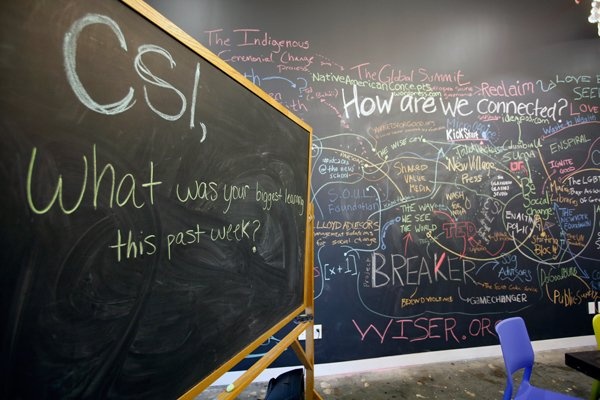
During the event, participants wrote the names of their organizations on a big chalkboard, sketched pictures, and drew arrows between groups that had already made connections or were hoping to.
New Yorkers might not be used to “playing name games and going around the table and sharing,” but given the opportunity they dive in and make real connections, says Ms. Lloyd.
“These are very serious folks,” she says. “They’re working on serious issues, but things like that give them an excuse to play around a little bit.”
Mutual Help
While the Centre for Social Innovation’s New York branch is still new, the collaborative atmosphere is already yielding practical benefits for tenants.
As executive director of the SOUL Foundation, which supports education in Uganda, Jenna Rogers is the charity’s only employee in the United States. Before renting a private desk at the Centre for Social Innovation, she worked out of her cousin’s product-development business in Brooklyn and various coffee shops.
The SOUL Foundation recently won its first foundation grant. As Ms. Rogers prepared her grant proposal, a staff member at KickStart International, another group in the co-working space that receives money from that grant maker, read it and offered advice.
Pitching in to help each other is the norm at the Centre for Social Innovation, says Ms. Rogers.
“We don’t just share Wi-Fi,” she says. “We’re a community.”