
Smart Ways to Attract Money and Friends by Creating Fun Events

By Michelle Gienow
Contributor
May 27, 2012 | Read Time: 8 minutes
Josefa Vaughan was looking for a new fundraising source for the charity she had founded, ArtSeed, which provides art education to disadvantaged youths. It was at the dawn of the recession, and her San Francisco group was having a harder time winning the grants it relied on. It wanted to tap more small donors.
So, with a handful of volunteers, she created an “artathon,” a daylong event in which participants solicited pledges that paid them for every hour they painted, sculpted, made music, or engaged in other creative endeavors.
“Throwing an artathon benefit was a natural fit between our mission and our needs,” says Ms. Vaughan.
In its fourth year, ArtSeed’s artathon raised more than $15,000 in April from 27 participants. “That’s pretty good, considering we all would probably have spent at least part of the day doing art for free on our own anyway,” she says.
The activity-based marathon is a reliable fundraising warhorse, and for a reason: It is a great way to raise money in lean economic times.
“The ‘-athon’ model is a wonderful opportunity for so many charities, no matter your size or staffing,” says Rachel Armbruster, a fundraising consultant in Austin, Texas, who has helped charities start and organize such events.
“An activity-based fundraising event can be completely customized to your organization and mission and is relatively easy to get up and running.,” says Ms. Armbruster. “It’s a good option, especially if your charity is grant- or major-gifts reliant.”
Following are some tips from fund-raising experts and event organizers on starting a marathon to raise money and awareness for a cause—or making an existing one better.
Pick a group activity that fits the charity’s mission. To get going, says Ms. Armbruster, whose clients include the Lance Armstrong Foundation and the ALS Association, first consider the cause and then brainstorm compatible group activities.
“Don’t be afraid to be creative,” she says. “There are always the traditional sports-based events, but really any activity that fits with your mission and has people saying, ‘Hey, that sounds like fun’ can be adapted.”
For example, Ms. Armbruster helped create a “bounce-athon” event for the Autism Society, held at Pump It Up indoor play centers nationwide. “Jumping in moon bounces for pledged donations was both a lot of fun and a great fit for autism families, who often can’t really participate in traditional fundraisers,” she says.
However, Brock Yetso, president of the Ulman Cancer Fund for Young Adults, in Columbia, Md., which hosts its own annual benefit triathlon, advises any charity considering throwing its own “thon” event to stick to what it knows.
Ulman’s first fundraising event, held shortly after the charity’s 1997 founding, revolved around soccer.
“We knew people in the sport, we could get things donated, we could get supporters,” says Mr. Yetso. “If you start with something you’re already established in, there is vastly more ease of entry.”
Research similar events. Attend activities in the same geographic area as the charity, especially those that benefit groups with similar missions, advises Ms. Armbruster. “Attend one as a participant—or, even better, volunteer and learn by being on the inside. Best of all, ask to shadow an event manager both pre-event and on-site.”
Set a date. “I feel like sometimes charities get lost in talking about having an event but never actually commit,” says Ms. Armbruster. “So put a stake in the ground. Say, ‘This is when we go live.’ Getting the date on the calendar creates the commitment, and then you just fake it till you make it.”
Build in a long lead time. At the Morris Animal Foundation, in Denver, Kate O’Brien begins planning about a year in advance for the charity’s annual K9 Cancer Walk. These annual dog walkathons, held simultaneously in five cities across the country, each draws an average of more than 600 participants and raises about $70,000.
“You need to keep the template simple, particularly in the first year. Make a list of five things you want to see in your event and really stick to those items,” says Ms. O’Brien, the group’s events specialist. “This will help you break down the event into logical pieces so you can approach it step by step and not get overwhelmed.”
She adds, “Then set goals: We need to be around X number of participants registered by such and such a date, around Y amount of dollars pledged by another. Working this way, you can keep tabs on all the different elements and see if anything is falling behind.”
All that detail may seem “daunting at first,” allows Ms. Armbruster. “But there is software support out there that makes this a pretty turnkey process that you can do with minimal staff. You can then bring in volunteers as needed. You don’t have to be one of the big guys to put one of these on.”
Balance raising funds and attention. Any “thon” event can begin to support itself from the day it’s announced by way of fees paid by those signing up to participate, say those who have organized such drives.
Groups have varying fees and fundraising requirements for participants, says Mr. Yetso. “One way to maximize people getting involved is to have a very low fundraising requirement, but you also still have to be able to cover the expenses of hosting an event.”
To calculate a reasonable fundraising threshold, he says, “you have to know how many people can reasonably be expected to participate and what your event will entail. Then you can work backward from cost and figure out a reasonable per-person figure.”
The question a charity must ask of itself is, “Do we mainly want to raise awareness by having lots of bodies participate, or do we aim more to raise money” by requiring participants to solicit donations? says Farley Sullivan. For the past five years, she has organized a knitathon benefit for the Pine Street Inn, a Boston charity that serves homeless people. (The most recent event, in November, raised $30,000.)
Tough fundraising requirements, she says, can result in fewer people signing up, although those who do raise, or simply pay, a higher fee to join an event are typically very motivated to follow through and may raise even more for the cause.
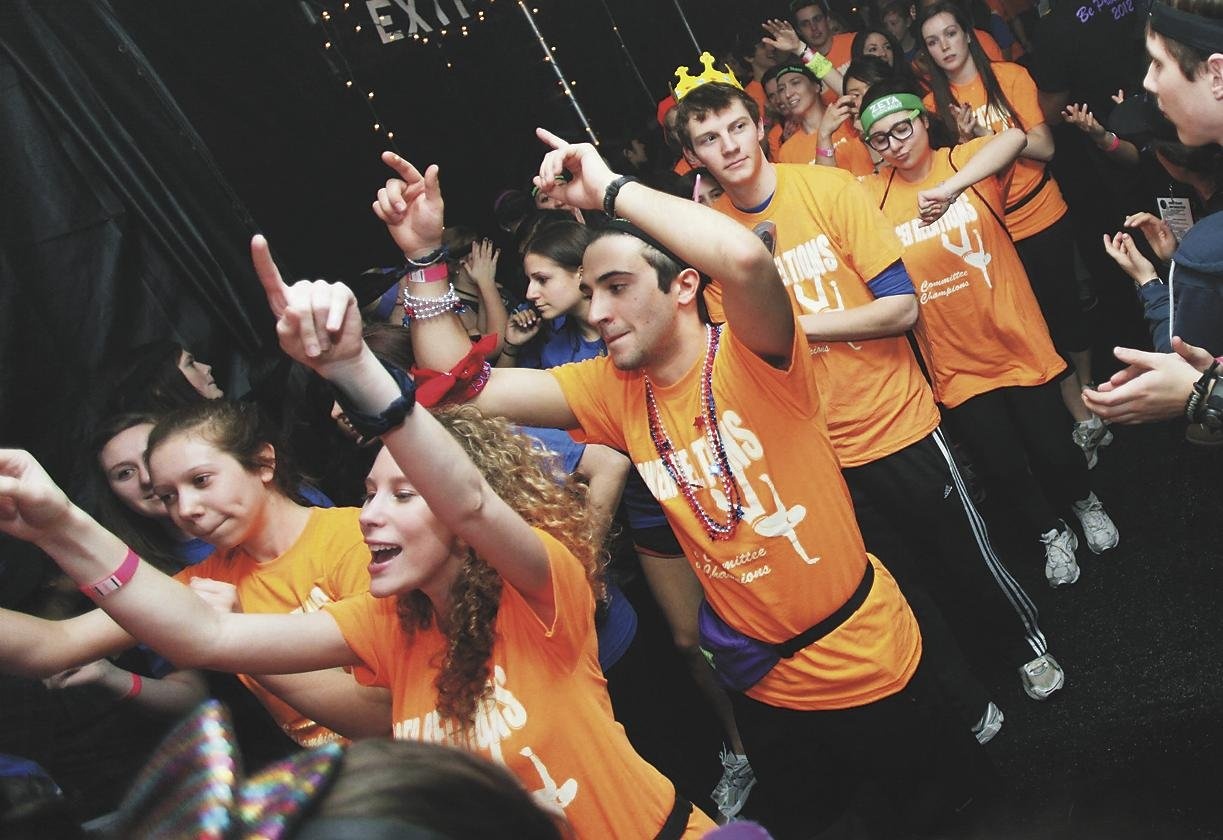
Help participants raise money. Scott Ritter served as executive co-chair of the most recent Northwestern University Dance Marathon, a 38-year-old event run by students. This year’s event, held in March, raised more than $1-million for two charities. One secret to its success, he says, is that participants weren’t asked to do much more than dance.
“One of the most daunting tasks at Dance Marathon, besides dancing 30 straight hours, is raising the $400 entry fee,” says Mr. Ritter.
“Making it as easy as possible for your participants to fundraise is essential,” he says. “Provide solicitation letters they can send out, have personalizable online fundraising pages—there are a lot of sites out there offering this—so there is an easy portal for pledging. Try to make it so their main job is just to disseminate the ask.”
Kunal Joshi, who served as the Dance Marathon’s other executive co-chair, says that fundraising does not need to stop with the entry fee.
“We try to heavily incentivize fundraising so people are motivated once they raise the initial amount,” he says. “We provide fun premiums, like for X amount of extra dollars raised, you get an extended foot massage during the marathon. We also have prizes for the top three fundraisers.”
Tie the mission to the marathon. “Generally people come to your event because of the activity; they may or may not be attuned to your mission,” says Patrick Riley, director of event planning at Event 360, a company that does event fundraising for charity clients. “This is really your opportunity to reach out, so be sure to have lots of posters or materials that educate about what your charity does.”
Also, he says, give attendees some “take-homes—T-shirts are terrific.”
One way to connect participants with the cause is to have people who have benefited from the charity’s work attend the event. Ms. Sullivan has clients from the Pine Street Inn come to the knitathon benefit to talk about their transition from homelessness to permanent supportive housing.
“My goal is to make homeless guys less scary,” says Ms. Sullivan, “but also to show to our knitters how they’ve concretely helped another human.”
Appeal in the moment. Most fundraising takes place before event day, but, Mr. Riley points out, “be sure to ask again at the kick-off ceremony.” “Everyone is surrounded by all the other people and energy and excitement, and that is a fantastic time for the executive director to ask everyone to take out their smartphone and say, ‘Let’s all donate together right now.’”
Follow up. One of Mr. Reilly’s Event 360 colleagues, Sarah Coniglio, stresses that following up after the event is essential. “There are obvious courtesies, like making sure the site is even cleaner after your event than when you got there. Thanking everyone for coming, particularly your volunteers,” she says.
In addition, she strongly suggests sending out a post-event survey. “Ask: ‘How did things go for you? What could we improve upon?’ That way you’re planting the seed for next year, even as you close the loop on this one.”
Besides, Mr. Riley adds, “the best crowdsourcing we’ve seen for new event ideas is the survey—we get some of our best innovations from participant suggestions!”




