
Steve and Jean Case Tout ‘Impact Investments’ Instead of Giving Money Away

By Alex Daniels
Contributor
November 3, 2014 | Read Time: 8 minutes
In meetings over the past year with other philanthropists, Jean Case has spread a simple message: Don’t just give your money away.
That’s not to say that Ms. Case and her husband, America Online founder Steve Case, won’t still make straightforward gifts to charity. But increasingly, the Cases plan to put their money behind causes that also have the promise of generating financial returns.
After a White House meeting in June, the couple committed $50-million to “impact investments,” which they will make personally or through the Case Foundation, which Ms. Case runs. They joined more than 20 other foundations and financial firms that announced they would make a total of $1.5-billion in impact investments.
Like traditional market players, impact investors expect financial returns, but not just for personal gain. Instead, they put their money into ventures with potential societal benefits, like improving reading skills or alleviating poverty. Any financial gains go back to the investor, whether it is a foundation or fund manager, where it can be put to use in other cause-oriented investments.
Jean Case has pushed investing in for-profit companies in private talks with fellow members of the Giving Pledge, a group of rich people who have said they will give away at least half of their fortunes to charity during their lifetimes. By making investments instead of gifts, she argues, philanthropists are more likely to keep a clear eye on the progress being made and will preserve more cash that can be reinvested.
Billions of idle dollars could be put to work for good causes, Ms. Case says—but only if donors are willing to take chances and continue their support even when things get dicey. “Are you comfortable if we have to shake and bake a little bit to find out what works?” she says she asks them. “There hasn’t been comfort with that in philanthropy, and there needs to be. The same old problems are dogging us today that have been with us a long time, despite a lot of talent and money that have chased those problems.”
This year, philanthropists plan to make $12.7-billion in impact investments, a 20-percent increase over 2013, according to a May study compiled by the Global Impact Investing Network and JPMorgan.
Some experts say impact investments are untested. They’re concerned that backers of the strategy will chase big returns at the expense of their organizations’ missions.
Aaron Dorfman, executive director of the National Committee for Responsive Philanthropy, said that while he supports impact investing, he worries it will crowd out traditional grant making if taken too far.
Measuring an investment’s impact, especially when it is made with many co-investors, is extremely difficult, says Jacob Gray, senior director of the Wharton Social Impact Initiative at the University of Pennsylvania’s Wharton School. “There’s a long way to go for the type of granular measurement that is necessary to talk about impact,” he says.
Net Worth Plummets
Shortly after AOL’s merger with Time Warner in 2000, Forbes listed Mr. Case’s net worth as $1.4-billion. In the years right after the merger, the Cases poured money into their foundation and tended to make grants of $5-million to $10-million to well-established charities, including Habitat for Humanity and the Special Olympics.
The merger quickly soured, and Mr. Case is now worth about $1.3-billion. In recent years, the foundation has been making smaller grants designed to develop an entrepreneurial mind-set among charities.
In 2001, the foundation had assets of $109-million and made $24-million in grants. In 2012, its assets were listed as $1.5-million, and it made $1.2-million in grants.
A Case Foundation spokeswoman declined to give current figures, saying that they were “similar” to levels two years ago. The Cases also declined to say how much they give to charity or invest through impact investments personally, outside of the foundation.
Some of the nonphilanthropic investments the couple has made since the AOL days have paid off. For instance, the acquisition of online car-rental company Zipcar by Avis Budget Group netted Steve Case’s Revolution Growth fund, an early investor, $96-million, according to Bloomberg. Other early-stage investments, like one in LivingSocial, fizzled.
Failure is part of taking risks, says Ms. Case. She knows from experience. In 2009, the foundation invested in PlayPumps, designed to bring clean water to African villages, which suffered some significant and very public early failures. Ms. Case chose to continue her support of PlayPumps, but as part of a broader safe-water campaign run by a more established charity, Water for People.
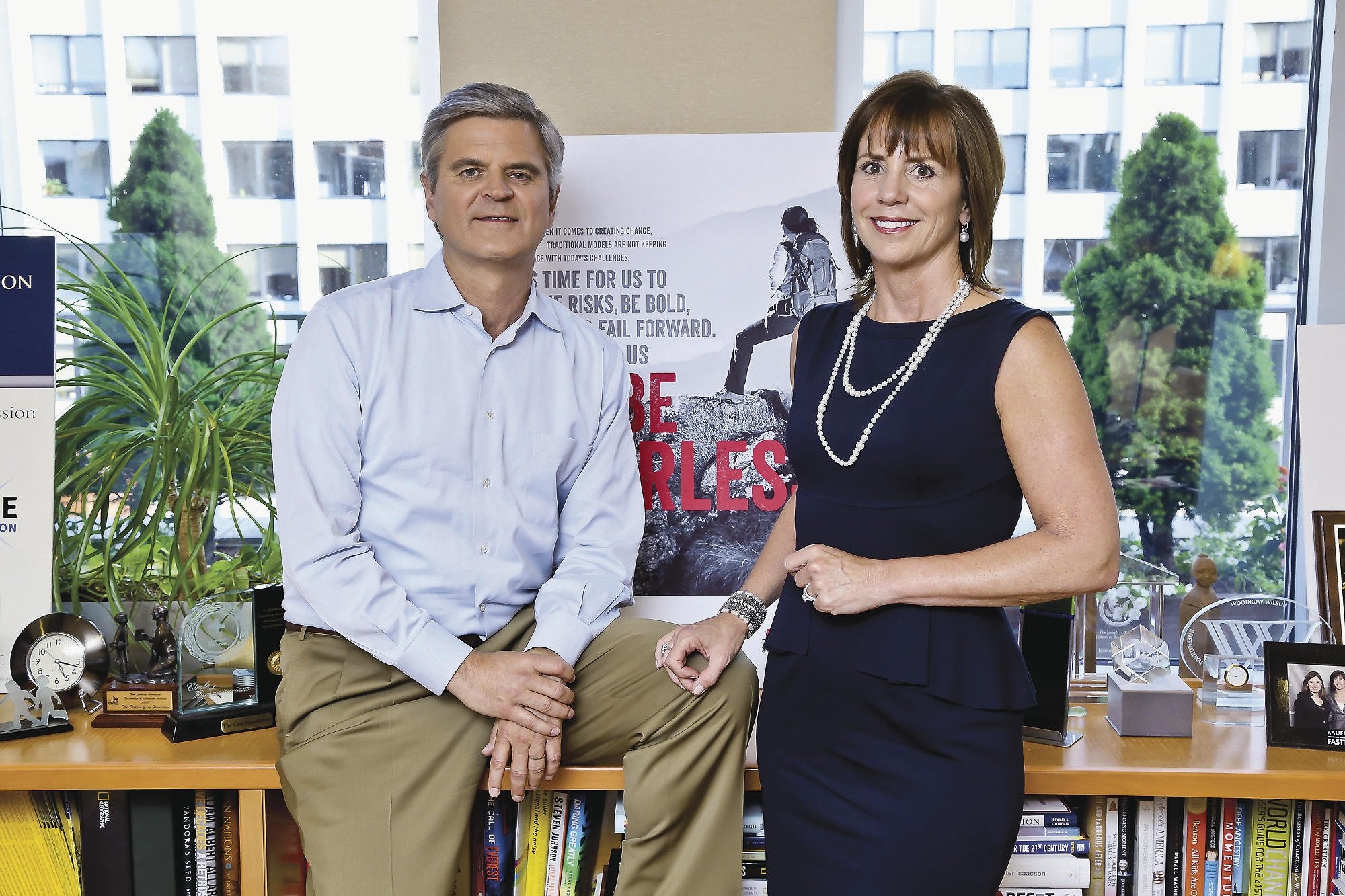
The foundation’s “Be Fearless” grant competition rewards grantees for unorthodox approaches and efforts to encourage giving among younger donors. The program is based on the idea that philanthropy needs an entrepreneurial booster shot.
That brash, risk-taking approach drives the push to expand impact investing, too.
To support the effort, the foundation in January donated $100,000 to Georgetown University’s Global Social Enterprise Initiative, for which Ms. Case is an executive in residence. Two contributions of a similar size are pending.
The Cases have also made several personal investments, separate from the foundation, that follow the impact model and provide a guide for how they plan to spend the $50-million they have committed to give.
For instance, Erik Hersman, chief executive of BRCK, a Nairobi, Kenya, start-up, has sold only 800 of his company’s devices, tough bricklike gadgets that are both modems and routers and can be used in remote locations.
As he pitches to government agencies and nonprofits, selling them on the need for the devices in rural schools and health clinics, he envisions the company topping $1-billion in sales.
Last Spring, the Cases chipped in, helping Mr. Hersman close out a seed-funding round of $1.2-million. He says the Cases provided less than half that amount, but he wouldn’t be specific. Getting the blessing of an Internet power couple was just as important as the cash.
“Being able to name them as an investor gives confidence to our potential business partners,” he says. “Even though we’re a small start-up in Africa, it gives us credibility.”
Ms. Case also helped convince Bill Strathmann, chief executive of Network for Good, which processes online donations to charities, to convert from a nonprofit to a for-profit company. The Case Foundation has been a longtime backer of the company, and Mr. Strathmann ultimately agreed that his organization’s status as a nonprofit was holding it back.
After making the switch in 2013, Mr. Strathmann says, it was easier to lure new hires, especially in sales, marketing, and technology, by offering stock options. “I was immediately able to attract talent,” he says.
The change also brought in fresh capital.
Like the folks at BRCK, Mr. Strathmann is dreaming big. Within a few years, he’d like Network for Good to process $1-billion of donations annually.
Investing Guidelines
Ms. Case has spent much of the past year working on a set of policy recommendations as a member of the U.S. National Advisory Board on Impact Investing. The Case Foundation has been underwriting a series of impact-investing profiles in Entrepreneur Magazine and last summer published a guide to impact investing.
“Like any burgeoning sector, we need to get smarter faster,” she says. “We’re trying to provide learning opportunities for the industry more broadly.”
Case has been a crucial proponent of injecting a business mind-set into philanthropy, says Paula Goldman, senior director of knowledge and advocacy at the Omidyar Network, which has committed $100-million to new investments.
Ms. Case’s work will help bring in potential investors who would otherwise be turned off by some of the dense financial jargon often used by social entrepreneurs, Ms. Goldman says.
“It’s not a particularly user-friendly language,” Ms. Goldman says.
Ms. Case has helped wealthy donors see beyond the “cultural expectation that the way you create good in the world is by giving your money away.” She has helped them embrace other ways to generate change.
“There was a lot of behind-the-scenes work,” Ms. Goldman says.
Impact-investing experts at other foundations, including the Ford Foundation, which helped pioneer the practice in the 1960s, also praise Ms. Case’s work. “There’s a needed education component among high-net-worth individuals,” says Christine Looney, who directs Ford’s $280-million program-related investment fund. “She can reach out to them on an individual level.”
‘Safe Table’
Ms. Case, sitting in one of the glass-walled conference rooms that line the foundation’s office in downtown Washington, crosses her arms and admits to being guarded talking about her wealth.
She prefers instead to discuss her upbringing, when she would help count her mother’s waitressing tips before they went out to buy food for her and her three siblings. That experience helped her develop an appreciation of the need for people to help each other.
Ms. Case says it’s easier to open up when she is at a “safe table” among other Giving Pledge members.
The $50-million in impact investments that the Cases pledged in June will be made in the next three to five years, though Ms. Case is hesitant to provide specifics. Philanthropy, she says, is a lot like traditional investing, with the smart money waiting for the right opportunities.
“It needs to come at a time when someone is sure it is right for them,” she says. “Giving money away is a very personal thing.”
Editor’s note: This article was updated on November 5 to clarify Aaron Dorfman’s thoughts on impact investing.







