
Strong Giving in First Half of 2017 Signals Strong Year End, Report Says

By Timothy Sandoval
Contributor
October 31, 2017 | Read Time: 3 minutes
A strong first six months of giving in 2017 could signal a muscular year-end fundraising season, according to a new report.
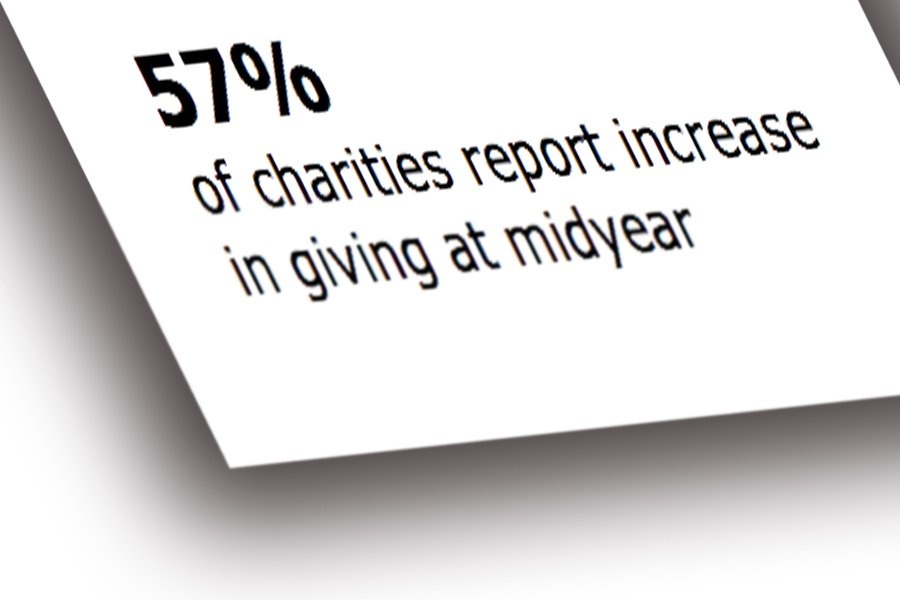
Nearly six in 10 nonprofits saw an increase in charitable dollars raised through June compared to the same period last year, the study says. About 23 percent of charities reported that donations were flat in the first half of the year, while 20 percent said they saw a decrease in contributions.
Roughly three in four organizations said they were hitting their fundraising goals though the first six months of 2017 — even if they did not see a significant increase in donations compared to the first half of 2016.
The report is based on an online survey conducted in late August and early September by the Nonprofit Research Collaborative — a coalition of professional fundraising associations and research groups that gather and analyze data on fundraising and giving.
Traditionally, the collaborative has found bigger gains in support when it collects data for the full calendar year rather than just through midyear.
The midyear giving results suggest that 2017 could end strong, says Melissa Brown, manager of the Nonprofit Research Collaborative. Last year, only 49 percent of organizations had seen an increase in donations at midyear — but 2016 still ended with 60 percent seeing jumps in contributions.
Other key findings from the survey of 1,167 organizations include:
Major gifts grow. Revenue from big gifts grew through June compared to the same period last year at half of the organizations surveyed, while online and event revenue grew at 48 percent and 47 percent of nonprofits, respectively.
This year’s strong stock market and economy are likely contributing to the growth in major gifts, Ms. Brown says.
Small organizations struggle. Only 48 percent of small organizations — defined by the study as those with budgets of less than $1 million — saw an increase in giving through June over the first half of last year, compared to more than 60 percent of organizations with budgets over $1 million that saw donations jump in the first six months of 2017. The reason for the difference is simple, says Ms. Brown: Bigger groups have larger budgets to invest in fundraising and marketing. “It takes money to ask for money,” she says.
Many small groups, Ms. Brown says, are seeking grants to support their development teams in order to boost revenue, she notes.
Arts nonprofits fall behind. About 61 percent of arts organizations said they were meeting their fundraising goals at the end of June. That’s a lower percentage than was reported by other types of nonprofits — like human-services charities, 69 percent of which said they are on track to meet their goals.
It’s possible that wealthy donors, who tend to contribute to cultural groups, are giving more to political campaigns and nonprofits that work on hot-button issues, Ms. Brown hypothesizes.
Attracting millennials proves challenging. In the first half of 2017, only a quarter of nonprofits said they used specific fundraising tactics to attract millennials, while 51 percent said took steps to appeal to baby boomers. Thirty-seven percent of charities said they targeted appeals to Generation Xers and 34 percent said they used methods aimed at “matures” — people age 70 and older (many nonprofits appeal to more than one generation).
Of the organizations that have tried to attract millennial donors, only 30 percent said they felt their appeals were successful. That figure was higher for older generations: Sixty-four percent of organizations said they felt successful in targeting Gen Xers, and 79 perfect said appeals to boomers worked well.
Millennials, many of whom are saddled with student debt and are settling into careers, tend to have less money give, Ms. Brown says: “They really want to be involved, they really want to give, but their cash resources are slim.”




