Target Pledging $1-Billion to Education, but Some Question Its Impact

By nicole lewis
Contributor
December 2, 2012 | Read Time: 8 minutes
Michelle Edwards grew up on the West Side of Chicago, playing school with her cousins and reading indoors on rainy days. She traces her love of books to that time, when family made learning fun and getting lost in a story would transport her beyond her urban neighborhood.
“Books were my refuge,” she says.
Ms. Edwards, now principal of Orr Elementary School, in Washington, strives to pass on her love of reading to her students.
She has a powerful ally on the school’s third floor, one with lime-green walls and chairs, a cheerful jungle painting, a huge stuffed dinosaur, comfy beanbag chairs, and, most important, rows and rows of books.
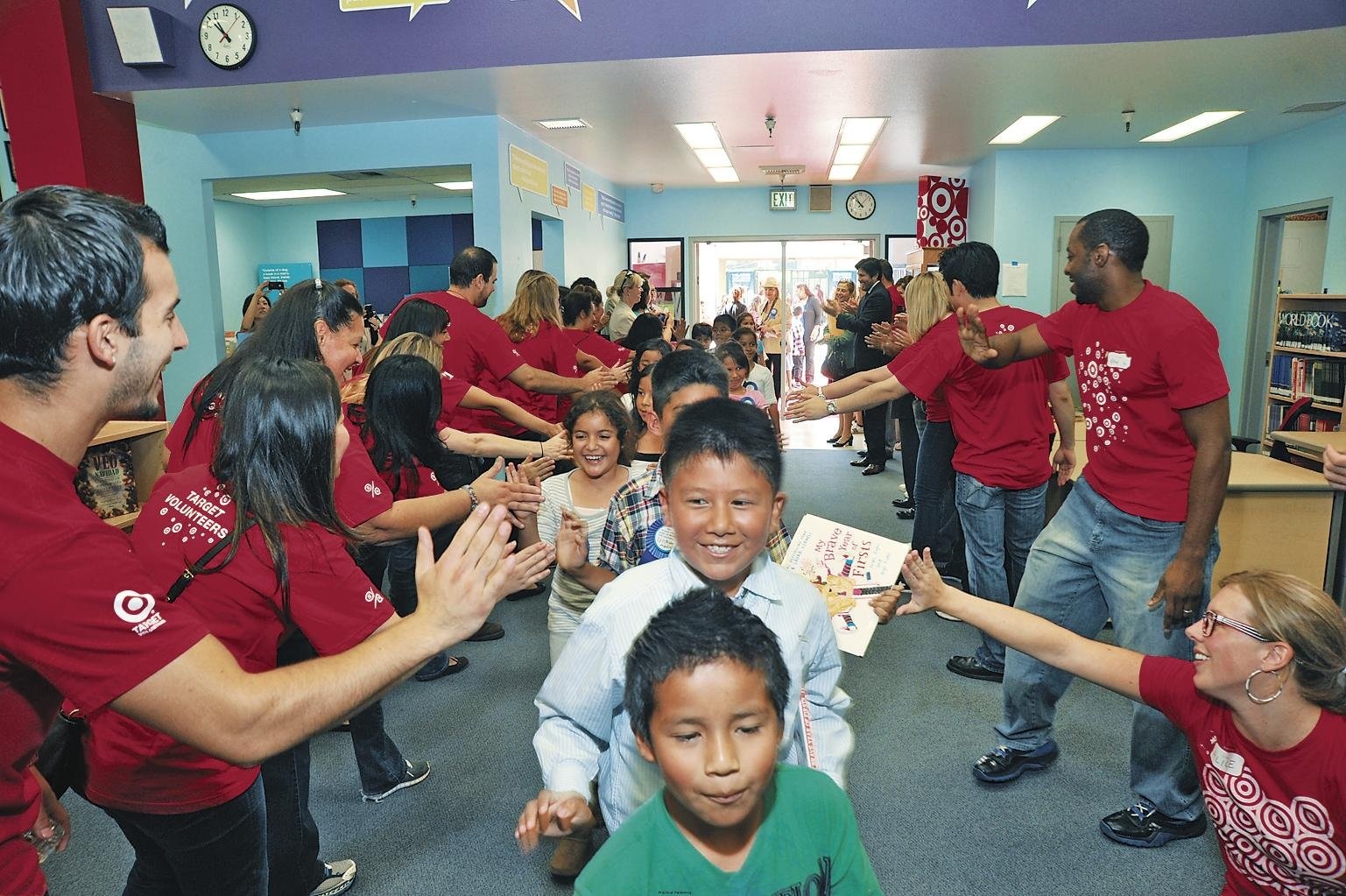
The school’s inviting and well-stocked library is among 150 nationwide that will have received extensive makeovers by the year’s end as part of the Target Corporation’s goal of donating $1-billion toward education by 2015.
Since the company’s founding in 1962, it has distributed $679-million to education causes.
Among America’s companies, only Wal-Mart has started a larger philanthropic effort, promising to give $2-billion to fight hunger by 2015. However, the numbers are not directly comparable, since Wal-Mart is donating mostly goods to that cause; only $250-million of the total commitment is cash.
Help With Reading
Target chose education as its signature cause in 2010, says Ms. Ward, after research identified that as a chief concern among customers.
In addition to giving money to schools to spend as they wish, the company is focused on improving reading skills, specifically helping more students read proficiently by the end of third grade. About 83 percent of fourth graders read below their grade level, according to a 2010 report by the Annie E. Casey Foundation.
“We want to ensure that more U.S. children are on a path to high-school graduation, so that they are ready for college, a career, and ultimately for life,” says Laysha Ward, president of community relations and the Target Foundation.
Direct Spending
The company’s ambitious financial commitment to improving education has drawn attention and praise. Target’s $1-billion campaign represents a “best in class” example of how a company can successfully intertwine corporate and societal concerns, says Mark Shamley, president of the Association of Corporate Contributions Professionals.
The focus on shoring up education, he notes, benefits “the business, the community, and the consumer.”
The bulk of Target’s spending on education goes to helping students and schools directly, through giving away money for books, renovating school libraries, supporting school-pantry programs, and giving schools extra cash to spend on their own priorities.
“There is a place for their sensible approach,” says Kevin G. Welner, director of the National Education Policy Center at the University of Colorado at Boulder. “It’s a thoughtful, deliberate approach to grant making that isn’t too arrogant in thinking they know already what is going to work, and it isn’t too disruptive. And it’s certainly filling needs that are being unmet currently.”
Impact Questioned
However, some observers doubt that Target’s mainly nuts-and-bolts approach to education philanthropy can make a lasting difference in helping improve student capabilities.
More money for computers or books is nice, but it’s akin to throwing a thimble of water into a river, says Frederick M. Hess, director of education policy studies at the American Enterprise Institute.
“If you want to spend dollars in ways that are going to change big, long-lasting systems, you have to think about leverage,” he says.
That approach, which grant makers like the Bill & Melinda Gates Foundation have adopted, often involves using grant money as a catalyst to fundamentally retool school policies, such as how teachers are trained.
“This stuff is more controversial, which is why especially corporate philanthropy has tended to stay toward the nicer, less objectionable stuff, even if it’s less likely to have an impact,” says Mr. Hess.
Customers Vote
Target, which ranks 38th on the Fortune 500 list of largest companies, has a long history of philanthropy.
Since the Dayton brothers opened the first store 50 years ago in Roseville, Minn., Target has donated 5 percent of its pre-tax profits to nonprofits—five times the average most companies give, according to Mr. Shamley. Now, with 1,772 stores nationwide, the company gives about $4-million a week to causes that include education, arts and culture, and disaster relief.
Target relies heavily on its customers to help direct its education giving.
The company’s largest commitment, Take Charge of Education, has raised $350-million, and the company hopes to increase that amount to $425-million by 2015.
Shoppers who use Target’s credit card to make store purchases direct 1 percent of their spending to a school of their choice. The school’s officials have complete discretion over how to spend the money, be it on school supplies, technology, or other needs.
Ms. Ward says, “In this challenging economic time, it allows our guests”—Target’s word for customers—“to have a voice and a choice in giving to local schools.”
Give With Target, a recent Facebook campaign, also offered the company’s patrons a chance to help shape its education philanthropy.
Of the $5-million the company allocated for the program, half went to 100 elementary schools nationwide that had shown academic improvement and where at least 70 percent of the students received free or reduced-price lunches.
The other $2.5-million was distributed through a voting process. Individuals could vote for one or more of the same schools to gain additional money in the form of Target gift cards. More than 3 million people voted and 30,000 schools received help.
Although Give With Target’s $5-million represents a small portion of the company’s $1-billion goal, Ms. Ward says the campaign helped achieve one of the company’s goals: making the public more aware of education needs.
‘We Are Vetted’
Target also helps call attention to the groups it supports, and that added visibility can help them land other donations.
For example, the company has long championed the Kids in Need Foundation, which distributes school supplies to schools with families who cannot afford to buy them. Twice the group has been selected by Target to participate in its Facebook giving campaigns.
The Facebook drive was a key reason the charity got what it will only describe as a five-figure donation from a new sponsor, Ann Taylor Loft, a women’s clothing company, for the charity’s teacher-grants program.
The program offers educators $100 to $500 to spend on creative classroom projects, such as recreating an episode of the “The Twilight Zone” or designing a battery-operated vehicle.
“The association with Target gives us additional awareness and gives us instant credibility,” says Dave Smith, the group’s leader. “If you tell a prospective donor we are supported by Target, we are vetted already.”
Feeding Families
To bolster its $1-billion pledge, Target has been finding ways to tie its grant making to other causes in education.
For example, in 2010 Target expanded and upgraded an in-house school at St. Jude Children’s Research Hospital, a longtime grant recipient. The company provided fresh paint, new desks and chairs, and artwork.
In another example of how the company cross-pollinates its education giving and other philanthropy, it gave Feeding America, the national hunger-relief charity, $2.3-million in 2010 to expand its school food-pantry program, which Target calls Meals for Minds.
“Target’s primary focus is on education; hunger is related to education,” says Maura Daly, chief communication and development officer at Feeding America. “We know that nutrition is critical to a child’s development and specifically their ability to learn.”
Meals for Minds operates a food pantry in 57 schools—those that also participate in Target’s library-makeover program.
The pantries are open at least once a month; parents of students are invited to visit and take food home to their families. Because the pantry is set up like any other school resource, Target hopes to erase the stigma families might feel by visiting a food bank and allows the food to reach the whole family, not just its children, says Ms. Daly.
“When kids are hungry,” she notes, “it’s likely that their parents are, too.”
When 2015 rolls around, Target will probably meet its goal of giving $1-billion to schools and other education groups. But it could be many more years before the company knows for sure whether all that money has had a lasting impact on students.
With the myriad education challenges this country faces, Target officials realize that working to improve education requires a much larger effort.
“We are committed to making a difference in education,” says Ms. Ward. “But it’s something that requires a lot of different sectors to line up behind. A billion dollars isn’t going to be enough. We clearly need others to join us in this fight.”
What Each Target Store Gives Annually
Each of Target’s 1,772 stores disperses the following grants to local schools and nonprofits as part of the company’s overall philanthropy, which focuses on education:
• $2,000 for arts and culture programs
• $2,000 for early-childhood reading
• $700 apiece for three field trips
• $500 for books for each school