Tech Wonders and Dilemmas Explored at Innovation Conference

By NICOLE WALLACE
Features Editor
October 11, 2016 | Read Time: 5 minutes
San Francisco
It’s not every nonprofit conference where participants get a virtual-reality headset in their registration bag.
But that was essential equipment at the Innovation Conference, organized by the Silicon Valley Community Foundation. The event brought together donors, grant makers, and corporate social-responsibility professionals to explore how new technologies can be used for social good.
Grant makers need to get more savvy about technology — and could face real repercussions if they don’t, Emmett Carson, chief executive of the Silicon Valley Community Foundation told participants.
We wanted to give teachers the sort of superpower to let them transport their kids anywhere
“Until those of us who provide the funding to nonprofit organizations are more comfortable funding technology-oriented projects,” he said, “the nonprofit sector will not be able to move forward in bringing the benefits of technology to marginalized communities or in bringing attention to technology’s shortcomings.”
Virtual Field Trips
During the meeting’s opening plenary, Ben Schrom, a product manager at Google, demonstrated the tech giant’s Expeditions app, which lets students and teachers explore places like Machu Picchu, coral reefs, and the surface of Mars using the company’s low-cost virtual-reality viewer, Google Cardboard — the same viewer conference participants got when they checked in.
In a lesson about Jackie Robinson created with Ken Burns, the documentary filmmaker, students see a large apartment building in present-day Brooklyn, which they learn was once the site of Ebbets Field. A photograph of the storied ballpark where Mr. Robinson played is then superimposed on the scene to help history come alive.
In two years, more than a million students in 11 countries have experienced the immersive lessons.
“We wanted to give teachers the sort of superpower to let them transport their kids anywhere,” Mr. Schrom said.
Designing With Users
Throughout the conference, nonprofit leaders stressed how important it is to design technology in concert with the people who will be using it.
The Enable Community Foundation grew out of an online community of 3D printing enthusiasts who design low-cost prosthetic arms. Most of the designs were created for North American children by young men in their 20s and 30s. But when the organization took the designs to Haiti, they were roundly rejected.
While kids in the United States loved the bright, colorful prosthetics volunteers designed — à la Iron Man — what Haitians wanted was to be able to walk down the street without drawing unwanted attention to their disabilities.
So designers at the Enable Community Foundation worked closely with patients, prosthetists, and clinic administrators to create new designs. Each day they were able to incorporate the feedback they received into a new iteration of the limb and print it out by the next morning.
“One of the tricks is learning to ask the right questions and ask them in many different ways,” said Andreas Bastian, director of the Enable Community Foundation.
Sci-Fi Solutions
A presentation by the winner of the UAE AI Robotics Award for Good drove home just how mind-boggling the applications of new technology for social good can be.
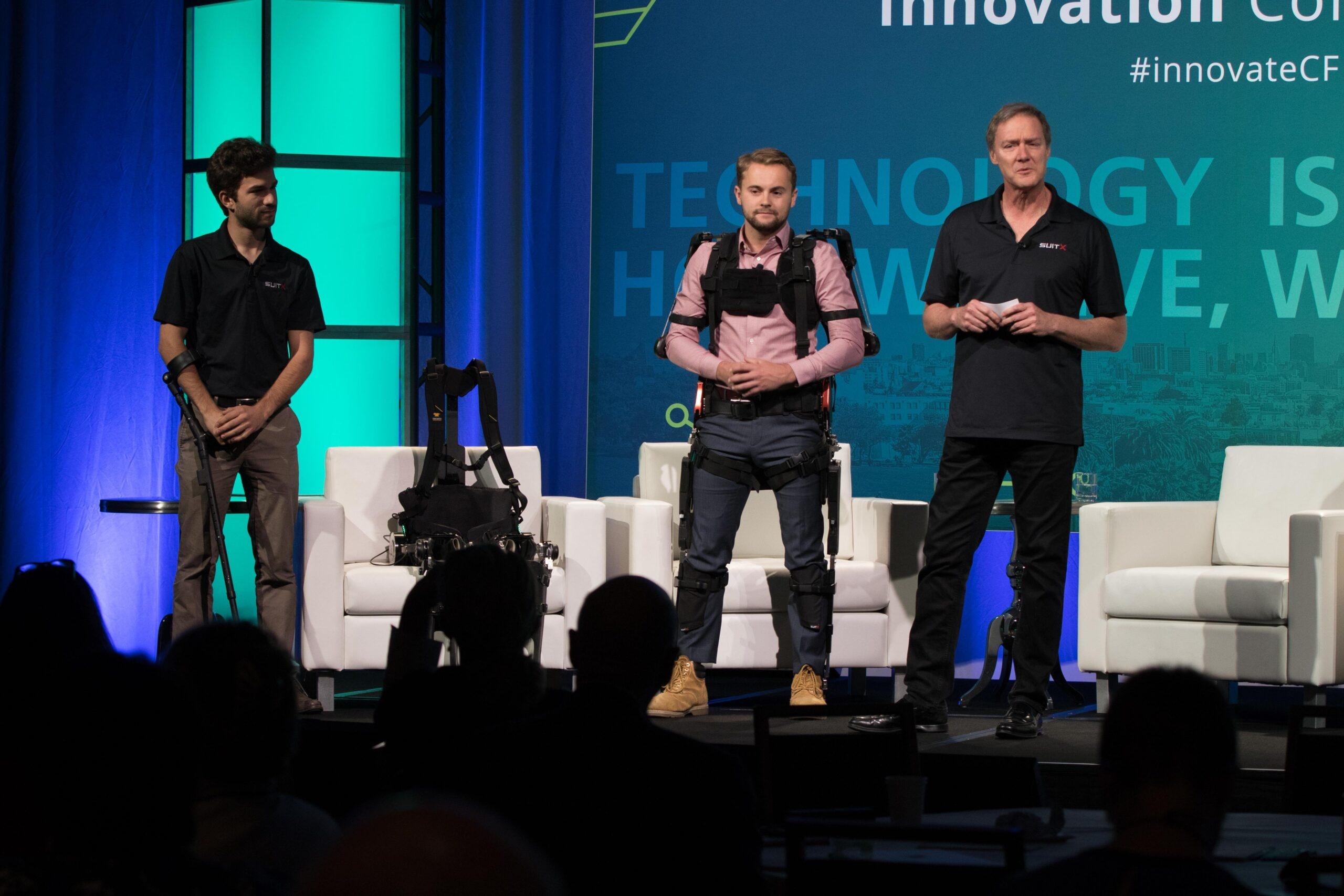
SuitX is a start-up that has built a medical exoskeleton, a wearable machine that allows people with lower-body paralysis to walk. The device is designed in interlocking sections so users can put it on and take it off by themselves, Frank Moreman, the company’s chief operating officer, told the audience.
One of the tricks is learning to ask the right questions and ask them in many different ways.
“If you’re going to drive somewhere, you don’t want someone else to need to be there in order to get you into your device,” he said. “A person can detach the legs and put them in the back seat of the car, and then when they get where they’re going strap them on themselves.”
The company is starting an FDA trial and hopes to have the exoskeleton on the market in 2017.
Avoiding a ‘Tech Ghetto’
While the potential for technology to improve lives is great, new advances can also be detrimental if poorly applied or people don’t think through the potential consequences of using them.
Bill Fitzgerald, director of the Privacy Evaluation Initiative at Common Sense Media, argued that data analysis isn’t inherently neutral and that tech teams must be diverse and include people with different backgrounds to head off problems.
“There’s no faster way to implement bias at scale than to have algorithms written by people who understand only a small percent of what’s out there in the world,” he said.
Even programs created with the best of intentions can be problematic.
Efforts to teach children in low-income schools to code could end up creating a tech ghetto, said Kamau Bobb, a program director at the National Science Foundation.
“What that is offering is essentially training,” he said. “What’s offered to students of privilege is education.”
Launching inner-city students into careers that put them on the path to becoming solidly middle class isn’t a bad thing, but it comes down to a question of “what is adequate for whom,” Mr. Bobb argued.
“The basic argument is true: that if you’re getting this and it’s better than what you had, then you’re better off,” he said. “But if it isn’t good enough for me, then I feel like I have an ethical dilemma — and I shouldn’t offer it to you.”