
‘The New Republic’ Tells Why Aid Projects Fail; ‘Forbes’ Showcases Donors
December 8, 2014 | Read Time: 7 minutes
‘The New Republic’ Examines Why Nonprofit Programs Fail
Going big with proven projects is all the rage among charity, government, and business experts in development, but it’s also why aid projects so often fail, writes Michael Hobbes, in The New Republic (November 24 and December 8).
Mr. Hobbes, who has worked at two aid charities, writes that he spent the past year devouring books and essays about successes and failures in international development.
What he learned, he says, is the flaw in the “big idea—that once we identify the correct ones, we can simply unfurl it on the entire developing world like a picnic blanket.”
Instead, some projects work precisely because they are small and tailored to the needs of the people they serve.
“The point is, we don’t know what works, where, or why. The only way to find out is to test these models—not just before their initial success but afterward and constantly.”
He adds: “Development projects thrive or tank according to the dynamics of the place in which they’re applied. It’s not that you set something in one place, then scale it up to 50. It’s that you test it in one place, then test it in another, then another.”
Another reason aid groups fail to achieve meaningful results, Mr. Hobbes writes, is the idea that low overhead is good. Because so many charities, government-contract decision makers, and watchdogs focus on keeping overhead low, nonprofits ask program staff members to take on tasks like accounting, managing personnel, and other administrative demands.
“The downsides of this approach were most obvious in fundraising,” he writes. Nobody ever got good at it, he says. Each staff member had to essentially invent an approach to seeking grants, and everyone ended up contacting the same donors repeatedly instead of coordinating and seeking out new people who might give.
“We missed opportunities for new funding, we bungled contracts we already had, and we turned donors against us,” he writes. “Every staff meeting, one or two people announced they were leaving. ‘I wasn’t hired to spend my day fundraising’ were the most common eight words at farewell parties.”
Yet another challenge, he writes, is that often what seem like good ideas for change have unintended and seriously harmful consequences. As an example, he cites an anti-gang program that had tremendous success persuading Latina teenagers in New Jersey to stay away from violent activities. By the end of the test program, however, every participant had become pregnant. Joining gangs, the researchers found, had given the teenagers a sense of identity; when they lost that, they found meaning another way.
“This is the paradox: When you improve something, you change it in ways you couldn’t have expected.”
He concludes: “If we really want to fix development we need to stop chasing ideas the way we go on fad diets. Successful programs should be allowed to expand by degrees, not digits.” NGOs, he adds, “need to be free to invest in the kinds of systems and processes we’re always telling developing countries to put in place.”
The real problem is not that “development is broken,” he says, “it’s that our expectations are.”
‘Forbes’ Looks at How Donors Can Improve Education
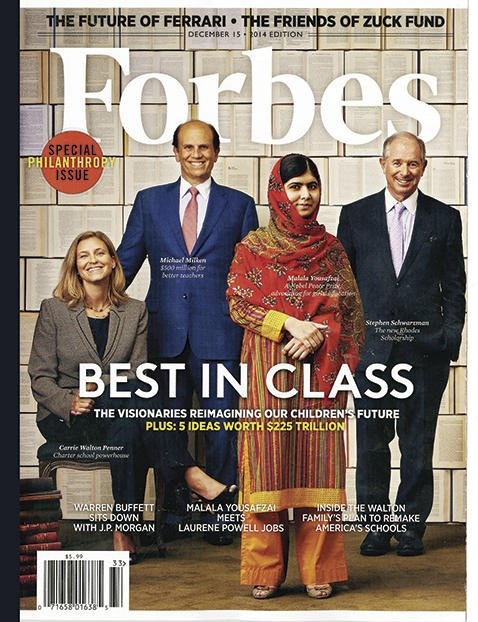
In its annual philanthropy issue, Forbes focuses on ways that big donors can make a difference in education (December 15).
It asked policy experts to identify five ideas that could help make the United States a leader in education and then calculated the return on investment from each one. The magazine also scouted out donors and nonprofits that exemplify the approaches, such as by ensuring that every kid can go to preschool and improving the quality of teachers and principals.
For instance, Larry Robbins, who made his wealth in hedge funds, is a board member of the Robin Hood Foundation and chair of the Relay Graduate School of Education.
Among his ideas: Allow great teachers to avoid paying federal income taxes. That would cost a lot less than what is now spent on fighting wars. “Should there not be a war for teachers?,” he asks.
Investing in all five approaches would cost an estimated $6.2-trillion over 20 years. But that would lead to a $225-trillion return over 80 years, Forbes suggests.
The issue also examines how members of the Walton family are financing school reform, and it enlists Laurene Powell Jobs to interview the Nobel Peace Prize winner Malala Yousafzai.
‘Harvard Business Review’ on ‘New Power’ vs. ‘Old Power’
Nonprofits and other organizations need to learn how “new power” works compared with “old power,” write Jeremy Heimans and Henry Timms in the Harvard Business Review (December.)
Old power, they say, means donating through a big institution like United Way that parcels money out on a donor’s behalf; new power is more like Kiva, which allows individuals to give small loans directly to needy entrepreneurs in poor countries.
Mr. Timms helped found Giving Tuesday and is head of the 92nd Street Y. Mr. Heimans is co-founder and CEO of Purpose, a social business that builds movements.
The two men say they wrote the article out of concern that too many people either overromanticize the way technology and other changes are shifting business and government, or dangerously underestimate the transformation.
Old power “works like a currency,” they say. “It is helped by few. Once gained, it is jealously guarded, and the powerful have a substantial store of it to spend. It is closed, inaccessible, and leader driven. It downloads and it captures.”
New power operates “like a current,” they write. “It is made by many. It is open, participatory, and peer-driven. It uploads, and it distributes. Like water or electricity, it’s most forceful when it surges. The goal with new power is not to hoard it but to channel it.”
That approach to power, especially with people under 30, they say, emphasizes the idea that “we all have an unalienable right to participate.”
That means decision making and governance are more about networks than top-down bureaucracies, and that organizations embrace collaboration and a “do it ourselves” ethic.
Transparency is a must, and while “new power loves to affiliate,” it is also more fickle, they write. “People are less likely to be card-carrying members of organizations (just ask groups like the ACLU that are seeing this form of membership threatened) or to forge decades-long relationships with institutions.”
For traditional organizations, understanding the new power requires deciding what parts of new power are worth adopting and thinking about “what if there were an Occupy-style movement directed at your organization?”
And it means, they write, that “leaders must be able to actually mobilize true believers, not just talk at them.”
Noted:
- The sad and sordid dealings of Sol Adler— Mr. Timms’s predecessor at the 92nd Street Y—that eventually ended in Mr. Adler’s suicide are traced by New York magazine (November 17-23). Mr. Adler, who held the job of executive director for 25 years and helped triple the organization’s budget during his tenure, was caught up in an extramarital affair with his assistant and in an extortion deal that siphoned money from the Y’s contractors. Mr. Adler’s wife, Debbie, tells the magazine that the Y’s board breached Mr. Adler’s contract, and she has sued the organization for $3-million as a result. She says she was frustrated that the organization didn’t show any sympathy when he was being treated in a medical program for depression. Meanwhile, the board told the magazine it had no choice because of Mr. Adler’s “egregious conduct.”
- Atlantic magazine (December) asks the heads of big foundations and others involved in philanthropy to name the greatest gifts of all time. Judith Rodin, head of the Rockefeller Foundation, says it was the wheat seeds that led to the Green Revolution (work the foundation supported). Darren Walker, head of the Ford Foundation, says it was Edsel Ford’s gift to support Diego Rivera’s creation of a 27-panel mural in Detroit. The masterpiece, he says, “remains a monument to human endeavor and hard work.”




