Veterinarian Runs Grass-Roots Drive to Raise Millions for a Historic Bridge

By LAWRENCE BIEMILLER
Contributor
October 2, 2011 | Read Time: 7 minutes
Lander, Md.
His friends told George Lewis he was crazy when he said he wanted to raise $2.3-million to rebuild a collapsed stone aqueduct in the C&O Canal National Historical Park, which meanders along the Maryland side of the Potomac River from Cumberland, Md., down to Washington.
“Who ever heard of the C&O Canal?” they asked. “Who even knows what an aqueduct is?”
Besides, they warned, to raise money nowadays, “you gotta compete with a little old lady on a corner with a tin cup and a starving baby.”
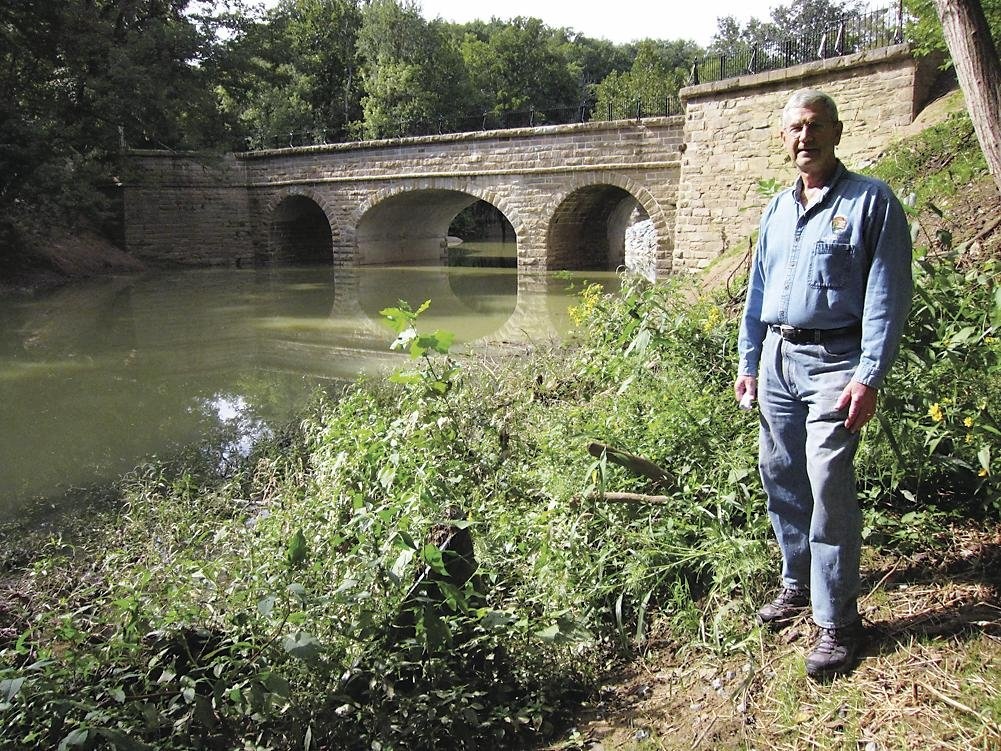
But that was five years ago. On October 15, many of those friends will join Dr. Lewis at the dedication ceremony for the restored Catoctin Aqueduct, an 1834 bridge that carried mule-powered canal boats high over Catoctin Creek.
Maryland’s governor is expected, along with Congressional representatives, National Park Service officials, Frederick County dignitaries, canal fans, and a variety of contributors—from a big defense contractor whose headquarters are nearby to a local woman who cleans houses for a living and has held three yard sales to support the project.
Infectious Enthusiasm
Dr. Lewis, who got interested in the canal after buying a house near here 15 years ago, is a retired U.S. Army veterinarian whose enthusiasm is almost certainly more infectious than any of the biological agents he once worked to defend against. Walking along the canal towpath toward the aqueduct, he says he’s learned a lot since 2006, when he wrote a personal check for $5,000 to a civil-engineering firm to get the project started.
He had worked with the park service before, on restoring a lock tender’s house, but this was an effort on an entirely different scale.
Early on, he persuaded state transportation officials to pick up half the tab, promising to raise the rest himself even though he had no fund-raising experience.
With help from the Community Foundation of Frederick County, he created a charity to accept donations, the Catoctin Aqueduct Restoration Fund, and came up with a business plan for the project. He asked a group of friends—“graybeards,” he calls them—to tear it apart, which they did “unmercifully,” he says.
But afterward one member of the group came up to Dr. Lewis in the parking lot and wrote him a check. The same supporter soon set up a meeting with a local bank president who agreed to help.
Dr. Lewis moved into high gear. He gave PowerPoint presentations at Rotary meetings, in board rooms, in politicians’ offices, and to members of the C&O Canal Association. He walked up to the aqueduct ruins with potential donors, local reporters, foundation representatives—anyone who would listen.
The project, he adds, has been “as grass-roots as you can get.” One supporter gave “up in the $80,000 range,” Dr. Lewis says, though he mentions her less often than the lady who has held the three yard sales.
Not everything ran exactly as he had hoped. For one thing, the project took three years longer than he first imagined. And he’s had to push the park service to interpret its strict rules for working with outside organizations more liberally than might otherwise have been the case. For instance, he talked officials into approving an “Adopt a Stone” fund-raising campaign by making it clear that he was not trying to sell off the park’s heritage to high bidders: Donors who adopted a stone, for a gift of $125 to $10,000, will be able to look it up in a low-key directory nearby, but that’s all. The campaign turned out to be both a good fund-raising mechanism and a good advertising tool, he says.
One development still makes Dr. Lewis a little uneasy: In the end, the federal government’s economic-stimulus program paid for more than half the cost of the reconstruction—which rose to $4.1-million, by the way, after it was discovered that one pier was in bad shape and that park-service rules required some costly measures intended to help protect the rebuilt aqueduct.
“I’m a Republican,” Dr. Lewis says with a grin. “I’m not a stimulus fan. And they come in and stimulus money is available—you talk about a dilemma!”
He made peace with the idea because the stimulus dollars were going directly to the park service rather than being channeled through his restoration fund. Anyhow, he says, since the fund had done its homework well, “you couldn’t find a better definition of ‘shovel-ready.’”
Engineering Ingenuity
The three-arch aqueduct is one of 11 along the canal, which was built beside the Potomac to take advantage of the comparatively level route the river had carved down from the mountains. But the river itself had too many shallows and rapids for navigation, so the canal’s engineers dug a tidy, four-foot-deep channel nearby, with 75 lift locks to raise or lower boats from one level stretch to the next. All this required engineering ingenuity: In one place, for instance, the canal enters a tunnel three-quarters of a mile long.
But the aqueducts that carry the canal over the Potomac’s tributaries are, many fans insist, the canal’s most beautiful features. The longest, a seven-arch crossing of Monocacy Creek, was considered one of Maryland’s seven wonders when it was built.
The Catoctin Creek span, with two semicircular arches flanking a long, elliptic arch, was notable for its handsome lines as well as its awkward approaches: On both ends, boats had to turn sharply to enter it, thanks to the angle at which the creek and the canal meet. Canal-boat captains called it “the crooked aqueduct.”
It was also the only aqueduct to have collapsed entirely, almost 40 years ago. Like all the aqueducts, it suffered every winter when canal water leaked into its stonework and then expanded as it froze. The aqueducts still suffer during floods, when they get battered by trees being carried downstream.
In the 1940s, stones began dropping out of the Catoctin span’s big middle arch when one of the piers shifted slightly. From then on, more and more of the upstream side—the side hit by flood debris—disappeared every year.
On October 31, 1973, two of the arches collapsed altogether, leaving only part of the third. For decades it stood forlornly beneath a metal bridge that the Park Service brought in so hikers, bikers, and runners could continue to use the towpath.
Luckily, many of the aqueduct’s stones survived. Some lay in the bed of the creek, where they were easy to see, but others had been gathered up and buried in the bed of the canal just down from the aqueduct site. There they were forgotten and then, in 2006, rediscovered.
The downstream face of the rebuilt aqueduct consists almost entirely of original stones, all put back exactly where they were in 1834 by engineers working from a 1900 photograph. The upstream face has only a few old stones, but Dr. Lewis says the replacements will eventually acquire the same coloration as their older neighbors. Meanwhile, the two faces hide reinforced-concrete arches that Dr. Lewis promises are significantly stronger than their cut-stone predecessors. This section of the canal has been dry since 1924, when flood damage closed the canal for good, but if water, mules, and canal boats appeared tomorrow, the aqueduct would have no trouble carrying them.
As he leads the way down to a creekside vantage point, Dr. Lewis is quick to hand out credit to others.
There’s Kevin Brandt, the park superintendent, who has been so encouraged by the success here that he’s pressing to rewater the Conococheague Aqueduct, 55 miles up the canal. There’s Randy Astarb, the park’s stonemason, who “cut almost every stone that had to be cut by hand.”
There are engineers, contractors, and construction workers—some of them recent immigrants, he notes, much like the Irish and German immigrants who built the aqueduct.
He doesn’t make much of his own role, though it’s clear no one would even have dreamed of rebuilding the Catoctin Aqueduct without his enthusiasm. He’s planning a party after the dedication, he says, and after that he’s going to shut down the restoration fund within a few months—just as soon as he can find someone to tell him how.