
Wage Fight Poses Dilemma for Nonprofits Squeezed by State Funding

By SUZANNE PERRY
Contributor
May 18, 2014 | Read Time: 6 minutes
When Kathy Potter, a member of the board of the Minnesota Council of Nonprofits, learned last year that the group was planning to back efforts to raise the state’s minimum wage, her first thought was, “Are you kidding me?”
Ms. Potter, executive director of Access of Red River Valley, a charity that offers services to people with developmental disabilities, says she agrees that workers should earn a living wage. She was once a single mother holding down three jobs to make ends meet. “It’s not fun,” she says.
But the 2014 legislature was considering a proposal to increase the minimum wage to $9.50 an hour—a 31-percent jump from the $7.25 federal minimum that applies to most workers in the state. Because it’s hard to attract qualified employees, Access offers starting pay that is $2 more than the minimum wage.
If it continued that practice, it would have to bump that wage to $11.50 while also raising pay for longer-serving workers—all in all, facing $600,000 in additional costs, including Social Security and Medicare contributions, she says.
The main problem, she says, is that Access depends heavily on state reimbursements for its services—and each year since 2008 those rates have fallen or increased only slightly. “We don’t get to raise our menu prices,” Ms. Potter says. “We can’t cut our hours.”
Ms. Potter’s dilemma reflects a brewing debate in the nonprofit world that pits an ideal against a practicality. Because so many nonprofits work with poor people, few contest the principle of raising wages as a way to fight poverty. But some, especially those that rely on shrinking government revenue, find it hard as employers to put the principle into practice.
“For some organizations, the choice between providing care to vulnerable communities and raising wages is very real and difficult,” Diana Aviv, chief executive of Independent Sector, an association of charities and foundations, said in a statement last month.
The statement backed legislation to increase the federal minimum wage, saying the current level does not allow people to “earn a life-sustaining wage that enables them to support themselves and their families.” It also asked charitable organizations “to pledge to work towards paying a living wage to all of its workers whenever possible.”
The wording provides ample wiggle room, however, acknowledging that some groups may not be able to increase pay now, given “increased demand for assistance in the face of stagnant, if not declining, revenues.” It added that many employ seasonal, part-time, and young employees, so minimum-wage proposals should consider exceptions for those categories.
In the end, the statement offered no quick fixes but restated the nonprofit world’s perennial plea for higher government reimbursements and more charitable giving.
“We don’t necessarily have the answer. We just know there’s a problem,” says Robert Lynch, chief executive of the advocacy group Americans for the Arts and a member of Independent Sector’s board. But, he adds, “we want to encourage every single arts organization to move toward paying a living wage and to stretch as far as they can go.”
Conflicted Response
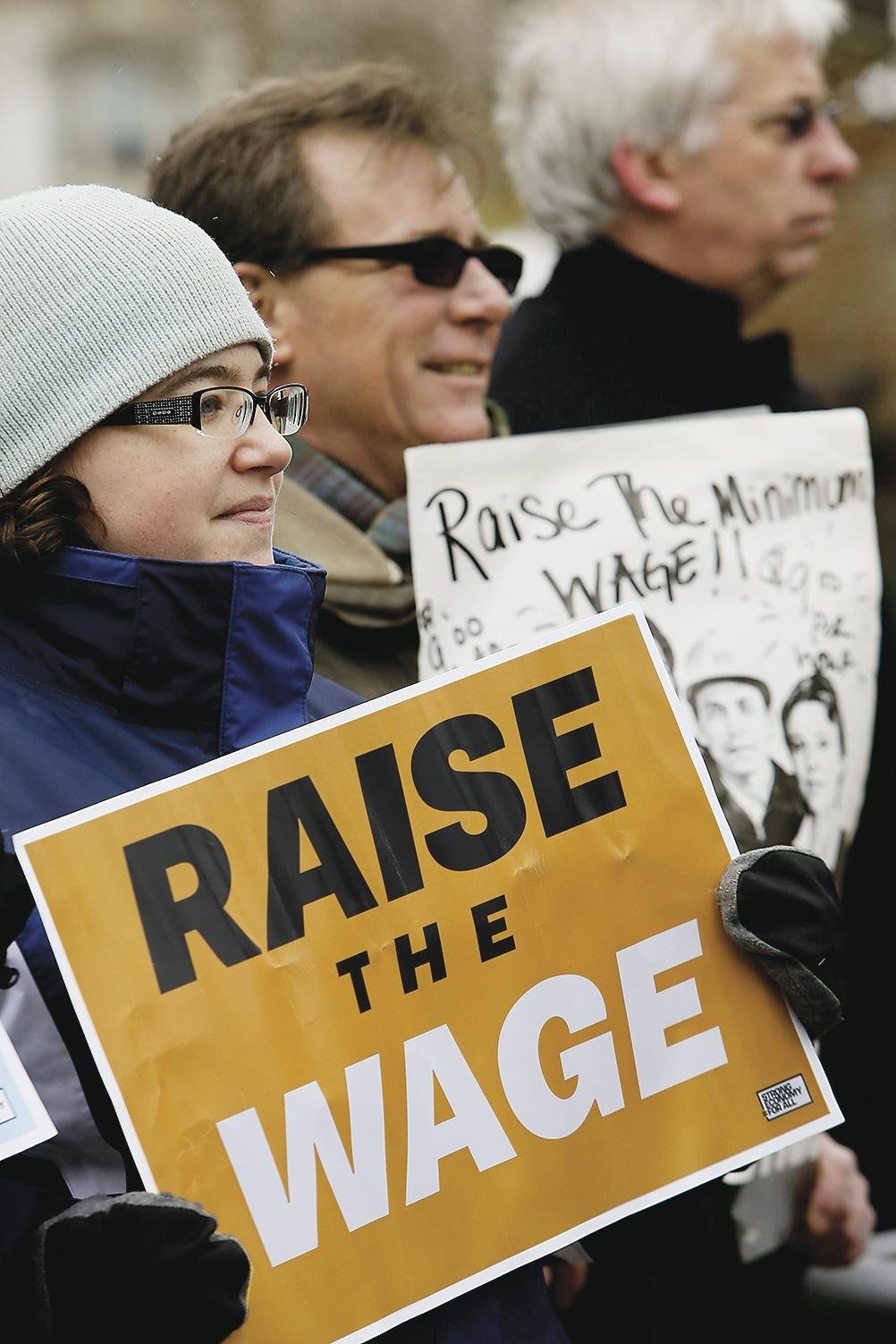
Senate Republicans last month blocked the federal minimum-wage proposal. But debates over the impact of wage increases have been playing out at state and local levels. Hard-line opponents—generally conservative and employers groups—say the requirement would hurt workers by forcing businesses to cut their payrolls or set up shop in other parts of the country. Many charity advocates are conflicted.
“As a nonprofit leader who is concerned with social justice, I’ve lost many nights of sleep considering this issue. How can we build a more just and equitable community without bankrupting the organizations that help our most vulnerable?” Sylvia Fuerstenberg, executive director of the Arc of King County, wrote in a March opinion piece in the Seattle Times after the city’s Mayor Ed Murray proposed raising the minimum wage from $9.32 to $15.
Ms. Fuerstenberg’s group provides services to help people with developmental disabilities live in the community rather than in institutions. The state, which provides about 60 percent of her budget, decides how much to pay for the services, getting a match from Medicaid. She estimates that providers like hers in King County would need $26-million more in annual funding to increase the minimum wage to $15.
“We would love to be paying this money,” she says. “These are skilled positions. These are not minimum-wage jobs.” Since she wrote her opinion piece, the mayor has refined his proposal in consultation with community leaders and has proposed phasing in the $15 minimum over three to seven years, depending on the employer’s size. If the Seattle City Council approves that plan, she will spend the time lobbying the legislature for higher state payments. Otherwise, she says, her group would have to cut elsewhere, for example its health-care coverage.
To help blunt the impact on charities, some state nonprofit associations have mounted dual lobbying campaigns to increase both the minimum wage and state reimbursement levels.
Maryland Nonprofits, for example, backed legislation that the legislature approved last month to raise the minimum wage from $7.25 to $10.10 by 2016, calling it an “important step to stem the growth of income inequality.” But it also supported a measure that was approved by lawmakers requiring the state to increase payments to nonprofits that help people with developmental disabilities so they can pay their workers a certain percentage above the minimum wage.
The Minnesota Council of Nonprofits and other advocates won their campaign to increase the state’s minimum wage: The governor signed a measure last month to increase the rate to $9.50 for large employers by 2016. But the council also threw its weight behind an advocacy campaign to increase by 5 percent the state’s rates for nonprofits that provide community-based services to older adults and people with disabilities, a proposal the legislature was considering in the final days of its session. Ms. Potter of Access of Red River Valley says she appreciated that the association took her concerns into account. But, she adds, the 5-percent increase “doesn’t begin to get us even close to where we were five years ago.”
White House Influence
Such nitty-gritty debates have not yet taken place at the federal level. Ms. Aviv says she proposed issuing the Independent Sector statement after participating in a conference call with White House officials about President Obama’s State of the Union address, which called for a minimum-wage increase, and after conferring with leaders of big nonprofits with affiliates. She says the statement uses the term “living wage” because the minimum wage does not always allow people to make ends meet, particularly in high-cost regions.
The National Human Services Assembly, a nonprofit coalition, has not taken a position on the minimum wage, says Irv Katz, its chief executive. But, he says, “I’m going to guess a lot of my colleagues in human-services organizations are really divided on this. We recognize that unskilled workers haven’t had a raise in years, and they deserve one. But going from seven-something an hour to 10-something an hour is a huge leap and would almost necessarily result in reduced levels of service.”




