
Do “warm glow” appeals designed to make people feel good about giving produce strong returns for charities? How do such messages perform compared with appeals aimed at concerns about the greater good of society?
To learn more about the effectiveness of warm-glow giving appeals, researchers looked north to America’s coldest state, Alaska.
The Test
Researchers were asked by the State of Alaska to help figure out what would make more residents donate a portion of the annual dividend they receive from revenue in the oil-and-gas industry.
Every resident receives an annual cash payment, called a permanent fund dividend, or PFD, which in recent years has totaled more than $2,000 per person. Through a program begun in 2009 called Pick. Click. Give., the state encourages recipients to donate some of that money to charities. But few Alaskans gave: By 2013, only about $3 million out of $550 million in PFD payments went to charity.
To boost giving, the state hired John List and some of his research colleagues at the University of Chicago’s Science of Philanthropy Institute, Michael Price at Georgia State University, and James Murphy at the University of Alaska at Anchorage to test different direct-mail appeals.
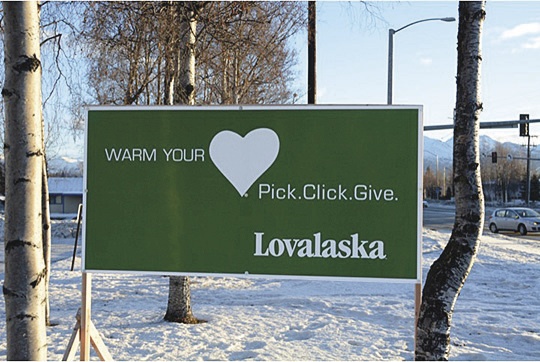
One postcard promoting Pick. Click. Give. featured a message that appealed to the good feeling that philanthropy imparts: a silhouette of a heart with the message “Warm your heart. Share your PFD.” A second postcard sent to a different group appealed to social responsibility: It featured a map of Alaska and the message “Make Alaska better for everyone.”
Researchers also monitored a control group that received no appeals beyond the radio spots and billboards they were already exposed to.
Results
Recipients of the warm-glow card with the heart silhouette were 31 percent more likely to give than donors who received the postcard with the map. The average contribution jumped 56 percent among those in the warm-glow group, who were also more likely to support a broader range of charities than the other two groups. Alaska charities received $1.5 million more from recipients of the postcard featuring the heart.
In contrast, those who got the “Make Alaska better” cards demonstrated no change in the rate of giving or the average contribution. Those who received no postcards also showed no statistically significant change in giving habits.
Digging Deeper
In 2015, the second year of the study, researchers replaced the map postcard with one informing residents of a chance for 10 Pick. Click. Give. donors to win double the amount of their state dividend. It had little effect on giving. Meanwhile, the heart postcards continued to draw people toward giving, although the impact was somewhat diminished.
Some research has shown that warm-glow donors’ experience can wane over time, but “we see the effect persisting here,” says Mr. Price. “It’s not just a one-off.” A significant number of donors keep giving when their emotions are engaged, he says. “In both the short and the long run, you see an increase in giving from them.”
The full study has not yet been publicly released.— Michael Anft




