Why College Alumni Don’t Give to Their Alma Maters: They Think Other Charities Need Money More

By Eden Stiffman
Senior Editor
August 30, 2016 | Read Time: 4 minutes
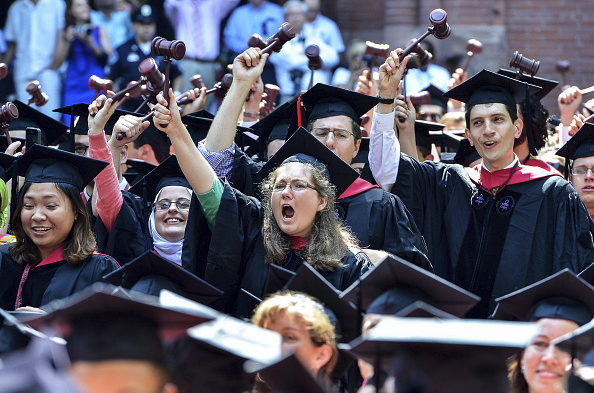
Nearly half of alumni who have never donated to their alma maters believe their college does not need their money as much as other nonprofits, according to a new survey of American donors.
That’s a perennial challenge for university fundraisers, according to the study by Cygnus Applied Research, a fundraising consultancy. More than 21,000 donors completed the annual survey, including more than 6,200 college graduates who give to charity but have never donated to institutions they attended.
Why Non-Giving Alumni Have Never Donated to Their College
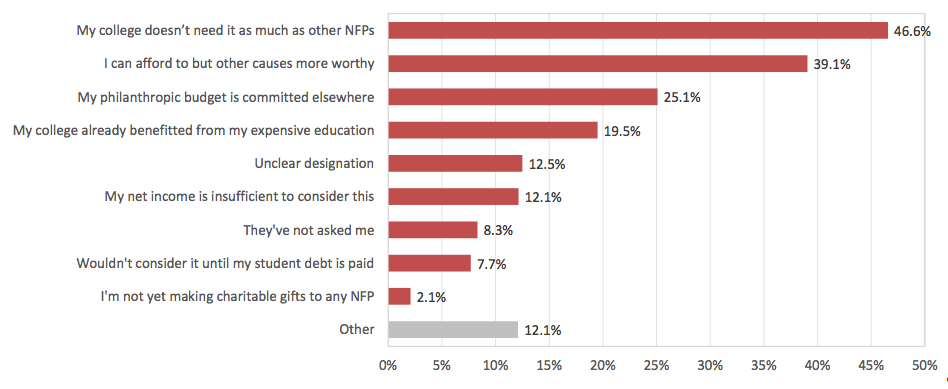
“There is the perception that colleges and universities are flush with money and because of tuition, and in some cases state support, they don’t need it as much as other nonprofits,” said Shaun Keister, vice chancellor for development and alumni relations at the University of California at Davis, where only 6 to 7 percent of alumni give each year. “For my own institution, this would be the No. 1 reason why alumni don’t give.”
Overcoming that obstacle often requires reinforcing to alumni that tuition freezes or declining state support may require universities to buttress revenue in other ways. The best bet for doing so is to steer clear of seeking unrestricted gifts, said Penelope Burk, president of Cygnus and the study’s author.
“That is a killer for any nonprofit,” she said. “All you’re saying when you’re raising unrestricted gifts is, ‘We are a good institution to support.’ Every institution and nonprofit can say that.”
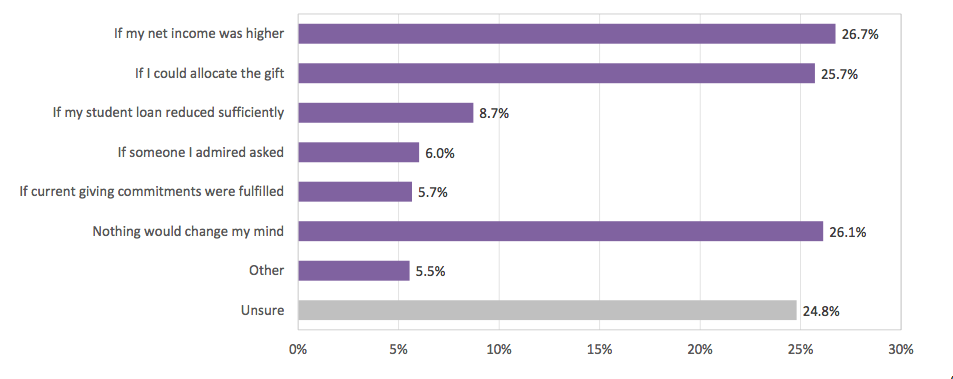
Thirty-six percent of alumni donors said their most recent gift to their alma mater was unrestricted. And about 26 percent said they would give more if they could allocate their gift to a specific campus program or project.
“If we want to maximize giving, we have to give donors the maximum number of options to follow their philanthropic passions,” said Mr. Keister. “One of the reasons higher ed has a true advantage in the marketplace is because we are so diverse. It would be almost impossible not to find one thing that would match up with someone’s philanthropic value system.”
Mr. Keister’s institution is hardly alone in the challenge it faces in persuading alumni to give. While the total dollar amount donated by former students is rising fast, the share of those who give has not grown, according to the Council for Aid to Education. Nationwide, the share of alumni who give was 8.4 percent last year, compared with 8.6 percent in 2014.
Raising More Money
Sixty-seven percent of donors in the Cygnus survey who had graduated from or attended college have made at least one gift to an institution where they studied. But just 20 percent of alumni donors said their most generous gift went to their alma mater. Thirty-one percent reported that their biggest gift to their college falls in the bottom third by dollar value when compared with their other charitable contributions.
What Would Increase the Likelihood of Non-Giving Alumni Contributing to their College Within the Next Five Years
The survey’s other findings include:
- Alumni who were involved in campus life beyond academics, through sports teams, clubs, and other activities, and who remain engaged after graduating were more likely to give. Sixty-eight percent of alumni donors who had extracurricular interests and affiliations made a gift.
- Donors with degrees from two or more institutions tend to be generous to all colleges they attended, but 62 percent said their priority was in supporting the place where they earned their undergraduate degree.
- Student debt played no role in determining whether alumni gave to their alma maters or not. Thirty-eight percent of alumni who donated to their alma maters and 37 percent who didn’t were carrying some student debt when they left college.
- Nearly 47 percent of alumni who give say they’ve remained connected to their college via online or direct-mail communications, compared to 14 percent of those who don’t give.
The majority of alumni who have never donated to their college can’t recall who at the institution last asked them for money. But more than 26 percent of alumni said the most recent solicitation came from someone in the college’s fundraising office, a fact Ms. Burk suggests is counterproductive. More personal appeals, and recognition from people of influence such as professors or deans, are significantly more successful in persuading alumni to keep giving after their first donation and increasing the amounts they give in the future.