
With an Eye on the Court, Foundations Help States Adopt Health Law

By SUZANNE PERRY
Contributor
April 29, 2012 | Read Time: 8 minutes
Sara Kay, an official at the Nathan Cummings Foundation, says she has been “obsessing” lately about the Supreme Court.
It’s not something that Ms. Kay, who oversees the foundation’s health-care grants, normally has to worry much about. But the court is expected to rule in June on an issue that’s close to her heart: whether the 2010 law that overhauled the country’s health-care system is constitutional.
Nathan Cummings strongly backs the measure and has committed $1.5-million to a fund dedicated to putting it into effect.
Supporters like Ms. Kay regard the 2010 law as a critical step in bringing down health-care costs and ensuring that low-income and other vulnerable people have access to care. So they are watching nervously to see whether the court strikes it down—either entirely or in part—or delays a decision until after certain contested provisions go into effect in 2014.
And no matter what the justices do, the law’s future is in doubt until after next November, when voters select a president and new Congress. All the Republican presidential candidates have pledged to kill the measure.
“What you really need is like a flow chart—if this, then that,” says Ms. Kay.
Forging Ahead
Despite the high level of uncertainty, grant makers and nonprofits across the country are moving ahead on the assumption that the complex law will be upheld, and that they must help states do the nitty-gritty work that is required to carry it out.
“As soon as the act was passed, a huge amount of work and responsibility shifted to the states,” says Denise de Percin, executive director of the Colorado Consumer Health Initiative. “The level of work for state advocates ratcheted up hugely.”
Ms. de Percin’s group, a coalition of more than 30 nonprofits, has been working to help Colorado create a health-insurance exchange, an online marketplace in which consumers and small businesses can compare and purchase insurance plans. Federal law asks states to get the exchanges running by January 2014. The coalition has conducted focus groups, held community forums, and prepared a report on how the exchange can best benefit consumers.
The organization received $100,000 from the Affordable Care Act Implementation Fund, which was set up by seven national foundations, including Nathan Cummings, to help states carry out the law. Administered by Community Catalyst, a health-care advocacy group, the fund has raised $6.7-million and awarded grants to projects in 17 states, with local foundations matching most of the money.
Stephen McConnell, who coordinates health-care grants at the Atlantic Philanthropies, which has committed $1.5-million to the fund, recalls the concerns that prompted the grant makers to pool their money in a way they don’t do very often.
“When this law passed, a number of us looked around and said, ‘Holy cow, we’ve got to get together,’ ” he says. “We realized right up front that because this was going to be such a huge undertaking, we couldn’t afford to waste a dollar or be unstrategic about how we do the work.”
Atlantic made a huge investment to get the health-care law passed, spending $26.5-million to support the work of Health Care for America Now, or HCAN, a coalition of liberal advocacy groups and labor unions.
Because it is incorporated in Bermuda, the foundation is not subject to restrictions that bar U.S. foundations from giving money to groups to promote or criticize specific pieces of legislation. Atlantic’s contribution to the Community Catalyst fund created a pool of money that can be used for advocacy efforts, including lobbying.
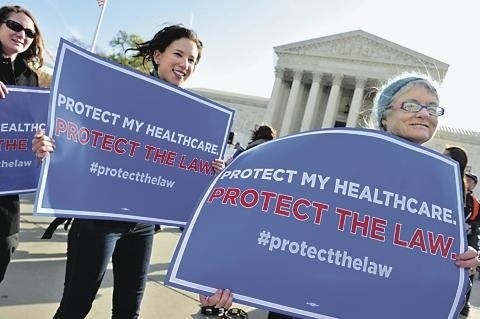
The foundation no longer gives grants to HCAN, but that group now gets about a third of its $3-million budget from other foundations—including the California Endowment, HJW Foundation, and Nathan Cummings—for public-education efforts. HCAN continues to champion the health-care law through activities that have included demonstrating at the Supreme Court building during hearings on the law held in March.
Mixed Response
Nonprofits now working on health-care efforts in their states face widely different political environments.
Laura Goodhue, executive director of the Florida Community Health Action Information Network, calls her state “the poster child of extreme opposition to the law.”
Florida is leading the 26 states that challenged the Patient Protection and Affordable Care Act before the Supreme Court, and Gov. Rick Scott, a Republican, ordered state agencies not to apply for any federal money or do any work to carry out the measure.
So Ms. Goodhue’s group has been aiming much of its efforts at the general public. It received $40,000 from the Community Catalyst fund last year to help educate small-business owners about the tax credits they would get by offering health insurance to their employees.
The group just won an additional $200,000 to lead efforts to ensure that a federal health-insurance exchange—which would be established if the state failed to create one—meets the needs of low-income and uninsured residents.
At the other end of the spectrum, Maryland is moving full-steam ahead to put the health-care law into place. The Democratic-led General Assembly approved a bill last month to create a health-insurance exchange.
With a supportive Democratic governor, Martin O’Malley, the state is expected to continue working to overhaul the state’s health-care system no matter how the Supreme Court rules.
“What we do here serves as a model for other states,” says Leni Preston, chair of the Maryland Women’s Coalition for Health Care Reform, a volunteer-led group created in 2006 to push the state to improve access to health care. “That brings for us a sense of responsibility to get it right.”
Ms. Preston’s group received a $75,000 grant from the Open Society Institute-Baltimore last year to support a project to ensure that the exchange—including the package of “essential health benefits” that its insurers must offer—takes into account the needs of minority women, the uninsured, and other vulnerable people.
Support in Seeking Grants
But there are some things that only state employees can do to make the health-care law a reality—and that includes applying for federal grants.
Knowing that the recession left many states with severe budget shortfalls, the Robert Wood Johnson Foundation gave $400,000 to Grantmakers in Health, a coalition of foundations, to create a fund to help states hire grant-proposal writers who might help them get money from Washington. The new fund offers grants to local foundations, supplemented by money of their own.
“The challenge with the Affordable Care Act is it had a lot of direction for states and a lot of grant funding available, but not for the administration of it, the implementation of it,” says Lorez Meinhold, a senior policy director in Colorado Gov. John Hickenlooper’s office.
Colorado, which has had to make big budget cuts in recent years, used $45,000 in money from Grantmakers in Health and two Colorado grant makers—Rose Community Foundation and the Colorado Health Foundation—to hire proposal writers.
The applications have brought in $45.8-million in federal money.
Colorado is also one of 10 states getting help from the Robert Wood Johnson Foundation to put the law in place under a program that gives grants to health-resource centers that can offer guidance to state agencies on issues such as setting up the insurance exchanges and expanding Medicaid.
New Mexico’s health and human services department used $75,000 in foundation money to hire a proposal writer—and reaped a $34.2-million federal grant to set up a health-insurance exchange, according to Dolores Roybal, executive director of Con Alma Health Foundation, a state grant maker that contributed $15,000 of the fundraiser’s cost.
Because New Mexico is among the states challenging the federal law, Ms. Roybal suspects that without the financial help, “the state government may have just said, ‘We’re not going to do it.’ ”
Broken System
If the Supreme Court overturns part or all of the Affordable Care Act, foundations and nonprofits will have to go back to the drawing board. Some advocates say the country’s health-care system is so broken that if the federal government doesn’t take action, they will turn their attention to efforts by the states.
Few have mapped out a specific Plan B, however.
“We are beginning to talk about that, but our basic model has been to plan for success,” says Karen Quigley, chief operating officer at Community Catalyst, the advocacy group. “We think a far worse thing is to have the law survive and not be able to deliver its benefits to the millions of people who will benefit from it.”
Editor’s note: Leni Preston of the Maryland Women’s Coalition for Health Care Reform is the mother of a Chronicle reporter, Caroline Preston.
Grants Aimed at Supporting the Affordable Care Act
$32.7-million
Purpose: To help states carry out the law by giving grants in three areas—to health-care resource centers that can offer guidance to states; to consumer groups to help influence the debate in their states; and to research institutes to monitor and track the impact of the law (for two years ending in May 2013)
Donor: Robert Wood Johnson Foundation
$6.7-million
Purpose: To create the Affordable Care Act Implementation Fund to help nonprofit coalitions work to put the law into effect in their states (commitments through 2013)
Donors: Atlantic Philanthropies, California Endowment, Nathan Cummings Foundation, Ford Foundation, Jacob & Valeria Langeloth Foundation, Rockefeller Foundation, an anonymous foundation. Money is distributed by Community Catalyst, a nonprofit advocacy group.
$1.2-million
Purpose: To help Grantmakers in Health connect and provide information to foundations that are supporting efforts to put the law into place
Donors: More than 30 foundations
$460,000
Purpose: To keep foundations informed about federal regulations that affect how states put the law into place
Donors: Atlantic Philanthropies, California Endowment, Commonwealth Fund, Nathan Cummings Foundation, HJW Foundation, Robert Wood Johnson Foundation, David and Lucile Packard Foundation, Rockefeller Foundation, SCAN Foundation
$400,000
Purpose: To help states hire grant-proposal writers to apply for federal money to help them carry out the law
Donor: Robert Wood Johnson Foundation. Money is distributed to state and local foundations by Grantmakers in Health.




