With Latest $7 Billion in Gifts, MacKenzie Scott Takes a Stand
Even more than in previous years, much of her giving this year has supported groups that focus on collaboration, community building, and equity.

By Stephanie Beasley
Senior Writer
December 10, 2025 | Read Time: 8 minutes
Billionaire philanthropist MacKenzie Scott has given more than $7 billion to organizations globally since last December, according to a list she published on her website Tuesday along with an essay sharing insights into her approach to philanthropy.
Scott, who was married to Amazon founder Jeff Bezos for 25 years before they divorced in 2019, has given away a total of more than $26 billion in gifts since 2019, according to her Yield Giving website. This year’s grants account for about a quarter of her total giving.
Nonprofit leaders said that many of Scott’s gifts this year emphasized support of organizations that focus on collaboration, community building, and equity even more than in previous years. A majority of groups were previous grantees, a change for Scott who in past years gave relatively few groups multiple gifts. Many groups she is supporting this year have been subjected to federal funding disruptions and shrinking philanthropic support.
“This gift couldn’t have come at a better time,” said Andrea Cristina Mercado, CEO of the Climate and Clean Energy Equity Fund, one of three climate collaborative funding groups that received a total of $140 million from Scott.
“Every week, we talk to a grantee partner of the Equity Fund that’s laying off staff or is closing its doors, and I have to be honest, when we were looking at our picture for next year, I was concerned about how we were going to be able to meet the moment at the Equity Fund and continue to invest in all of our grantees,” Mercado said.
Now staff at the Equity Fund are more confident that they will be able to sustain their commitment to providing flexible, multi-year funding to climate groups across the country in the years to come, she said.
In an essay published Tuesday, Scott downplayed her donations, calling them “a vanishing tiny fraction of the personal expressions of care being shared into communities this year.”
But these gifts come as nonprofits of all kinds are facing major threats to their existence, according to a recent report from the Center for Effective Philanthropy, which produces data on the sector and has also received funding from Scott. The group also found that Scott’s gifts have strengthened many nonprofits and helped them become more sustainable. She has particularly supported causes that were especially hard hit by federal cuts and policy changes, such as diversity, equity and inclusion programs, historically Black colleges and universities, health care, climate work, and disaster relief.
“If only others who had access to the kind of wealth that Scott has would show up in similar ways, more people might have more access to the services and support they need,” said Elisha Smith Arrillaga, CEP’s vice president for research at the Center for Effective Philanthropy.
Diversity and Equity in Education
This year, Scott prioritized support for educational institutions and programs, particularly those that benefit low-income students and those that come from groups that have historically been underrepresented in higher education. Scott gave roughly $783 million to historically Black colleges and universities this year and has provided about $1.3 billion total to HBCUs since 2020, according to a list compiled by Marybeth Gasman, a professor at Rutgers and the executive director of the Rutgers Center for Minority Serving Institutions.
Leaders at several of the institutions have said the gifts were especially meaningful to them at a time when the Trump administration is pressuring colleges and universities to eliminate diversity, equity, and inclusion programs and also threatening to defund institutions that don’t implement certain policies.
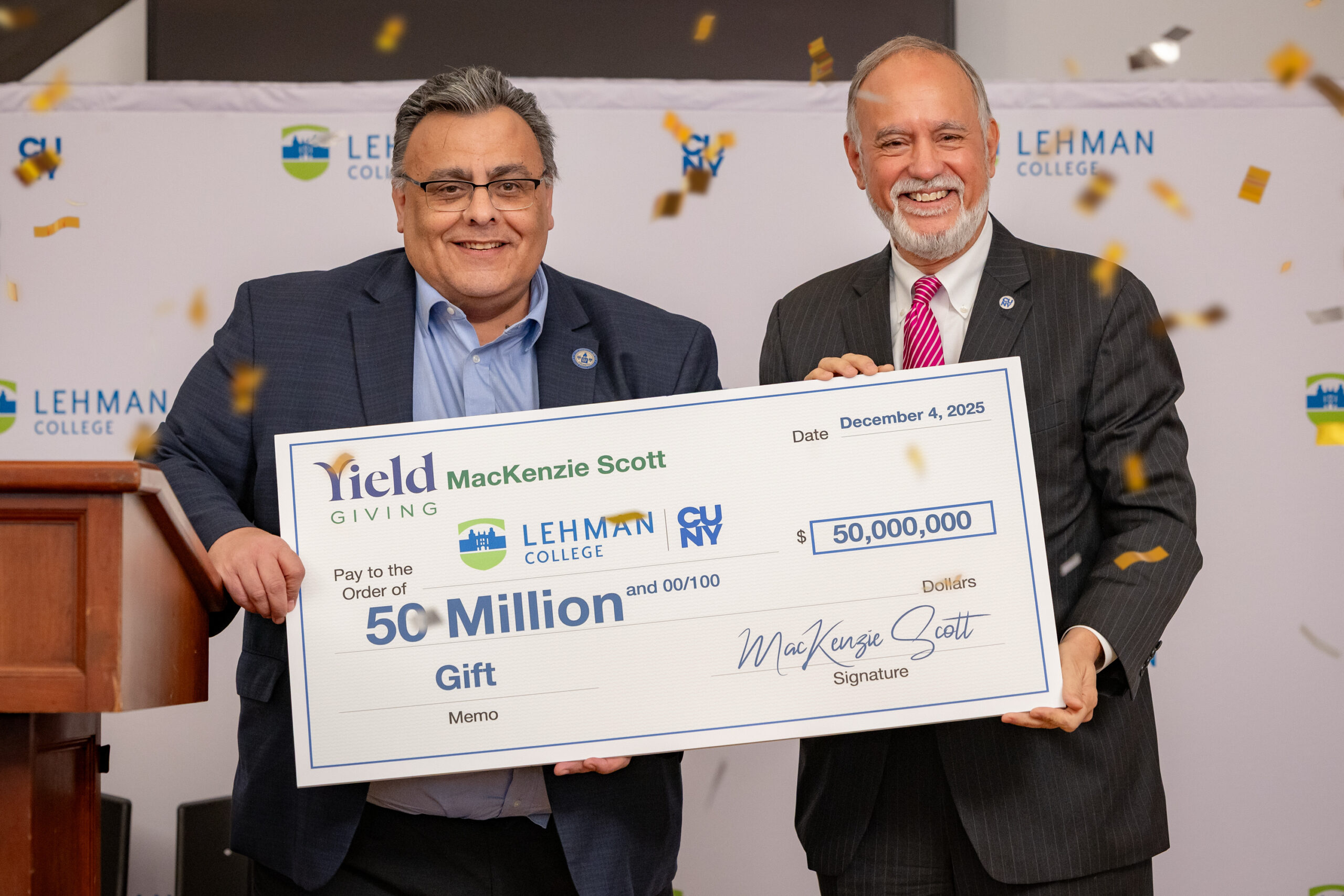
Earlier this month, when Bronx-based Lehman College, part of the City University of New York system, announced that it had received a second gift from Scott for $50 million after receiving $30 million in 2020, college president Fernando Delgado called it an “extraordinary affirmation” of what the college had achieved in the past five years. Those achievements include opening a $95 million nursing building last year to help train students.
“As higher education, in general, works to find its way in an uncertain environment, this gift is a major source of encouragement that we are on the right path,” he said in a news release.
More than half of Lehman’s students come from families that earn less than $30,000 a year. Over all, the college’s students are more than 52 percent Hispanic and over 30 percent Black. The school also has high percentages of first-generation and foreign-born students, according to data provided by the college.
Scott has also given gifts to several Tribal Colleges and Universities such as the College of the Menominee Nation, which recently received a $10 million gift from Scott. And she has donated to various other two- and four-year institutions nationwide.
Scott’s gifts to HBCUs and other minority-serving institutions are life-changing for those institutions, said Rutgers’s Marybeth Gasman. Such sizable awards change their futures and demonstrate a level of trust in their leadership that has not been seen from past funders, she said.
“These students will make an enormous difference in their families and communities for generations to come,” Gasman said. “Scott’s donations will have a ripple effect.”
Climate and Disaster Aid
In Scott’s most recent essay, which was initially published in October and updated this week, she discussed how she draws inspiration from a prophecy written by the Hopi tribe of Native Americans that encourages people to be engaged in the “co-creation of our communities” and expressed a desire to see more people engage in acts of service.
“Votes are not the only way to show what we’d like to see more of in our societies,” she wrote. “There are many ways to influence how we move through the world and where we land.”
Through her giving this year Scott has also prioritized causes like climate research and disaster relief. The Woodwell Climate Research Center announced in October that it had received a $10 million gift from Scott that it would use for its research into climate change solutions. Climate Breakthrough, a global philanthropy intermediary group that provides awards to those working to address climate change, was also among Scott’s grantees this year. It received $20 million that it said will use to select and fund more awardees.
And for the first time, Scott gave big to domestic climate nonprofit work, whereas in previous years she funded more international work, noted Andrea Cristina Mercado of the Climate and Clean Energy Equity Fund. That group was among three U.S.-based climate collaboratives to receive a collective $140 million. The others were the Hive Fund for Climate and Gender Justice and the Solutions Project. The Hive Fund, which received $60 million, was the only member of the three to disclose an individual gift amount.
“She’s driving forward a case for increased philanthropic climate investments in the U.S. at a time when the U.S. is grappling with climate disruption, escalating energy costs, and extreme threats to democracy,” Mercado said.
Scott also donated $60 million to the Center for Disaster Philanthropy, which is helping to shepherd more philanthropy dollars to disaster survivors and affected communities as the Trump administration continues to shrink FEMA funding.
The number of climate-related gifts was notable, as were the gifts to donor collaboratives that pool money from multiple funders like Hispanics in Philanthropy and the Pawanka Fund for Indigenous communities, said Gabrielle Fitzgerald, CEO of Panorama Global, a nonprofit that manages donor collaboratives.
“To me, that’s a strong message to other philanthropists that these are really effective ways to do your giving,” Fitzgerald said.
Health Care
Health care was also a top priority for Scott, who gave large awards to health-related groups. They included the Jed Foundation, which received a $40 million award. The youth suicide prevention nonprofit also received a $15 million gift from Scott in 2022. The Jed Foundation was started by Phillip and Donna Satow after their son died by suicide in 1998. It partners with colleges and universities, school districts, and community-based organizations across the country to offer workshops, training, and other educational resources on mental health and suicide prevention for teens and young adults.
The Jed Foundation had total revenues of about $15 million back in 2021 and had just finished developing a five-year strategy to expand its work to more educational institutions, which staff felt was achievable yet also likely to stretch the organization’s resources, CEO John MacPhee said. That first Scott gift allowed the Jed Foundation to go “more quickly and boldly into what was our existing five-year plan,” according to MacPhee.
The foundation now works with 550 colleges, 150 high schools, and 28 school districts that represent more than 600 schools, he said. And it would like to keep growing so it can reach more students, MacPhee said. The additional $40 million award from Scott will allow the foundation to develop a seven- to eight-year strategy for sustainably scaling up its work at a time when suicide is the second-leading cause of death among young people, he said.
“I really believe in the work that we do,” said MacPhee, “and I also take it as an enormous responsibility to live up to that trust and make sure that we work extremely hard and wisely and have the big and lasting impact that she’s giving us money to achieve.”