September 22, 2013 | Read Time: 6 minutes
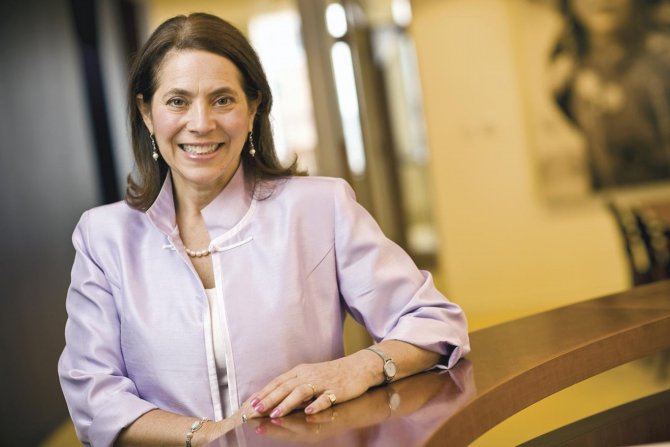
When Lorie Slutsky started working at the New York Community Trust in 1977, men held every executive position there.
“There wasn’t a single woman in a senior job—none,” Ms. Slutsky recalls.
Much has changed since she became president in 1990 at the $2-billion community foundation. Today eight members of her 13 senior staff are women, including the general counsel, chief investment officer, and controller. The board president is also a woman.
While Ms. Slutsky has built an organization that has put more women into jobs that have high levels of responsibility and pay, she is in a relatively rare position in the nonprofit world. For example, of the 118 big nonprofits that provided 2012 data for The Chronicle’s executive-compensation survey, only two women were among the 20 highest paid. They were Ms. Slutsky, who received $762,824 and Donna Shalala, president of the University of Miami, who received $869,520.
A Lack of Urgency
Women are scarce in high-paying, high-responsibility positions in both nonprofit and corporate America. For three years in a row, 14 percent of CEO jobs at Fortune 500 companies have been held by women, according to a survey by Catalyst, a nonprofit that advocates for women executives.
The continuing discrepancy in top jobs and in top pay between men and women at charitable organizations is especially troubling since nonprofit staffs are dominated by women, say charity and foundation leaders.
“I’m deeply disturbed that we haven’t made the kind of progress we should be making,” says Diana Aviv, chief executive of Independent Sector, a membership organization that advocates for nonprofit issues.
Equally worrisome to Ms. Aviv is that compensation parity between men and women is no longer an urgent issue among either male or female leaders of charities.
“I don’t see women talking about it,” says Ms. Aviv, who earned $456,571 in 2011. “It seems that that kind of battle has been left behind in the dust,” she said. Reproductive rights have been discussed more frequently than efforts to “equalize women and men in terms of compensation” and in top executive positions.
A Mentor Gap
Ms. Slutsky says one reason women face so many challenges in the nonprofit world is that most groups don’t have lots of bosses.
“So they don’t offer a lot of chances for upward mobility; there are fewer senior positions to aspire to,” she says. “That means for someone to rise up in the hierarchy, someone else usually has to leave.”
Or the employee leaves, which can be a good thing, Ms. Slutsky says.
When strong female employees leave because of a lack of promotional opportunities, executives should make it clear that the door is open for them to return after they’ve expanded their professional experience.
Ms. Slutsky took the opposite approach, steadily rising through the ranks at the trust.
“I was fortunate to have wonderful mentors here at the trust over the years,” she wrote in an e-mail. “They happened to be men.”
And men are a critical element for women to advance, Ms. Aviv notes. Men in leadership roles need to appoint more women to boards and provide more female managers with exposure to board members.
“The search committees of boards have to be made up of as many women as men,” she says.
‘Accelerating Change’
One organization that has successfully increased the number of women in its leadership ranks is United Way Worldwide, which in 2012 hired Stacey Stewart as president of United Way Worldwide’s U.S. operation.
Ms. Stewart, who earns $335,082, leads a network of 1,200 local United Ways in which 62 percent of chief executives are women. [Editor’s note The previous sentence has been revised to note Ms. Stewart’s salary. A previous version of this story inaccurately said that sum had not been disclosed.]
That’s far above the 19 percent who lead the nation’s Philanthropy 400 charities. With a United Way Worldwide work force that is nearly 80 percent women, the nation’s largest charity is able to fill top jobs largely from within its own ranks. It seeks out aspiring female leaders by offering mentorship programs and leadership education. In addition, the charity’s “women’s leadership councils,” comprising 55,000 women leaders in 143 communities, work to identify and develop local female talent and are focused on recruiting women board members.
The growth in the number of women in top jobs over the past five years was fastest at the largest United Ways, perhaps a sign that soon other big nonprofits will see more female leaders. But the group’s chief executive, Brian Gallagher, says the organization wants to do more to recruit Latina leaders and to make sure women leading smaller United Ways “can make the step up to leading United Ways in major metropolitan areas,” he said in a statement.
“Women leaders are key to accelerating change,” wrote Mr. Gallagher, father to two daughters. “Research shows women are more inclined to advocate for their beliefs, get deeply involved—beyond writing a check—to make a difference, and bring others into the movement.”
Ultimately, though, it may be demographic forces that determine how soon women—who made up 51 percent of the U.S. population and 57.7 percent of the adult American work force in 2012—see equal representation in top jobs at big nonprofits.
As law schools and business schools graduate more women than men, Ms. Aviv says, she hopes that eventually more of the top jobs at the biggest nonprofit institutions will go to women and eliminate the gender gap in pay.
“Is there is a demographic wave that will eviscerate this?” she wonders.
Leading Small Groups
Some female leaders see healthy signs for the future as they review the number of women who now run small groups.
In a study of 95,000 nonprofits released last week by GuideStar, 52 percent of groups with budgets of $500,000 to $1-million were led by female chief executives. The percentages at smaller organizations were even greater: 57 percent of groups with assets under $250,000 had female chief executives.
“The future is very promising,” says Rebecca Rimel, head of the Pew Charitable Trusts, who earned $750,713 in 2012 to run the $5.3-billion charity.
Still, she says, she is frustrated by the small number of women who have been appointed to top roles at the wealthiest nonprofits. “I’d like to see more women who are qualified promoted into the C-suite,” she says.
Nonprofits must do more to provide female employees who have executive potential with opportunities to interact with board members on committee work related to the organization or in mentorship programs. With more networking opportunities, women will be better situated to be considered for the top job when it opens.
“I believe that pipeline is filled up,” Ms. Rimel says.