
Year-End at Direct-Mail Companies Show Paper Isn’t Passé Yet

By Megan O’Neil
Contributor
December 15, 2015 | Read Time: 6 minutes
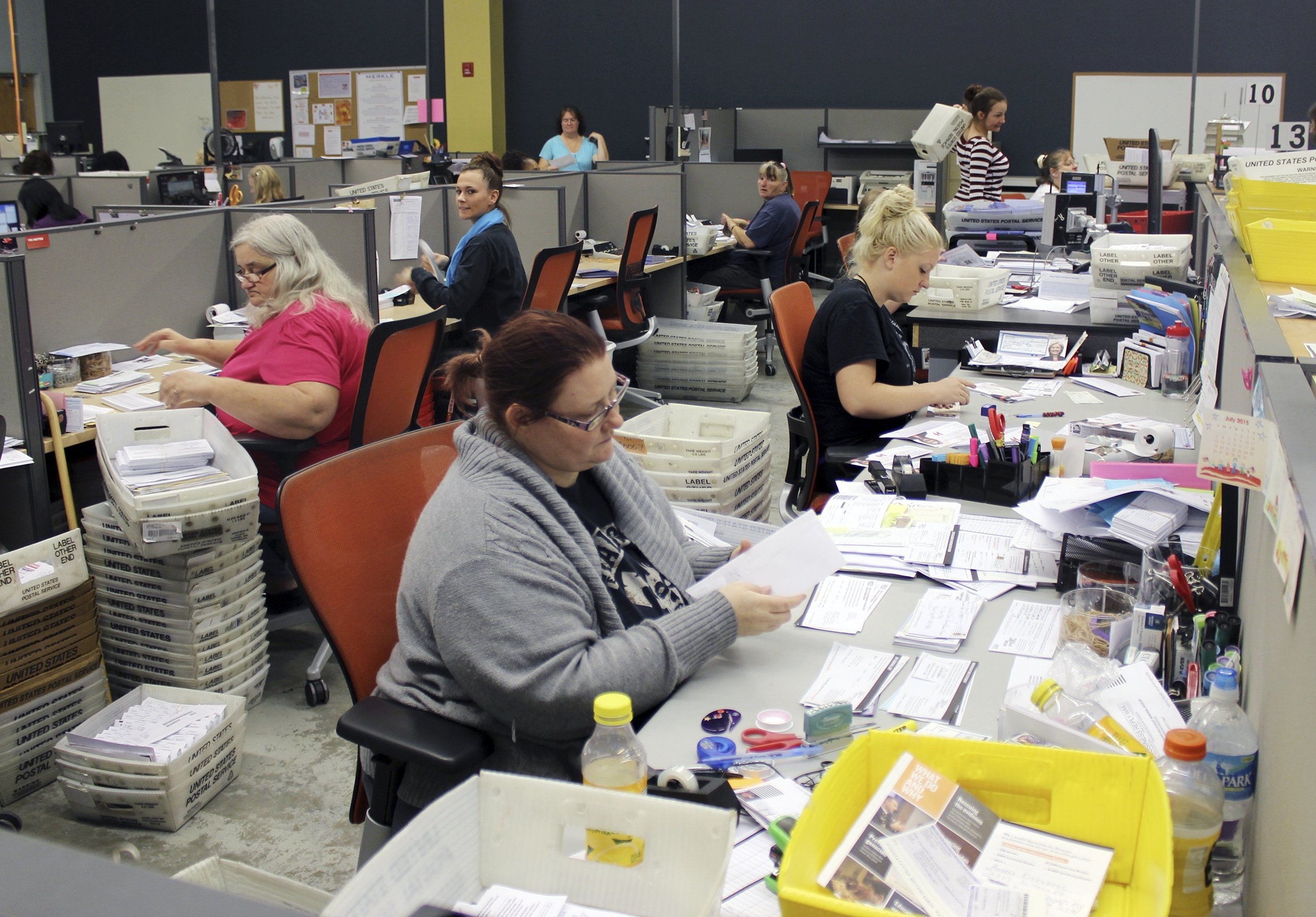
HAGERSTOWN, Md. — The mail begins arriving at 4 a.m. at Merkle Response Management Group’s sprawling 125,000-square-foot facility on the outskirts of this small city.
Piles of envelopes stuffed with checks, cash, and donor credit-card numbers are ferried by company trucks from United States Postal Service distribution centers in Maryland, Pennsylvania, Washington, and West Virginia, right up to the Merkle loading dock.
Workers start rolling in early as well: On this day, all of the 320 parking spots at Merkle are full by 9 a.m. Their job: Take the flood of donation-filled mail arriving from around the country — destined for nearly 200 charities — sort it, and make sure it ends up where it belongs.
It’s go time at direct-mail companies like this. They are a central component of the year-end charitable fundraising machine, although only a small percentage of charity leaders, and even a smaller percentage of the public, ever get a firsthand look at such operations.
“I think there is a perception that this is done at the organization and there is a room full of seniors with letter openers opening each envelope,” says Merkle President Bill Sayre.
At Merkle, much of the processing of direct mail is handled by machine. A mail sorter detects whether sealed envelopes contain checks and separates them accordingly. Other machines slice open envelopes on three sides, or along the top edge only, depending on the size and shape.
One room is dedicated to document scanning, where machines with names like NCR iTRAN capture images of tens of thousands of documents a day. An autopen — a device with a mechanical arm that grips a blue ball-point pen — is programmed to scrawl out “handwritten” thank-you notes for charity CEOs, in penmanship that mimics their own, who don’t have time to do it themselves.
And then there is the warehouse, a riot of T-shirts, hats, wristbands, calendars, books, and fishing rods and reels — known in this business as back-end premiums — to be sent out to people who have made donations.
Paper Is Still King
During the last quarter of the year, this facility processes between 3.2 million and 3.5 million pieces of mail a month, says Mr. Sayre. That’s about 700,000 more pieces of mail monthly than it handles during the rest of the calendar.
Business remains robust, and it’s evidence, he and others say, that for the myriad digital communication channels available to charities and their donors, the paper card and envelope aren’t going anywhere anytime soon.
“Direct mail for our clients is king,” says Jamie Natelson, vice president at Avalon Consulting in Washington.
For most of those clients, contributions by direct mail account for about 80 percent of annual revenue, she says.
“We would love all the millennials to be giving, but most of our donors are 60, 70, 80 years old, and they still respond to the mail,” she says.
While age demographics is the biggest factor in the staying power of direct mail, there are others, year-end-fundraising experts say. Psychology plays a role. Many consumers still enjoy holding colorful holiday cards in their hands.
“Recent research has demonstrated that although the web tends to get more immediate action, donors generally trust what is written on paper more than what appears digitally,” the DMA Nonprofit Federation Advisory Council said in an email to The Chronicle.
Donating remains a hugely personal act, the council said.
“Many people still want to physically write that check,” the council said. “Mail allows them to do that. And while people do move, most do not change their addresses as often as they move their email accounts. More often than not, the mail will find you.”
And as people see fewer and fewer things in their mailbox, receiving personalizes cards has a certain novelty factor, they say — even among people in their 20s and 30s.
Not a ‘Tipping Point’ Yet
That isn’t to say that digital communications aren’t making inroads. They are, Ms. Natelson and other say, but the shift is slow.
In 2014, 73.6 percent of Avalon’s clients’ year-end revenue came from direct mail, down from 79.9 percent in 2010. The percent of year-end donations coming from online, meanwhile, increased from 13.3 percent in 2010 to 19.8 percent in 2014.
“There will be a tipping point,” Ms. Natelson says of direct mail versus online. “We are certainly not there yet.”
Alan Hall, chief executive of nonprofit marketing giant Russ Reid, says that just over 50 percent of the company’s business is direct mail. Headquartered in Pasadena, Calif., it has hundreds of nonprofit clients, including 85 food banks and 80 rescue missions, as well as big national charities like the American Red Cross and Operation Smile.
Testing at Russ Reid shows that the more channels a campaign uses, the more successful the campaign, he says.
“What is really changing is the way email and search and display are being used at year-end,” Mr. Hall says. “What you will see is multiple emails all the way through to year-end to get people to give.”
Still, because charities are soliciting donations via multiple channels, it is hard to pinpoint exactly what moved a donor to give, he says. Someone may have been motivated to make an online donation by one of many emails or by an online ad, he says. Or, maybe that person received a beautiful Christmas card in the mail and then sat down on the couch with a laptop to make an online donation. That question mark makes it hard for charities to know where and how to invest their year-end fundraising dollars.
Moreover, charitable giving channels do not just disappear, says Mr. Hall. He uses the birth of television as an analogy.
“When TV came along, radio didn’t just go away,” he says. “TV was added. Our work continues to get more and more complicated. We end up being in more and more channels. So as mobile becomes more prevalent, it is not like desktop is going to go away.”
Guarding Data
All this means that the mail keeps rolling in at direct mail companies. Merkle, located a mile off the main thoroughfare in Hagerstown, a city of 40,000, has about 175 nonprofit clients. They all do some sort of year-end fundraising campaign, Mr. Sayre says. Merkle, which works on the receiving and premium-processing side, increases the hours of its 550 full- and part-time workers to handle the load.
Checks and credit-card numbers aren’t the only things that arrive in those envelopes. Merkle sees between $30 million and $40 million cash annually. And occasionally, an errant credit card is accidentally dropped into the mail by an elderly donor.
Donor data is almost as important as the gifts, Mr. Sayre says. His machinery and staff capture that information, and it is stored in a database that his nonprofit clients can access.
“Raising the money is absolutely important,” he says, “but getting it back in the hands of organizations so they can use it for their mission is equally important.”






