Year-End Fundraising Is Going Strong, Especially Through Digital Channels

By HEATHER JOSLYN and Eden Stiffman
December 15, 2015 | Read Time: 11 minutes
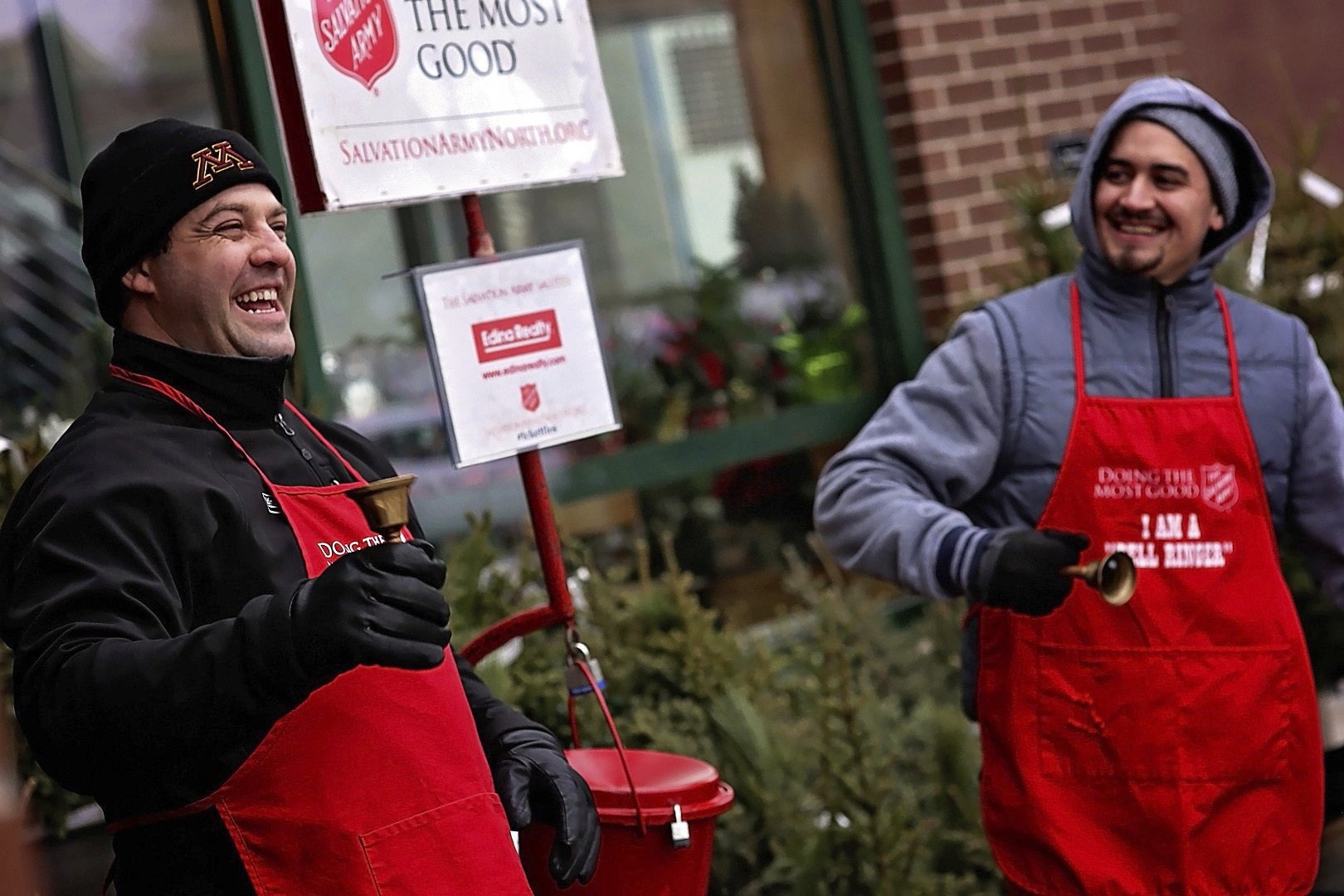
To get a sense of how nonprofit fundraising is going at year’s end, look no further than the charity perhaps most identified with the holiday season: the Salvation Army.
First, the good news. Giving Tuesday was a booming success. The organization raised $784,820 during the philanthropy marathon on December 1, up 28 percent from last year’s event. The charity is planning to build on those gains with a big push planned in the final days of the year, including more digital advertising, says Lt. Col. Ron Busroe, the group’s national spokesman.
“We’ve seen double-digit growth since we really got serious about digital fundraising,” he says.
Throughout the year, digital giving represents around 6 percent of the Salvation Army’s donations, he adds, but “right now we’re looking at about a 25 percent increase in online gifts over last year.”
But the charity’s signature campaign, its Red Kettle drive, is down 15 percent from this point last year, with the Northeast region lagging the most.
Looking ahead to 2016, Colonel Busroe says he worries that election-year giving may “suck up dollars that normally would go to nonprofits.”
And that, in an nutshell, is where year-end giving stands for many American charities: Online giving continues to boom, and charities that have adapted are doing well. But some traditional appeals may be losing momentum, and no one knows for sure what impact the volatile stock market and 2016’s elections will have on philanthropy.
No ‘Donor Fatigue’
For the most part, says Kim Klein, co-founder of Klein & Roth Consulting, the charities she’s spoken with this season are “on par or doing better than last year. The recovery is still happening. People who are doing good fundraising are doing fairly well.”
A common thread among groups that are doing well is that they’re spreading the responsibility for raising support among a wider group of people — board members, volunteers, or staff members who don’t work in the development department. “That’s not a new insight,” she acknowledges, “but I think people have gotten more serious about it.”
Charities that spread out their fundraising efforts more evenly throughout the year, rather than focusing so intensely on the final month, are also succeeding. “I still think December is way too jammed,” she says.
In February, Marts & Lundy, a philanthropy consulting firm, released a report with Indiana University’s Lilly Family School of Philanthropy that predicted a nearly 5 percent rise in giving in 2015 and 2016. Thus far, says Don Fellows, Marts & Lundy’s president, “the trends this year have been all positive.”
“We’re certainly seeing a good increase in million-dollar gifts and above as well, at least reaching last year’s total but most likely the trend suggests that we will surpass last year,” Mr. Fellows says.
But the trends also reveal a continued shift from traditional channels for appealing to donors, he adds: Phone solicitations and direct mail are fading, even as online giving continues to boom.
Karen Osborne, senior strategist at the Osborne Group, a fundraising consultancy, is also hearing good news from charities: “People are raising money. I haven’t heard a lot of donor fatigue. I think it’s going to be a solid end of year.”
But some of those gains could be short-term, she suggests. Development staffs are stretched thin, either because they haven’t hired enough fundraisers or they can’t find the talent to fill jobs. “That has a direct impact on the ability to hold on to those donors, to get the maximum gift from those donors.”
The upshot, she says: Too few fundraisers are tending too many supporters. “People’s portfolios are huge, huge.”
Stories and Impact
Charities seeing growth in their year-end fundraising include groups that work on issues that are currently in the news, such as gun control or aiding refugees, says Steve Daigneault, senior vice president at M+R online fundraising and marketing consultants.
More broadly, he says, charities that are stable and not in a period of transition, either with their online fundraising operations or their staffs, are seeing more success in securing gifts this season.
The American Red Cross has benefited both from its cause being in the news — flooding in Texas and South Carolina, wildfires in the West — and from a robust online giving operation and ad campaign. Thus far, for the fiscal year that began in July, fundraising is up 9 percent compared with the previous year, says Don Herring, the charity’s chief development officer.
“This time of the year, we’re trying to touch as many donors as we can,” he says. “We continue to get better at making donating easier year over year.”
It emphasizes the impact of its work in an ad that’s been running this month, which will continue until the end of 2015. The message focuses on a house fire and its aftermath and the services and support the Red Cross offers to the displaced family.
About 10 percent of the charity’s revenue comes in during the last two weeks of the year. Throughout the season, to generate excitement among employees, he says, “we keep people updated on a daily basis — everyone throughout our organization — what’s our progress around our fundraising goals. More importantly though, every day we share stories about the work in communities so that all our volunteers and employees can relay stories to donors.”
Emphasizing Impact
Such examples matter, says Ms. Osborne, and they illustrate a growing trend. “I see donors putting pressure on us to talk about our impact, and I see more and more organizations really trying,”
What charities “are finally catching on to is the importance of talking about impact, in a mission way, as opposed to just telling one’s story about one person who’s been helped,” she says.
It’s important to shift from storytelling to “telling about societal impact,” she says. “Donors want us to solve problems, not just help one person or one dog.”
Such storytelling combined with broader context has helped World Bicycle Relief raise money this season. The group provides bikes for students, health-care workers, and entrepreneurs in rural and developing countries and trains mechanics to help keep the bicycles running.
Last year, the charity reported more than $13 million in revenue and distributed 53,400 bicycles, a figure it hopes to increase this year to more than 60,000. On Giving Tuesday, it sought to raise $117,000, the cost of 800 bicycles, for its program in Africa. The charity blew past its goal, raising more than $160,000 — enough to purchase 1,087 bikes.
While in past years, the charity’s year-end campaigns have focused on one individual’s story, the rallying call this year is “Palabana: a Community on the Move,” featuring stories of impact from a Zambian community. Through stories, vivid photos, and videos, the group is sharing how giving one individual a bike helps that person’s family and even the whole community.
The charity is in “an attractive position” at this point of the year-end giving season, says Ruth-Anne Renaud, director of global marketing. “We are seeing an increase in the number of donors participating in our campaign so far across every segment,” she adds, including individuals, corporations, and peer-to-peer fundraising. “We find that lift in results so far encouraging as we go into these final few weeks.”
Got a Match?
This season, a group of anonymous donors pledged to provide World Bicycle Relief with up to $1.2 million for a dollar-for-dollar match. Matching gifts seemed to be everywhere on Giving Tuesday, and some groups, including Heifer International and the tiny advocacy group the Sikh Coalition, reported success with them. But when the tactic is mentioned, Mr. Daigneault sighs.
“We’re in a little bit of a match arms race,” he says. “The matches just continue. Every year there are more matches, the type of matches escalate in terms of how many times the person’s gift is matched — two times, three times, sometimes more than that. The thing that’s newer this year is that people are starting to use their matches earlier in the month. Typically groups save their matches for the last week of the year.
“If you have limited match money, that’s where I would use it, in the last week or day,” he says.
Ms. Klein is skeptical of the impact of the widespread use of matching gifts. As a donor on Giving Tuesday, she says, “I got 100 appeals on Giving Tuesday, and I thought it was ridiculous. And the main appeal was, ‘Give today. It’s Giving Tuesday.’ And the second part was, ‘We have a match.’ Well, there’s nothing very exciting about that.”
Matches, she feels, have become a trend that may be cresting: “They tend to work and then everybody uses them. And then they don’t work anymore. Like anything.”
But other trends have more staying power, experts say.
This season, more organizations are rasing money from crowdfunding sites. Aggregating small gifts for a bigger impact, says Ms. Klein, is “very exciting, very democratic,” even as charities continue to grapple with how they build relationships with those donors.
She also points to another trend, giving circles, in which like-minded smaller donors pool their money and together select charities to support. “It’s not new, but it’s really gathering steam,” she says. “People are being very intentional about giving bigger gifts to fewer organizations.”
Going Mobile
Giving Tuesday offered a window into the growing popularity of online giving, particularly the explosive growth of mobile devices.
The online gift processor Blackbaud reported that it took in 52 percent more money from donors than during the 2014 event. Its data revealed that 17 percent of gifts it processed on the day came in from mobile devices, with that rate peaking at 10 p.m. Eastern time, when 42 percent of gifts arrived via smartphones and tablets.
The rates at which website visitors become donors are lower on mobile devices than on desktop computers, says Mr. Daigneault. “But I do think it’s important for organizations to be optimizing their communications for mobile devices.”
Branded search ads — paid ads that bring up a charity’s website when certain terms are searched on — are also gaining in popularity, “Organizations that are running branded search are seeing three to four times return on investment,” he says. “Up to the last week of the year, they could see 10 times return on investment.”
More charities than ever participated on Giving Tuesday, creating a crowded field that drove down “open rates” for email appeals, he notes. “It was not uncommon to see multiple email messages from an organization on Giving Tuesday.”
Regardless, many groups raised more money from the 2015 event than they did last year’s. Traditionally, some charities have struggled with early December fundraising, he says. With the advent of Giving Tuesday, however, “it’s kind of nice that there’s now a reason to give earlier.”
Major and Small Donors
Jewish Voice for Peace did not participate in Giving Tuesday. With a couple of dozen staff members, “we’ve realized that it’s better for us to prepare for a really strong last couple of weeks of the year,” says Ari Wohlfeiler, the advocacy groups development director.
But the group, which relies almost entirely on individual donors for its $2.5 million annual budget, might not need the boost of a 24-hour philanthropy marathon in 2015. Though the last days of the year will deliver the final verdict on the season, the group is doing well, he says. This quarter, the number of donors is up almost 30 percent compared with the final quarter of 2014, and the total number of gifts is up as well.
The issues it works on — including fighting discrimination against Muslims — are in the news, which helps raise its profile. The group’s advocacy and fundraising “complement each other,” Mr. Wohlfeiler says. “People want to give to the organizations that they see doing really specific, timely, strategic work. People want to be active.”
To facilitate that, he says, “We’ve created easy ways to contribute that also have a political impact.”
The nonprofit invested this year in persuading more donors to sign up to give recurring monthly gifts. Its donor pool is split virtually half and half between major donors and smaller ones, and the group’s fundraisers are working both sides of the spectrum hard.
This season, Jewish Voice for Peace is running an intensive major-donor campaign with a 60-person team made up of staff members, volunteers, and every board member reaching out to large contributors for in-person meetings and phone conversations.
But smaller donors are largely courted online. Roughly 50 percent of the dollars and 80 percent of gifts come in that way, says Mr. Wohlfeiler
Email appeals are focused on stories and impact. “It’s a lot about reflecting back to our donor base what they’ve accomplished this year, and it’s also about what we haven’t accomplished this year,” he says. “One challenge we have is to explain what we’re not yet able to do because we don’t yet have the resources.”
Like every fundraiser across the country, Mr. Wohlfeiler must wait until January 1 to know for sure if his organization will get all the resources it needs to fulfill its mission.
As he puts it, “This is the part of the year when you hope that everything you prepared turns out.”
Send an email to Heather Joslyn or Eden Stiffman.