
A Blueprint for Faster Giving: Lessons From My Pop-Up Foundation
A former foundation executive’s grassroots experiment shows what philanthropy can accomplish when it prioritizes urgency and trust over traditional institution‑building.

By Lisa Pilar Cowan
Contributor
February 24, 2026 | Read Time: 5 minutes
I am not a patient person, a trait that posed particular challenges during the years I worked as a grant maker in institutional philanthropy. I felt stymied by the slow pace and lack of coordination as each foundation crafted its own bespoke strategy. Those frustrations were a primary reason I left my position as vice president of the Robert Sterling Clark Foundation in May 2025.
So the last thing I imagined is that I’d be back in philanthropy just five months later. This time, however, the philanthropic space I occupy looks very little like what I left behind. In November, I founded the Haven Fund — what I call a “pop-up foundation” — devoted to supporting local New York City organizations helping undocumented immigrants. This effort has proven surprisingly successful so far and should be instructive for anyone who shares my concerns about how the sector typically operates.
An Eye-Opening Journey
My journey to the Haven Fund started shortly after I left my foundation job. I wanted to find a more direct way to respond to the federal government’s anti-democratic, racist, and cruel policies. I trained to accompany undocumented immigrants to their asylum hearings and ICE check-ins, where I was exposed to a system I knew little about — one that was rapidly changing and becoming scarier by the minute.
The work was among the most painful, confusing, and consuming I’ve ever done. The best possible outcome of any given court appointment was that it could be delayed to another day.
In New York City, where I live, a group of neighborhood-level organizations was doing much of the work to support undocumented immigrants in the five boroughs. The demands on them were growing and threatened to become overwhelming if and when President Trump decided to focus his attention on his old hometown. I wanted to help strengthen these organizations but no longer had access to a foundation endowment.
Walking around my Brooklyn neighborhood I started to wonder what it might look like to create an instant foundation that mirrored the borough’s trendy pop-up restaurants. Could we open for a short time to meet the moment, with minimal staff and infrastructure? Such a structure might offer a faster way to move money and could also build community among participants and with grantees.
I formed an advisory committee and connected with JustFund, a common application platform that simplifies the process of collecting money and making grants. Together we set up the Haven Fund in just a few weeks. We had no physical office and no organizational history. But we did have critical capacity, including advisory board members experienced in the immigration field, my own relationships to a wide community of New Yorkers, and the JustFund platform.
Our goal was straightforward: Raise $1 million to make $50,000 grants to 20 neighborhood-based organizations. As soon as we raised enough money for each grant, we would give it out — no RFPs or grant cycles needed. Once we reached that goal, the Haven Fund would cease operations, so there would be no need to spend resources on institution building.
‘Stone Soup’ Philanthropy
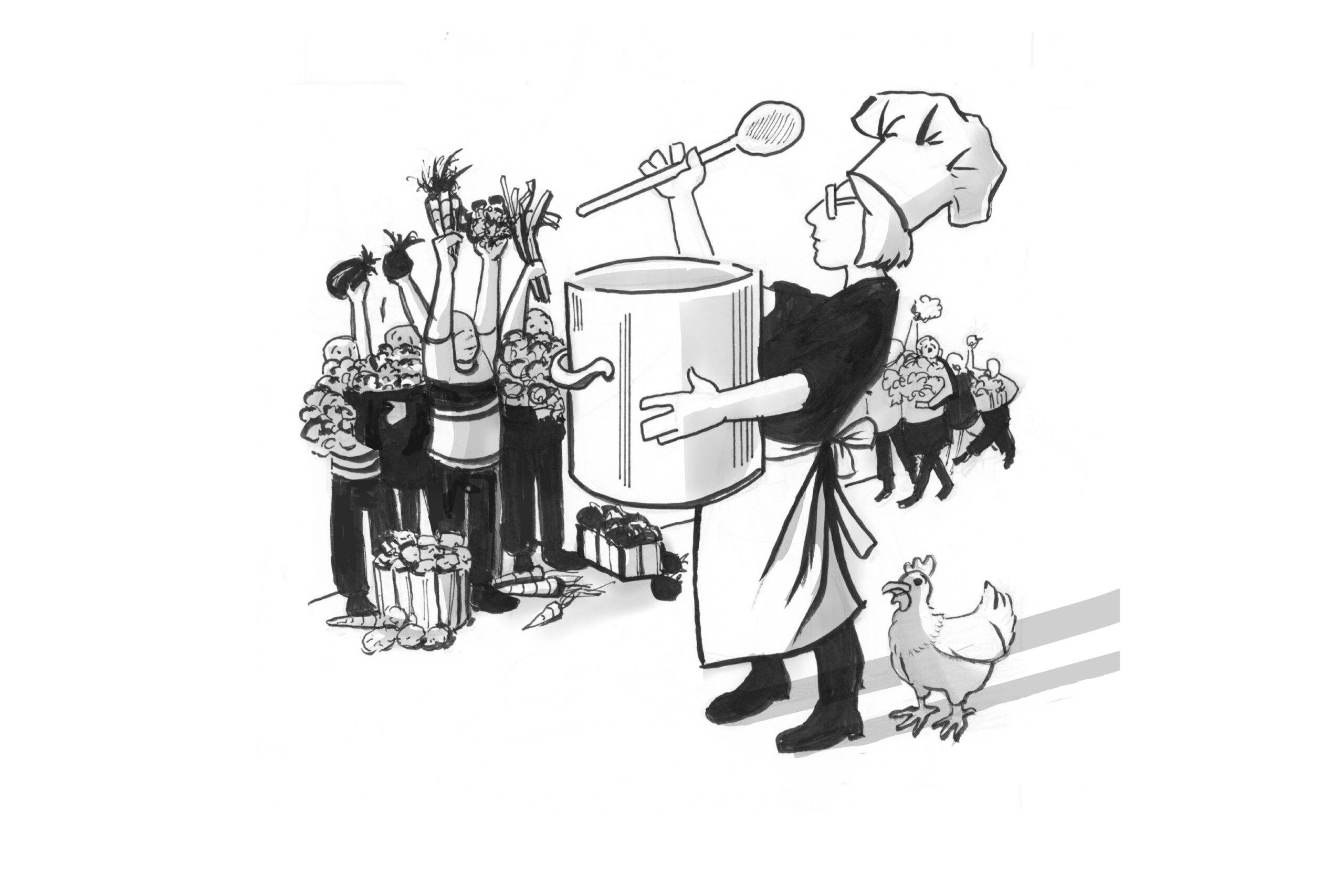
Creating the Haven Fund has reminded me of one of my favorite childhood stories, “Stone Soup,” which tells the tale of a trio of hungry travelers who arrive in a new town and ask the locals for food and shelter. The wary townspeople say they have nothing to offer, so the travelers set up a pot of boiling water in the middle of town and add three rocks to make soup from stones.
Curious townspeople ask what they’re doing, and the travelers tell them they’re making a delicious stone soup. It is absolutely the best, they say, but even better when you add a carrot. One interested townsperson gets a carrot, and then another volunteers an onion. One-by-one they start to offer a potato, salt, celery, even a chicken. In the end there is a delicious stone soup for everyone in the town to share. It is a story of a community coming together, cautiously, to create something that brings joy and sustenance to all of them.
The Haven Fund has followed a similar trajectory. I turned to friends, neighbors, and colleagues — people I knew from every part of my life — and invited them to quickly come together to protect and care for our city and the immigrants who live here. Like the townspeople in “Stone Soup,” many responded by contributing something they already had: knowledge of the immigration sector, a design for a website, a way to track donors, a system to connect to volunteer opportunities, and, of course, dollars. They then invited their friends, neighbors, and co-workers to give as well.
Together we have made something more nutritious and delicious than what we could have accomplished on our own. In less than four months, we have raised nearly $400,000 toward our $1 million goal and have made or are in the process of making seven grants. What started as a simple cauldron of hot water is now enriched by having many creators moving quickly together rather than one slow and exacting head chef.
This approach has its limitations, of course. One small emergency fund cannot begin to address the enormity of government malevolence or counteract the billions of dollars funneled to ICE. Moving money to frontline organizations is only one strategy, along with protest, voting, legislative action, and narrative shift. But for now, our approach — using some of the ingredients of philanthropy and leaving out others — seems to be working. In the months ahead, I’ll report back on our progress.





