
After Helping Haiti at Its Worst, a Need for Economic Development Grows Clearer

By Perry Letson
Contributor
July 11, 2010 | Read Time: 7 minutes
Disaster relief is not what my economic-development organization usually does. But as a nonprofit group that had been working for many years in Haiti, that’s what my colleagues at ACDI/VOCA suddenly had to do when the earthquake struck in January.
Our experience providing disaster aid taught us many valuable lessons, but as we reach the six-month mark since the catastrophe, one thing is clearer than ever. Haiti would be far better off today if even a fraction of the charitable contributions and government aid now flowing in for disaster relief had been devoted to sound development assistance years ago, especially in rural areas.
Even though we lacked certain skills in disaster relief, our presence in Haiti, mostly in the southeast, and our organization’s skills proved useful. Our Haiti experience shows the value of flexible development programs that allow organizations to make quick adjustments and move money and aid workers in ways that meet the greatest needs. What’s more, we discovered worthwhile approaches that were counterintuitive to those used by relief groups. The challenge going forward is to understand the limits of recovery efforts and focus on the future. Our employees still express fatigue and are sensitive to the complaints now surfacing in the news media over the lack of achievements at the six-month point. As one staff member wrote, “If the United States still has people displaced from Hurricane Katrina, what can be expected in such a challenging environment as Haiti?”
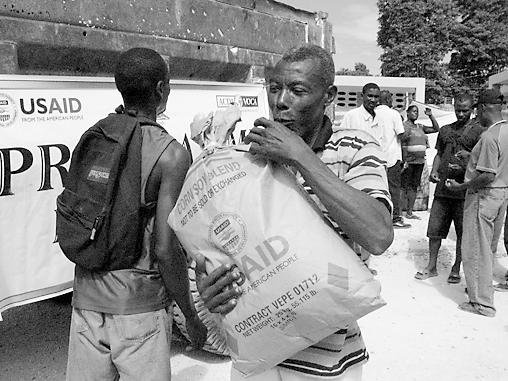
When the earthquake struck, we had 120 staff members in the country; our organization had food and supplies stockpiled for a mother-and-child nutrition program and for the very likelihood that hurricanes would strike. We of course were stirred by compassion and a desperate desire to help, and we are proud that ultimately we managed to feed and provide support to more than 150,000 people, as well as maintain our agricultural-development projects despite some immediate disruptions.
Our work, like that of other organizations, was conducted in an atmosphere of chaos. From the first moments following the quake, when our top official in Haiti, Emmet Murphy, had to abandon his car on the avalanche-prone highway from Jacmel to Port-au-Prince, travel even on that main road was an adventure. Vehicles and fuel were in short supply. Cellphones didn’t work. Banks were closed. Credit cards and ATM’s were useless. We had to fly in cash, which was spent quickly.
Our workers suffered alongside the people they sought to help. Two employees lost their homes, and some lost loved ones. Everyone ached. As Mr. Murphy wrote, “Anyone who hasn’t lived through something like this cannot entirely appreciate how physically, emotionally, and mentally exhausting the last few months have been.”
Disaster response demands distinct skills, and international economic-development organizations like ours could all benefit from a better understanding of how to respond when catastrophe strikes.
Our staff did not have well-honed emergency-management skills. We lacked both the fund-raising capacity and the independent financial resources that would have enabled more robust programs. At times we lacked a proper disaster mind-set. For example, it occurred to us later that we should have requested U.S. Agency for International Development food aid for our health workers who were toiling in remote areas.Of course, we were not the only ones scrambling to help and improvising solutions. Over time, a swarm of well-meaning but in some cases inexperienced aid organizations and individuals descended on Haiti. Some of them were not in sync with the prevailing United Nations system. Their money, disproportionately spent on logistics and otherwise on relatively isolated, random activities, could have been better used by strong groups already working in Haiti.
Even among experienced organizations, overlapping activities and inconsistent approaches posed conflicts. For example, the various organizations that have hired local workers to clear debris and rehabilitate roads seem to be using different pay scales.At times, our organization’s economic-development focus proved useful. Through a USAID contract previously unconnected to Haiti, we conducted analyses to deepen our understanding of two critical markets in the earthquake’s aftermath: construction labor and dried beans.
We looked at employment opportunities in construction and recommended options that took into account supply and demand as well as existing governmental policies.
The other analysis yielded a finding some found counterintuitive because it argued against humanitarian food aid. The issue was whether to distribute as food aid the dried beans that are a Haitian staple. It turned out that achieving the short-term goal of feeding a limited number through donated beans risked disrupting the local bean market and thus the long-term goal of economic recovery.
Our recommendation was to stimulate demand for local beans with cash payments to enable Haitians to buy their own food, and at the same time to provide more farmers with locally multiplied, and therefore better adapted, high-yielding bean seed as well as cash to offset planting costs.
Because of our existing agreement with USAID, we already had close ties to that agency. We also developed ties with the U.S. military and became a dependable contact for aid deliveries by U.S. Navy helicopters into Jacmel. We tried to avoid competition for credit and turf battles and resisted political pressures to feed select groups of quake survivors.
We found ourselves glad that USAID’s planners wisely triggered a special provision in the food-aid program we were running. This features allows a federal project to retool its mission in reaction to sudden emergencies and to channel supplies, food, and staff members to deal with the problem at hand. In Haiti, for example, we immediately redirected resources originally devoted to improving the health of mothers and children and used them to assist anyone who needed help. Such flexibility and coordination must prevail in relief work.
In another example of coordination, Save the Children granted us funds to expand local food production.
A flood of refugees from Port-au-Prince was exacerbating the already dire scarcity of food in the southeast region of the country. Local farmers needed help to step up planting for the new growing season.
Fortunately, ACDI/VOCA had a project under way to establish nurseries, produce seeds, and award small grants to farmers to enable them to buy seed and fertilizer and pay for soil preparation. However, we did not have enough money to cover the entire region until Save the Children stepped in.
Ingenuity was called for at all times.
For instance, we took on food distribution in Tabarre, an area north of Port-au-Prince that had become dangerous. The needs almost overstretched our capacity because we were not used to such large-scale distributions. Tensions among those waiting in the heat erupted in looting, fights, and even gunfire, despite the presence of armed U.N. peacekeepers. We stepped up our security but also got a local deejay to play popular Haitian music, which helped calm the crowd.
Post-earthquake, our organization is taking steps to become better at disaster preparedness and response. But as Haiti moves from relief to recovery, we look forward to returning to our development calling.
We believe substantive progress toward Haiti’s prosperity depends on rural development. Already we see signs of rural resurgence: Market activities have sprung up even in the tent cities where produce is sold, robust new networks of previously unlinked organizations have formed, and resources devoted to loans, worker training, and agriculture are being pumped in to spur development.
The potential for production of food and cash crops is promising, as is the development of fisheries, essential oils, handicrafts, and tourism. Haiti’s rural assets can feed the hungry, lay the groundwork for a more vibrant economy, and insulate against the shock of future disasters.
Our experience in Haiti has reaffirmed our mission—to spur economic development. Where poverty is so pervasive and pernicious, and especially where food is an issue, broad-based rural development is the ticket.





