

November 11, 2014 | Read Time: 10 minutes
New York
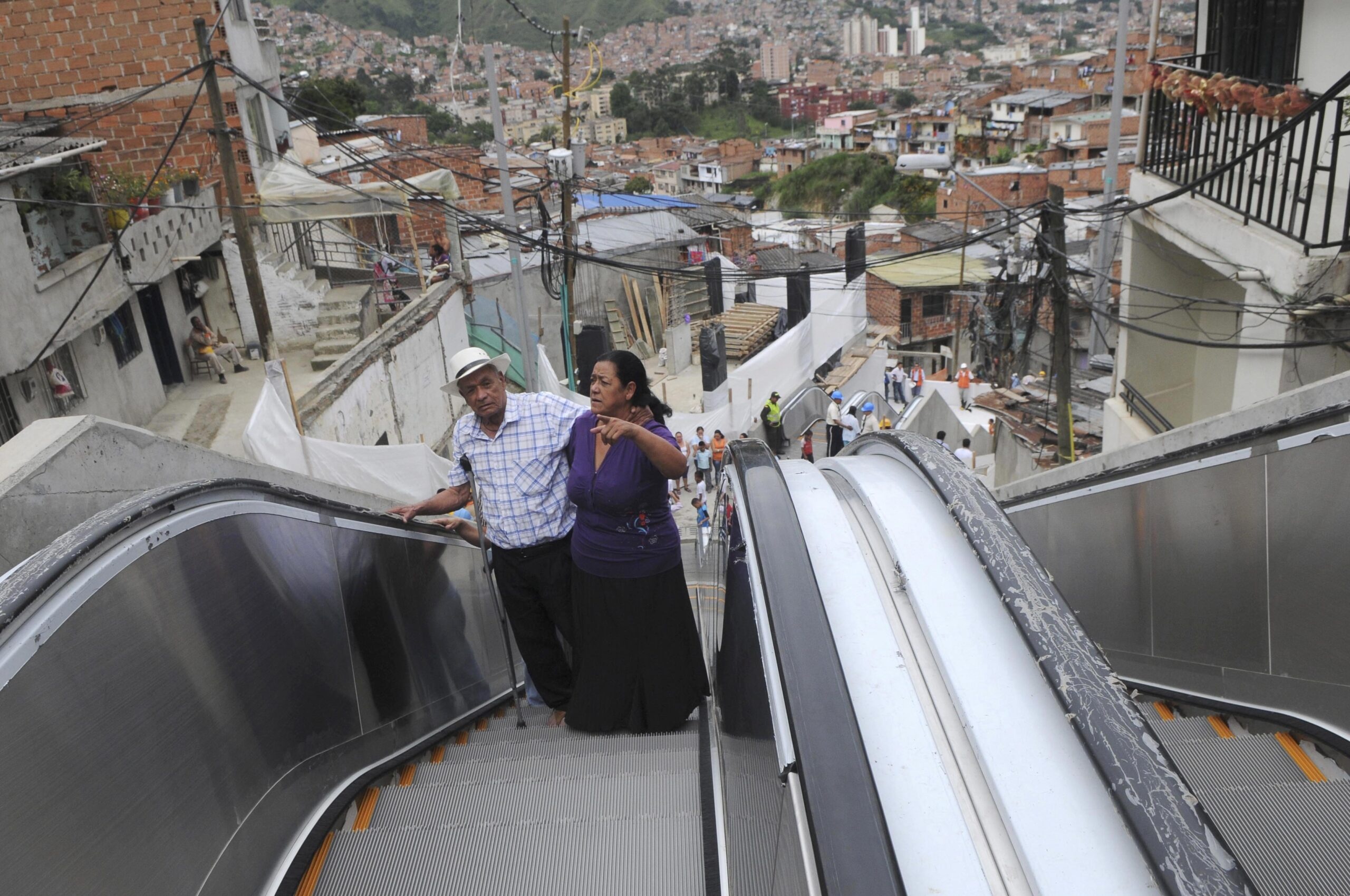
Medellín, Colombia, was buckling under the weight of poverty and a violent drug trade when its civic leaders decided to take action. They installed a towering, 1,200-foot escalator in 2011 to link one of the city’s most troubled hillside barrios with downtown. With this and other innovations, Medellín in time began to bounce back.
The South American city’s gradual brightening from its dark days as a dangerous drug capital is one of Judith Rodin’s favorite examples of resilience in action: a community that confronted a damaging constellation of problems; dreamed up smart, creative solutions; and emerged stronger and better prepared for future pitfalls. Building resilient communities, says Ms. Rodin, president of the Rockefeller Foundation, means “not every disruption has to become a disaster.”
Ms. Rodin believes so strongly in the concept that she has started major grant-making efforts at Rockefeller focused on the idea, spending more than $500-million so far to help communities of all kinds build resilience. And this week she unveiled a new book, The Resilience Dividend: Being Strong in a World Where Things Go Wrong, to get people talking about the topic
The concept, with roots in ecology and psychology, has also taken hold in such diverse fields as engineering, hazard management, and social justice. In philanthropy, Ms. Rodin says, it offers an ideal philosophy to guide communities toward a future in which they are nimble, innovative, close-knit—and prepared for the inevitable upsets.
“We’ve been stuck in 20th-century solutions and 20th-century ways of trying to solve problems,” Ms. Rodin said in an interview at the foundation’s headquarters here. Resilience, she explains, “identifies a 21st-century challenge—that crisis is the new normal—and then frames solutions around that point of view. That’s very different.”
‘The Resilience Dividend’
Medellín and other communities around the world are the focus of Ms. Rodin’s new book, in which she sets forth Rockefeller’s road map for resilience and suggests the approach serve as a compass at a time when natural disasters, economic volatility, and civil unrest are common.
She uses an eclectic mix of examples to illustrate the do’s and don’ts of resilience in a variety of contexts: a successful development of flood protection policies in Tulsa, Okla.; “groupthink” that contributed to the Fukushima nuclear meltdown in Japan; and even a weakness in the supply chain of the clothing company Lululemon Athletica that prompted a minor outrage over translucent yoga pants.
And she explains the resilience “dividend.” That payoff, Ms. Rodin writes, comes when communities become more skillful at managing and preparing for bad times and—because of the changes they’ve made—are able to reap benefits even when times are calm.
The book reflects Ms. Rodin’s scholarly interests as a psychologist and her deep involvement in community work in West Philadelphia during the 1990s and early 2000s, when she was president of the University of Pennsylvania. She says she hopes the book will shape public opinion about the need to engage in the tough work of resilience.
At the foundation’s midtown Manhattan office, a large screen in the reception area flashes colorful stills of communities taking part in 100 Resilient Cities, the foundation’s $100-million global venture to foster resilience in municipalities of all stripes. So far it has sent $36-million of that money to help cities as diverse as Mandalay, Medellín, Norfolk, Porto Alegre, Quito, Oakland, Ramallah. Floor-to-ceiling windows look out over the peaks and canyons of Midtown, not far from areas severely damaged by Hurricane Sandy two years ago—a natural disaster Ms. Rodin invokes frequently when talking about the foundation’s focus on resilience.
A cornerstone of that work, she says, is the strategic use of philanthropic dollars to encourage others to invest, too.
“We don’t have, as grant makers, all the money in the world to solve all the problems we deeply care about,” Ms. Rodin says. “So to use our precious dollars as risk capital, or to leverage other people’s capital—in this case, government and private-sector investment—has become a hallmark of our efforts around resilience building.”
Government Partners
Investment in resilience starts to pay off more quickly than most people realize, Ms. Rodin says. Consider the nation’s energy grid: Investing in technology that provides a more modular, decentralized source of power allows communities to decouple a section of the grid that fails during a crisis.
“If we had had smart grid technology during Sandy, this whole part of lower Manhattan wouldn’t have gone down,” Ms. Rodin says. But it also passes on savings to customers a very short time after the initial investment is made. That, she says, is a resilience dividend.
“We want to demonstrate to government that they get a double bang for their buck—we think a triple bang for their buck—when they make these investments through a resilience lens,” she says.
Indeed, so far the government has been a key partner in Rockefeller’s work.
The Department of Housing and Urban Development’s Rebuild by Design competition began in 2013 in the aftermath of Hurricane Sandy, with Rockefeller committing $3-million as the competition’s lead financial supporter. In June, the agency awarded nearly $1-billion in federal funds to six design teams in the New York region. HUD praised their “inventive” proposals as “a blueprint for how communities can maximize resilience as they rebuild and recover from major disasters.”
The competition went national in September with another billion dollars in federal money. The National Disaster Resilience Competition is open to the 67 cities, counties, and states that were declared federal disasters from 2011 to 2013. Resilience academies and boot camps will feature teachers from Rockefeller, the Federal Emergency Management Agency, and the National Oceanic and Atmospheric Administration, says Ms. Rodin. She deems Rebuild by Design a “quite extraordinary public-private partnership.”
The foundation’s 100 Resilient Cities, meanwhile, takes a global approach. Cities chosen to participate in the challenge receive money to hire a chief resilience officer; help in developing a resilience strategy; and access to government and business aid to carry out the strategy.
When the competition first opened, Rockefeller had 1,000 inquiries and received 400 completed applications. The second round just closed with 330 applications spanning six continents. Ms. Rodin says she was surprised at the range and diversity of applicants, including “those that are flinchingly poor to those that are so highly resourced it surprised us they applied.”
‘A True and Compelling Opportunity’
Governmental organizations that focus their work overseas, like the U.S. Agency for International Development, the Swedish International Development Cooperation Agency, known as Sida, and the World Bank, have also answered Rockefeller’s call. So have companies like Palantir Technologies, a data company, and the global reinsurance company Swiss Re.
The foundation is now working with USAID and Sida in a Global Resilience Partnership aimed at building more resilient communities in three regions: the Sahel, the Horn of Africa, and South Asia. Rockefeller and the two government agencies have each committed $50-million to the effort.
“We picked three really tough places,” Ms. Rodin says. “If development dollars would be spent differently through this kind of resilience-building framework, those regions would be developing the capacity to rebound more effectively.” They would require less humanitarian aid and experience less erosion of dollars with each new crisis, she says.
Government officials’ enthusiasm has surprised Ms. Rodin.
“It’s been nothing short of amazing,” she says. “As grant makers, we don’t always feel this way. Sometimes we feel we’re bumping up against government—you know, banging on the door trying to persuade them of what we know and why we do things the way we do. So this has been a true and compelling opportunity for Rockefeller, and it’s why we’re doubling down on it.”
The foundation’s assertive branding of its resilience work has not gone unnoticed.
One nonprofit leader, who asked not to be named, applauds Rockefeller’s investment but suggests that the foundation’s parameters for what defines a resilient community may not provide a strong enough emphasis on social justice or on the link between natural systems and built ones. And Rockefeller’s creation of the chief-resilience-officer positions, the leader says, has caused tension and inefficiency in some cities that are eager for Rockefeller’s financial support—but already have sustainability directors who perform many of the same tasks as the ones Rockefeller supports.
‘A New Way of Thinking’
At the three-year-old JPB Foundation, Dana Bourland says resilience has been a theme in shaping the organization’s environmental grant making, which she oversees. Putting resilience at the forefront, she says, underscores how connected many issues are and shapes how the foundation encourages collaboration.
“This isn’t just about making grants to improve energy efficiency in the affordable-housing sector,” she says by way of example. “It’s using the opportunity to make energy efficiency a way of enabling community resilience.”
Reimagining community development in this way is “a new way of thinking and therefore a new way of doing business,” Ms. Bourland says. “Consequently, there will be new sources of capital and revenue that we haven’t identified yet.”
Still, a shared challenge for Rockefeller and other grant makers may be how to determine whether their resilience efforts make a difference. The approach is often more complex than promoting one change in behavior and requires coordination among government, business, and nonprofits.
Ms. Rodin says she sees Rockefeller’s role as extending beyond that of a grant maker.
“We’re really, we hope, mobilizing a revolution,” she says. In Medellín, the resilience revolution is still unfolding. But Ms. Rodin recalls a notable development when she visited. Along the corridors of the city’s now-famous escalators, vibrant street art had emerged, a colorful byproduct, she thinks, of the city’s investments.
What is Resilience?
Resilience has its roots in 1970s ecological research. Scientists noticed that after healthy ecosystems experienced disruptions like fires or storms, they reorganized to produce the same basic functions as before. If the systems were unhealthy, they would not. The researchers concluded that people managing social systems could learn valuable lessons from nature.
Today, resilience is a popular concept in many fields beyond ecology, including psychology, engineering, and hazard management. It generally refers to the capacity of any system—in nature, a community, or an organization—to rebound after a shock and grow stronger from that damaging experience.
In her new book The Resilience Dividend: Being Strong in a World Where Things Go Wrong, Judith Rodin, president of the Rockefeller Foundation, contends that communities must become more resilient if they are to navigate the 21st-century disruptions of urbanization, climate change, and globalization.
She lays out five characteristics of resilience that communities and organizations should consider:
- Know your strengths, assets, liabilities, and vulnerabilities and be willing to assess frequently and take in new information.
- Cultivate a diverse range of ideas, information, technical elements, or people.
- Make collaboration and coordination a key part of your system; without this, too many moving parts can result in chaos.
- Find ways to “fail safely” and prevent one disruption from setting off a chain reaction.
- Adapt and be flexible in adjusting to changing circumstances.
“We need to make sure that it isn’t only and always a crisis that leads us to act,” Ms. Rodin says. “That’s way too expensive both in financial resources and in lives and lost livelihoods.”





