
Grant Makers Need a New Approach to Reversing Inequities in America’s Cities

By Rip Rapson
Contributor
April 7, 2016 | Read Time: 7 minutes
Many of America’s cities are enjoying a renaissance after decades of losing residents, jobs, and investments to the suburbs. Yet these places are also home to some of the nation’s greatest racial and economic inequities, where gaps between the top and bottom rung of the economic ladder are widening and low-income communities — especially people of color — face stagnant wages, disproportionately high unemployment, and the looming threat of being priced out of the neighborhoods that they and their families have called home for generations.
For a nation whose majority population will soon be people of color, these inequities loom large over the future prosperity of cities and their surrounding metropolitan regions — and pose a major challenge for philanthropy to tackle.
In our own grant making, Kresge and Surdna have stepped up our focus on cities by working with local nonprofits, businesses, and city governments to promote the creation of quality jobs with decent wages, benefits, and career ladders. That includes both generating new jobs and improving the quality of existing low-wage jobs. We are providing better access to capital and training for local businesses, particularly those owned by minorities, women, and others who have not had as many opportunities as others. We’re also investing in worker co-ops and other efforts that build the power of workers and amp up their ability to shape their futures.
These approaches are united by a broad vision: the idea that everybody in a city, regardless of economic class or race or educational status, must have opportunities to reach their potential. Otherwise, we know that local economies won’t flourish.
In our work, we have embraced three tenets for philanthropic investment that are central to the All-In Cities, an agenda produced by the nonprofit PolicyLink and funded by a host of national and regional foundations that will promote inclusion and equitable growth in cities.
As other foundations consider helping cities, it’s useful for them to focus on these ideas. Philanthropy should:
- Support and work directly with advocates and city governments to develop and institutionalize policies that will promote economic inclusion. These include measures to improve job-quality standards (such as higher minimum wages and benefits like paid sick days), advocate for workers’ rights, and increase the participation of minority- and women-owned businesses in contracting.
- Collaborate with local businesses to increase their accountability for creating good new jobs and career-track opportunities, raising pay for existing low-wage jobs, and expanding access to capital for groups of people who historically struggle to get loans and other financial tools.
- Pay for projects that address head-on the financial insecurity facing low-income people and people of color. This includes, for example, providing low-cost financial services, promoting efforts to build wealth and assets, and strengthening cradle-to-career pipelines for young people of color and those from low-income families.
These kinds of activities have required our foundations to stretch our boundaries as we have forged partnerships with city governments and local and regional businesses that we might not have considered just a decade ago. But this approach is yielding dividends that have fortified our commitment.
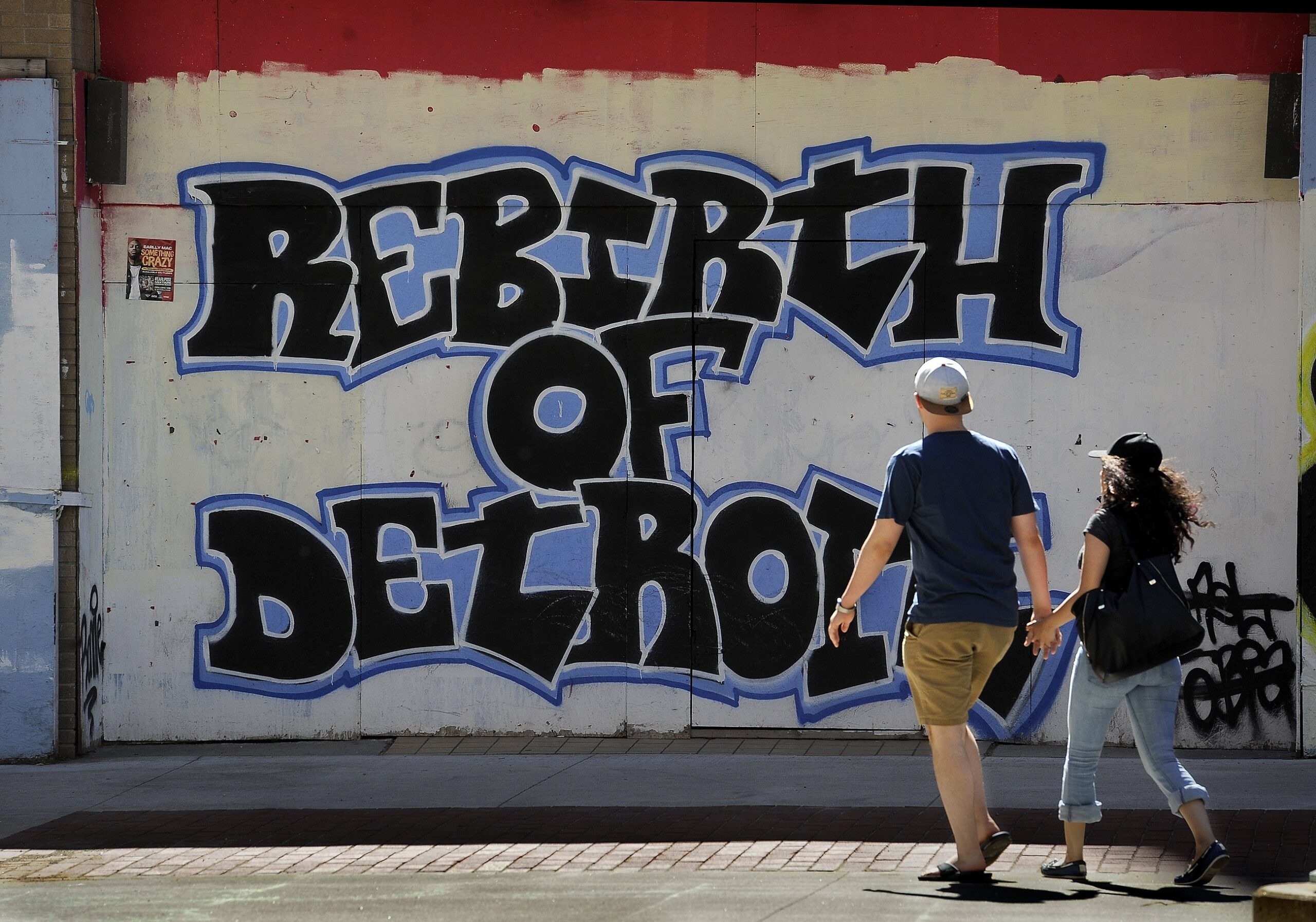
Take Kresge’s work in our hometown of Detroit, for example. Though we traditionally keep ourselves apart from the vacillations of politics and capital markets, the Great Recession and the city’s subsequent municipal bankruptcy forced Kresge to re-evaluate our neutral stance.
Alongside a number of other foundations, we have worked closely with all levels of government and with a wide spectrum of business partners to invest in critical civic infrastructure and the local economy. We contributed $100 million to the “Grand Bargain,” an $850 million fund that became key to the city’s early emergence from bankruptcy. We joined with nine other foundations to create the New Economy Initiative, a fund to promote entrepreneurship and business growth. We launched the $30 million Woodward Corridor Investment Fund, which blends philanthropic and for-profit capital to jump-start residential and commercial investment along Detroit’s signature avenue.
These investments, though in their early stages, are already seeing results. The first project of the Woodward Corridor Investment Fund, Regis Houze, provided 58 new work-force and lower-income apartments, two retail spaces, and 17 new jobs. The 187 grants made through the New Economy Initiative from 2008 to 2014 have generated 1,338 new companies, added 13,204 new jobs, and extended entrepreneurial services to 139,862 individuals. Of the nearly $13 million in grants awarded in 2014, 46 percent have supported women, immigrants, people of color, and others who often lack access to the capital needed to start new businesses.
At Surdna, we realized several years ago that we needed to do more to promote equitable economic development. For far too long, economic development has paid lip service to the people who live in the places business and philanthropy seek to revitalize: Like passengers in a car, they are invited along for the ride when they should be in the driver’s seat.
Therefore, we have doubled down on locally based approaches that give residents a prominent voice in all decisions and that promote racial and economic inclusion.
For example, we are funding community-development financial institutions to increase access to capital for groups historically underrepresented in business, such as the Minneapolis Metropolitan Economic Development Association, which has increased small-business lending in the city by more than 200 percent in the past three years. It has also created or retained nearly 8,000 jobs, half of which are held by people of color. Through grants for grass-roots organizing, we are building community power through efforts like the National Domestic Worker’s Alliance campaign to improve the wages, benefits, and protections for the 2 million workers who care for families, the elderly, and people with disabilities.
We are also helping organizations redirect city and state policy incentives to promote growth in neighborhoods that have not traditionally received private or government investment.
As an example, in Pittsburgh we have supported Urban Innovation21 to shift economic subsidies and direct new business development to the Homewood and the Hill districts — two economically distressed African-American neighborhoods that had not previously been connected to the city’s economic transformation. Urban Innovation21 has provided training to nearly 400 locally owned businesses — $300,000 in grant support to a select group of them — and has helped them leverage approximately $400,000 in additional capital.
Now more than ever, the traditional approaches to economic development are simply not working for cities: They exacerbate inequality and stifle growth, leaving the talent and potential of low-income residents untapped and the inequities of the market unchecked. But making progress on these issues will demand that foundations be patient, ready to innovate, and realistic in their understanding of the complexity of these issues.
This means acknowledging that any single approach will be limited in its impact and may take years to take effect. And it also means that philanthropy shouldn’t shy away from talking about failures; we should approach them just as we would our successes, with humility, curiosity, and a willingness to adapt.
For example, worker-owned cooperatives are one of the most promising ways to create quality jobs and a more democratic workplace, but success — if it comes — takes years and may curb only one aspect of inequality. The potential for some co-ops to fail should not be viewed as a deal breaker but instead as an opportunity to refine our approach and share what we have learned. America’s metropolitan regions are at the heart of the nation’s future. Philanthropy must assume a significant role in strategically supporting cities and their surrounding regions as they tackle inequalities that many grant makers have battled for decades.
Indeed it will be nearly impossible for many of us to continue to meet the demands of our missions — whether within social justice, racial equity, cultural preservation, environmental sustainability, or many other realms — unless we pick up the charge of equitable urban development. It’s time for more foundations to focus on this challenge.
Phillip Henderson is president of the Surdna Foundation. Rip Rapson leads the Kresge Foundation.





