
Grant Makers Need to Help America Find New Ways to Put People Back to Work

By Michael Likosky
Contributor
November 3, 2013 | Read Time: 5 minutes
America’s failure to get past the financial crisis and achieve the high rates of economic growth needed to put citizens back to work presents an opportunity for foundations to step up and play a key role in finding remedies.
To do that, foundations may need to think differently about some of their projects so that they focus on achieving a financial impact rather than a social one. If properly done, the focus on finances will lead to much-needed social change. And nowhere is the potential for financial impact greater than in the realm of our nation’s infrastructure.
Building infrastructure has always been the largest driver of economic growth.
Investing in our ports, our freight-rail system, renewable and traditional energy sources, and other basic infrastructure needs has always created jobs. And building state-of-the-art communications and transportation networks, along with improving access to water and energy, has long been a pathway to raising productivity and thus stimulating the economy at large.
Today, unfortunately, we do not invest anywhere near an adequate amount in our infrastructure. Because the year-in, year-out budget crises of most cities and states make it politically difficult for them to make the large-scale investments that we need, the traditional public-financing model has become problematic. Taxpayers simply do not want to pay for a power-grid upgrade, for instance—even if the long-term cost of sticking with an energy-wasting grid is greater than the one-time cost of the improvements.
Absent large-scale public spending, we need to get more creative in how we finance our infrastructure projects. And this is where foundations can lead the way—in serving as incubators of new ideas for financing and spreading the word about what works.
In particular, foundations need to promote ideas that bring together global investors such as pension funds, insurance companies, sovereign wealth, and banks to provide investment capital to finance long-term infrastructure projects. These investors are particularly motivated to support such development because they expect the United States to grow quickly and for a long period of time, so they are keen to invest in our country’s future en masse. They often collaborate with construction firms and get investments from federal, state, and local governments.
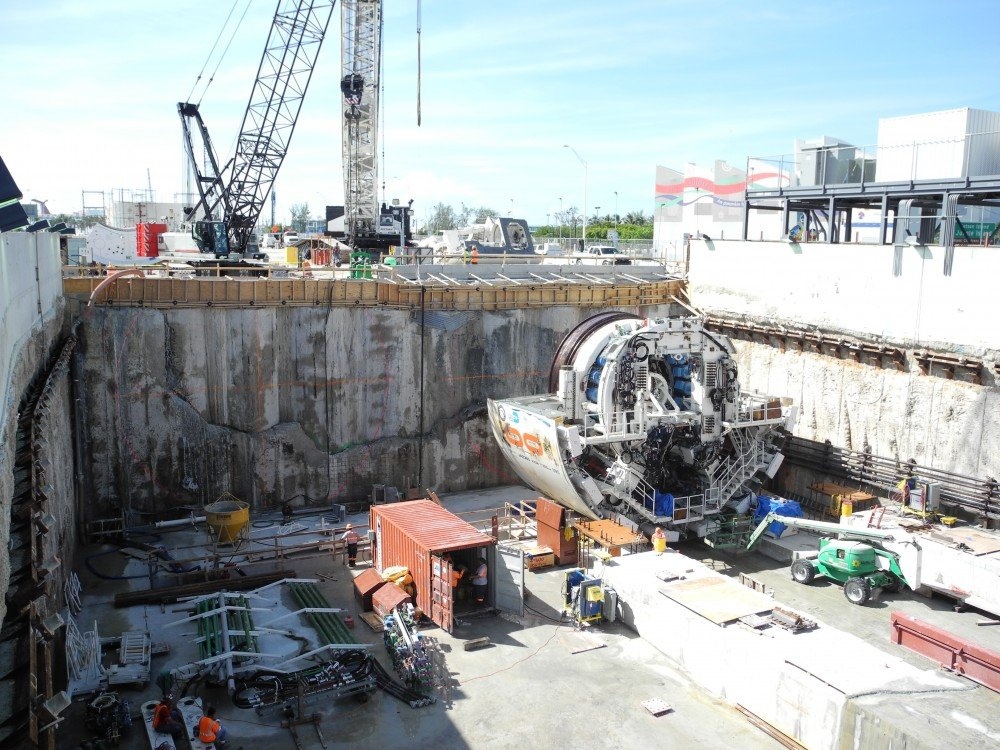
The Port of Miami Tunnel is perhaps the best current example of a successful collaborative venture. The project was financed by federal, state, and local governments, as well as large amounts of private money.
When completed, the tunnel will allow trucks carrying goods to and from container ships in the harbor to bypass the downtown area, no longer snarling traffic and polluting business and residential neighborhoods. Importantly, the tunnel project also includes plans for widening the port so that the next generation of much larger ships will be able to unload their goods in Miami. President Obama spoke recently at the tunnel construction site and said that public-private deals like the tunnel represented the way forward.
Foundations and nonprofits have played an important role in the public-private partnership that has made the Port of Miami Tunnel possible. Part of the tunnel project involves hooking the flow of goods from the port into a freight-rail network. The federal program that provides money for use of this freight-rail solution was the product in part of nonprofits financed by foundations.
While infrastructure investment projects of this sort are mostly the domain of business and government, foundations can make a big difference in understanding how private companies and state and local officials can work together on projects that promote growth. Grant makers can promote educational efforts and finance advocacy groups and other coalitions to help bring about cooperation among businesses and governments. And they can create and support nonprofits that lead the way in helping communities think about and plan for fulfilling their infrastructure needs.
Grant makers can also:
n Help confront the uneven ability of states to draw infrastructure investors into their economies. And since not all industries and municipalities welcome investors from outside their typical domain, foundations can help inexperienced governments and companies learn from others.
n Pay to train government officials and business representatives to develop meaningful ways to work together on infrastructure projects. Businesses cannot do this on their own. Financial and construction firms, for example, are very different and often don’t know how to work each other—but foundations can help them learn. For instance, grant makers could finance boot camps run by an independent expert to show industry and government leaders what they need to know. They could also sponsor the creation of easy-to-read guides that distill what works in government-business partnerships to spell out the benefits, risks, and potential results of a deal.
n Play a vital role in educating citizens, policy makers, and others about the way business can reduce the cost of infrastructure for governments—allowing them to spend more money on things like health and human services. Foundations can draw together allies who might not realize they have much in common in pushing for infrastructure investment: leaders of social-service nonprofits, groups that want to reduce taxes, and those that want to build jobs all have reason to push the idea that government and business should be working together to finance everything from new, energy-efficient transportation systems to water systems. Foundations are better suited than any other entity in society for pulling all these disparate players together, being neither commercial nor political.
The big challenge, of course, in building more infrastructure is paying for it.
Foundations could make sure policy makers know more about the financial institutions that have proven successful in guaranteeing adequate infrastructure investment. For example, infrastructure banks are used in every developed country in the world except America to finance projects that bring together government and business. President Obama has made an infrastructure bank a priority and has included it as part of his budget each year of his presidency, but Congress has never passed it. He has done this because, for little money, a bank can promote transformative change.
It’s time to make putting Americans back to work a priority, and foundations need to be at the start of that call.
Michael Likosky is a senior fellow at the Century Foundation.





