

April 4, 2010 | Read Time: 8 minutes
During these tight times, when nonprofit groups are leaning on supporters more than ever, charities are finding that they can weather the difficult economy by treating donors less like bankers and more like generous family members.
The key to a closer relationship is asking them for their opinions and showing them how their gifts are used, fund raisers say. Because supporters want to make a difference, one of the most genuine and effective ways to show appreciation is to invite them to make suggestions and to listen hard to what they have to say, says Betsy Moon, development associate at the American Civil Liberties Union of Texas, in Austin.
“We ask our donors to give us advice in areas we know they are interested in or have some special expertise. It makes them feel valued, especially when we are able to use their suggestions, which is often.”
For example, she says, “we changed a mail campaign, before it went out, based on feedback from a donor we had asked for marketing advice. We were going to tell Texans that they should look at the generous amounts ACLU members in other states were giving. ‘In Texas, you don’t do that,’ he said, and he was right.”
Katya Andresen, chief operating officer of Network for Good, in Bethesda, Md., which processes about $400,000 in daily donations to nonprofit groups nationwide, says charities have little choice but to reach out to donors in ways that go far beyond sending a receipt for their gifts. “Today’s supporters increasingly expect engagement that makes them seen, heard, and involved, both online and off.”
Donors Notice
Donors are noticing this new level of appreciation, says Sandy Rees, a fund-raising consultant in Loudon, Tenn. “For those organizations that have never done a good job of thanking donors, the gap is now glaring.”
Paying more attention to giving thanks can pay off for charities, even in tough times. When Betty Nelson became director of development at the Lindsborg Community Hospital, in Kansas, two years ago, the hospital was using computer-generated thank-you letters. She added a few handwritten lines to each letter. Last fall she handwrote 400 notes to the hospital’s donors. Ms. Nelson estimates that 25 percent of the donors in that campaign doubled their gifts.
No matter how tempting it may be to save money by trimming thank-you responses, it is rarely a good move, advises Mal Warwick, a fund-raising consultant in Berkeley, Calif.
Instead, organizations can prune their mailing lists and give far more generous attention and appreciation to their most loyal donors. Instead of spending $1 or $2 per name to give attention to a list of 20,000 occasional donors, consider spending from $3 to $5 in more personal communication to the 3,000 or 4,000 donors the charity can always bank on, Mr. Warwick says.
More thanking means more work in a time when many organizations have reduced the size of their staffs. But thank-you calls from board members and from employees who carry out the charity’s mission can be more effective than routine calls from development staff members alone.
Once a year, St. Mary’s Food Bank Alliance, in Phoenix, holds a “thankathon,” which draws the charity’s board members, senior managers, and fund raisers together to spend two hours calling donors.
“We want individual donors to know that we notice them, and we want them to understand that their donation is making a very real difference in the community,” says Beverly Damore, St. Mary’s chief communications officer.
“We have many people who have been giving in the $20-a-month range for a long time,” she says. “They discount the impact of their contribution until we tell them that each dollar provides food for seven meals, which adds up to a lot of people they are personally feeding each month. I have had people cry on the phone when I tell them about the people they are helping.”
A Personal Touch
At CareConnect of Boulder, Colo., which provides services to older adults and disabled people, donors get personal calls from board and staff members following major fund-raising events, says Maureen Ewing, the group’s executive director. They are thanked for attending and asked for their suggestions for future events.
Ms. Ewing said the charity is careful not to ask for money at every turn: “The donor needs to be part of something and not just giving and giving.”
Some older clients who receive help from the organization also write thank-you notes to the donors. “Seeing handwriting on an envelope that is a little squiggly may have more impact.” Ms. Ewing adds.
Mary Ann Wilner, a donor, said she was surprised to receive a New Year’s card from CareConnect and was touched that it was handwritten by an older client.
“It was a sweet, authentic note about what receiving grocery service means to her, and it engaged me,” says Ms. Wilner, who plans to increase her giving by 20 percent this year.
Seeing Results
In an era when Americans are losing faith in many institutions, charity supporters want more information than ever before.
“Donors want accountability along with their thank you,” says Lilya Wagner, of the Fund Raising School at the Center on Philanthropy at Indiana University, in Indianapolis. “They want to know what their money did.”
Even small donors want confirmation that their money is being used wisely, she said. They may already be looking for results through GuideStar or one of the other nonprofit watchdog Web sites.
Ms. Wagner advises that the thank-you note should include specific and truthful information such as: “Your $100 donation is feeding a child in Africa for three months.”
The Grey Muzzle Organization, a Raleigh, N.C., charity that helps homeless older dogs, makes thank-you cards by hand featuring stories of dogs it has saved.
Pumper, for example, is a kindly looking old Dalmatian, whose photo and story are often featured. He was flea-ravaged when he came to a local shelter as a stray. A grant from Grey Muzzle paid to get him care and into a new home.
“Our donors are older-dog lovers, and they appreciate getting a photo of an old gray face with lots of character,” says Julie Nowicki, president of Grey Muzzle.
Ms. Nowicki replies herself to people who send in contributions. With many checks come stories about the donors’ former dogs.
She credits the thank-you cards with helping to increase giving: Donations doubled during the 2009 holiday season, compared to the previous year.
Online Appreciation
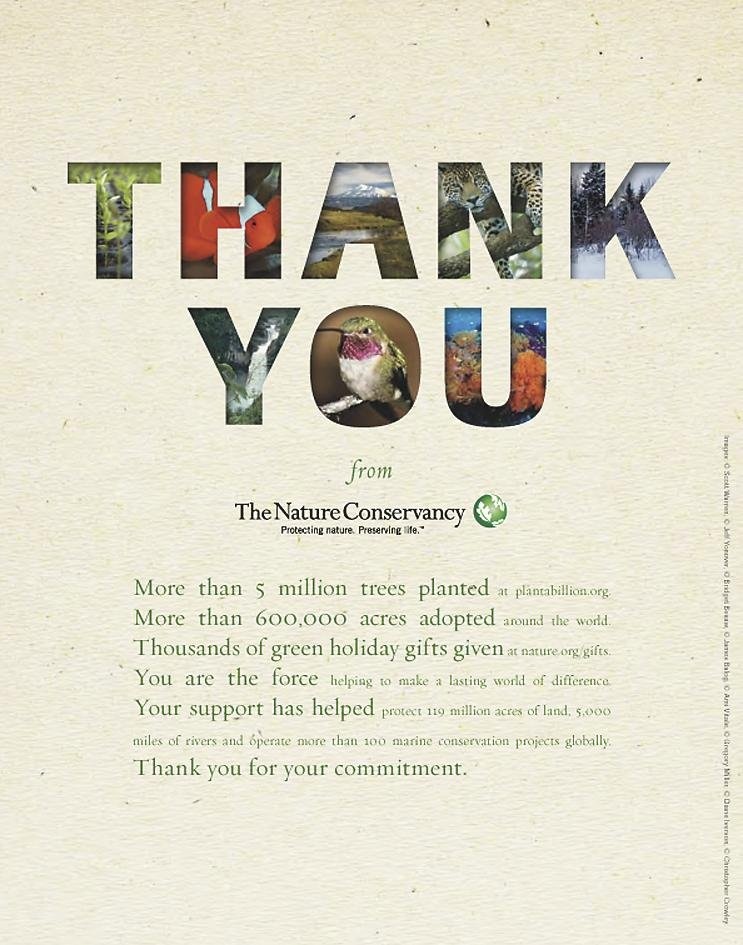
The Nature Conservancy is taking a new approach to thanking its online donors.
“Anytime we send out an e-mail, we point out first what donors did to help us,” says Sue Citro, director of digital membership.
“When giving a report from an international water conference last year, instead of reporting, ‘Here is something our scientists did,’ we began with, ‘In Stockholm, our scientists are praising you for your support of the Conservancy’s work,’” she says. “We have changed the way we report our successes.”
The thanking culture at the charity has also changed how the organization uses e-mail, she says: “We always found that hard asks for money by e-mail didn’t work well for us.”
The charity stopped asking and started thanking. From July to December 2009, Web revenues grew 52 percent over the previous year.
Ms. Citro says, “Thanking is now part of everyone’s job in the digital division.”
Giving Presents
Treating donors more like family may even involve buying them a book they might like.
Last October Kate Grant, executive director of the Fistula Foundation, and her governing board members purchased 350 copies of Half the Sky, by Nicholas Kristof and Sheryl WuDunn, as a thank-you for top donors.
The Santa Clara, Calif., charity provides surgical services to women in poor and remote regions of the world who have torn internal tissues resulting from childbirth or rape. The book lays out the problem and makes the case for the group’s mission.
With the book came a personal note from Ms. Grant: “I hope you will find the book as moving and engaging as I did.”
When she communicates with donors, she says, she purposely uses “I” instead of “we.”
“If you say, ‘We thank you,’ it takes away some of the emotion,” she says.
Donations grew 50 percent at her charity in the first three months of the year, and Ms. Grant believes her group’s new emphasis on thanking donors more personally was a key reason for the growth.
“You need to be talking as you would to a friend,” says Ms. Grant. “That is the relationship you are trying to create.”
Tips for Thanking Donors Effectively
- Ask donors for advice—it makes them feel involved and valued.
- Focus on the most-loyal donors, and give them more attention.
- Enlist a charity’s leaders and board members to call donors to offer thanks.
- Send donors additional material, such as books or studies, about a charity’s work or cause.
- When appropriate, ask clients to write thank-you notes to donors.
- Invite donors on field trips to see their gifts’ impact.
- Be specific in thank-you notes about the results of donors’ gifts.






