
LeBron James Sets the Pace for Charitable Giving and Activism by NBA’s Rising Stars

By Gregory R. Witkowski and Len Elmore
November 18, 2020 | Read Time: 5 minutes
This week the 2020 NBA draft picks are finally going to get an opportunity to join the ranks of the best players in the world. They also get an unprecedented opportunity to elevate social-justice causes, since the NBA has created a foundation, announcing a 10-year, $300 million program to fight racial inequities. For these new NBA players, the importance of this goal should not be understated as grassroots activists seek to persuade more people to take action. New players will find no better role model than the person whose skills on the court many seek to emulate: LeBron James.
The 35-year-old James has long insisted that he should be measured by what he does off the court, and over his career, he has displayed as much growth in his efforts for social justice and community service as he has in his on-court skills. His approach, focused locally at first but now national in impact, provides one path for these budding NBA stars to follow.
James’s commitment to social justice and giving back started in his rookie year. He immediately created the LeBron James Family Foundation, which has remained his primary means to give back. In its first year of operation, the foundation granted $185,000 to provide relief and aid to New Orleans after the devastation of Hurricane Katrina, which so disproportionately devastated African American neighborhoods. He purchased $120,000 of goods from Sam’s Club to be sent to provide immediate relief to those in need.
Following this first massive gift for disaster relief, James focused on basic needs for the underprivileged in Ohio. He granted money to his hometown, Akron, and professional home, Cleveland, to the National Urban League, YMCA, Boys Hope, and Girls Hope. These donations indicate that he took his personal experience with need and translated it into helping others in similar situations. These gifts were more about providing for some basic needs than about transforming his communities.
The turning point for James’s philanthropy was in 2010, the year of “The Decision.” ESPN broadcast James’s choice of where to play from a Boys Club in Greenwich, Conn. While James’s choice to create such buildup was much maligned at the time, he consciously sought to use the broadcast to raise $3 million directly for Boys & Girls Clubs. James made sure that this aid went not only to his hometown Akron and Greenwich, but also to organizations in the cities he had spurned in free agency. Fifty-nine Boys & Girls Clubs completed major renovations with these funds. It was an act of generosity and thoughtfulness lost in the backlash of his choosing to play for Miami.
‘I Promise’ Schools Effort
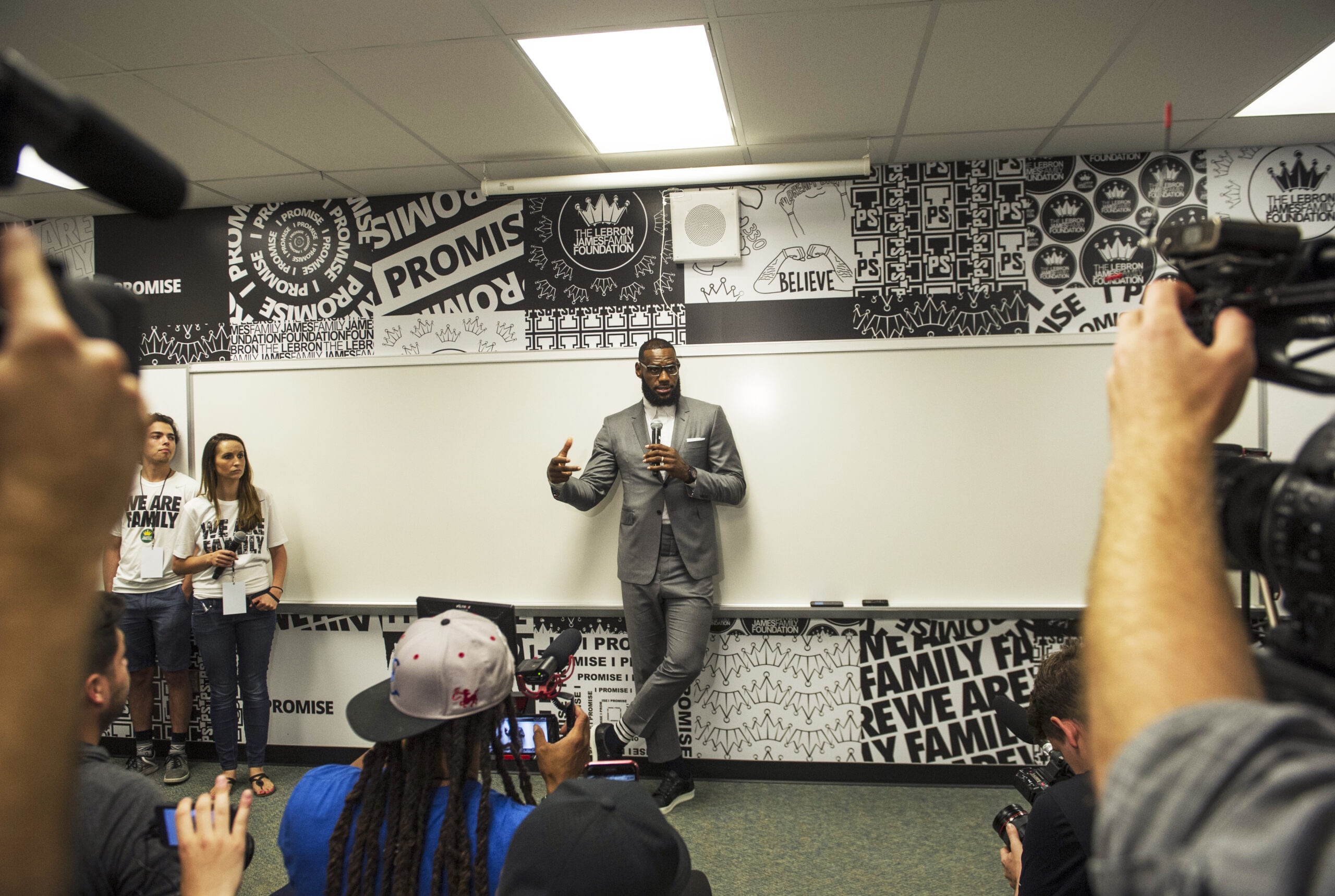
While James moved his basketball skills to South Beach, his philanthropic heart stayed in Akron. In 2011, James launched the “I Promise” program in Akron schools, designed to improve educational achievement for at-risk students starting in the third grade. The program started small, but has since become a key part of his philanthropic legacy. The program grew to other grades and included scholarships to the University of Akron. James’s foundation helped create a resource center at the university.
In 2018, the foundation worked with Akron leaders to launch the “I Promise School,” a public school that enrolls at-risk students to help them achieve academic success. As James said at the opening, he knows “exactly what the kids are going through” because he was once in their shoes. The school takes a more comprehensive approach to education, providing resources to parents, food when needed, and educational materials.
James has followed in a long line of philanthropists who turned to education to lift up communities. He has moved beyond giving for immediate need and has been working to create systemic change in education and on making sure others have the opportunities he had in Akron.
James has also become a vocal advocate for Black history and culture. He donated a combined $1.8 million to the Smithsonian Institution from 2015-17, becoming a “Milestone” founding donor of the National Museum of African American History and Culture. More than that, James has recognized his fame has allowed him to speak out against unjustified killings of unarmed Black people. From donning a hoodie to bring public recognition to the shooting of Trayvon Martin in 2012 to criticizing inaction after Louisville police killed Breonna Taylor this year, James has actively sought justice for African American victims.
Much like James’s philanthropy moved from providing support to individual cases to seeking systemic solutions, his calls for social justice have as well. He has collaborated with other sports and entertainment stars to launch “More Than a Vote,” designed to get out the vote in African American and other underrepresented communities as well as fight voter suppression and other efforts to disenfranchise African Americans.
James was not the first athlete to be socially aware; he cites Muhammed Ali and Bill Russell as his models. He is not the only socially engaged athlete, as many other NBA players have likewise used their fame to become advocates. And he is not above critique, as the Lakers’ trip to China indicated. But, James has used his money and voice to alleviate need and foster social change from the start of his career. He has shown that a star athlete can be both a commercial success and politically engaged even in the world of social media and partisan divide. LeBron James certainly is a good model for this year’s NBA draftees to emulate, not solely because of his championship rings and MVP titles, but for his active role in social justice.





