
Lessons From the U.N. Climate Meeting: Donors Need to Take Bigger and Bolder Action

By Leslie Johnston
Contributor
November 18, 2021 | Read Time: 5 minutes
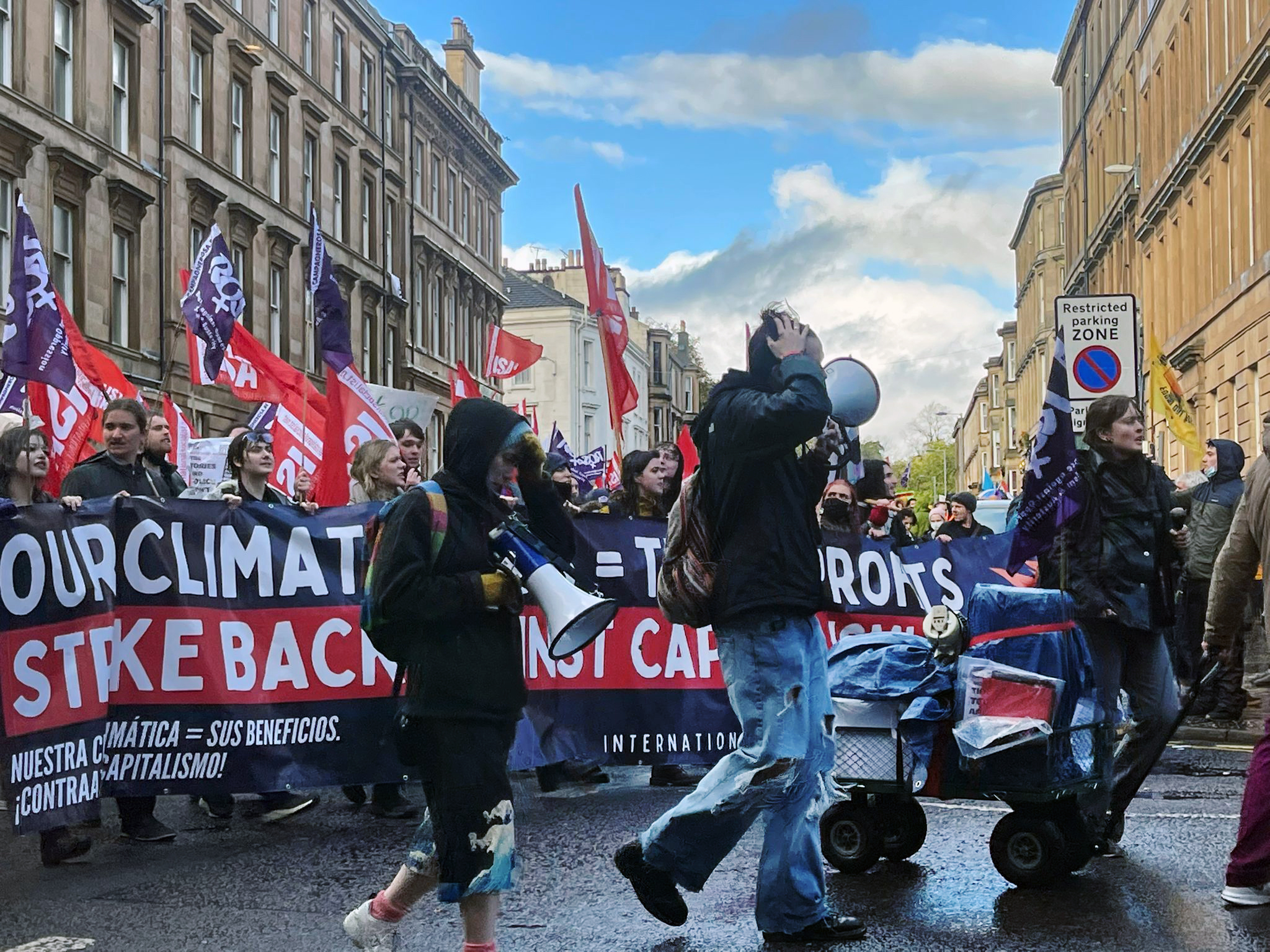
On my first day at the United Nations climate change meeting in Glasgow, as I waited in the long line to enter the conference’s high-security area, I saw a little girl in the window of a nearby hotel holding a sign that read “Save Our Planet.” She looked hopeful but also determined. Her message to the adults below: Act now — before it’s too late.
As I reflect on the days that followed at the conference, known as COP26, I am torn between optimism and outrage. On the positive side, private business stepped up with major commitments. The world’s largest financial institutions pledged to use their $130 trillion in assets to effectively restructure the industry to achieve net-zero emissions. I attended a session on human rights where I was flanked by deeply engaged C-suite executives from the mining industry — an encouraging sign if there ever was one.
Yet I also feel outrage because we are in an emergency situation, facing a dual crisis of climate and inequality, but we aren’t acting like it. If the bathtub is overflowing, you don’t just keep scooping out water. You turn off the tap. Despite positive steps forward, the final agreement negotiated by government leaders failed to meet the critical goal of limiting global warming to 1.5 degrees Celsius (2.7 Fahrenheit) above preindustrial levels. For now, greenhouse gas will continue to flow on a planet in peril.

And what about philanthropy’s role? There were some big announcements. Jeff Bezos donated $2 billion toward landscape restoration and food-systems transformation. The Rockefeller Foundation, among others, pledged to make up any shortfall in a U.N.-backed $100 billion funding package to help developing nations curb carbon use. And the Ford Foundation, along with a group of 16 other philanthropic organizations and five governments, pledged to invest $1.7 billion to help indigenous and local communities protect the planet from climate change, biodiversity loss, and pandemic risk.
Other grant makers like the one I lead — the Laudes Foundation — focused on more niche areas. Alongside the small handful of billion-dollar announcements, philanthropic organizations did what we do best — quietly enabling dialogue, gathering key players to tackle big, systemic issues such as food systems and gender equity, and announcing new research designed to spur action. Laudes, for example, joined the Ikea Foundation in releasing the Whole Life Carbon Roadmap Report, which aims to build a common vision for achieving net-zero carbon emissions in buildings and infrastructure in the United Kingdom.
But was it enough? Is philanthropy doing everything it can to “save our planet,” as the young girl in the window pleaded? In short, no. While philanthropy was present at the conference, we have a long way to go to make a real difference.
Despite the big commitments announced at the conference, less than 2 percent of philanthropic funding worldwide goes to climate action, according to ClimateWorks. In the United States, the number is a paltry 1 percent. That needs to change immediately. Grant makers can start by joining us in signing the International Philanthropy Commitment on Climate Change, which calls on all foundations, regardless of their mission, to use their resources to address the climate emergency.
Philanthropy also needs to be smart about how it spends its money. Total philanthropic global giving on climate is $750 billion a year, barely making a dent in the more than $90 trillion the World Bank estimates is needed to build sustainability by 2030. Donors need to focus on those areas where a relatively small amount of funding can bring about larger action. Philanthropy is society’s risk capital and should be used as such. Here are three places to start:
Help build stronger accountability mechanisms. Clearer commitments and standardized reporting are making it easier to hold governments and businesses accountable for reaching their climate goals. This includes the announcement at COP26 of an International Sustainability Standards Board, which will provide investors with information about a company’s climate-related activities.
But much more is needed, and philanthropy can play an important role by supporting projects that help ensure organizations stick to their COP26 commitments. For instance, Fashion Revolution’s Transparency Index, which Laudes Foundation supports, ranks 250 of the world’s biggest fashion brands based on their public disclosure of environmental and human-rights policies and practices. Organizations like Finance Watch monitor and share the impact of financial investments on the environment. Programs such as these need more philanthropic support to expand their efforts to track business and government climate practices.
Enable collaborative innovation. To reach the climate goals the planet needs, different industries and organizations must work together and share their knowledge and ideas. This can be challenging since companies are reluctant to collaborate with competitors.
That’s where foundation-backed industry platforms such as Built by Nature come in. Built by Nature brings together developers, architects, engineers, and others to create sustainable building practices and fund projects that meet those standards. Such collaborative efforts have the potential to transform manufacturing and distribution in dozens of industries but need far greater philanthropic support to succeed on a large scale.
Connect the coalitions of the willing. Foundations are good at gathering unlikely allies to create collective impact. Unfortunately, they are also good at creating new programs, platforms, and coalitions that are often duplicative and can slow down progress. Instead, philanthropic leaders should join together in coalitions that are already working effectively to address climate change.
One example is Platform for Accelerating the Circular Economy, or PACE, an international coalition of business, government, and philanthropic and nonprofit organizations that is developing a worldwide model for reducing waste and pollution in the production of goods and services. PACE has developed climate action plans in areas such as food, plastics, and electronics, which are then carried forward by each group of partners. Philanthropic organizations, for instance, fund research and mobilize communities and institutions to adopt action plans that call for phasing out certain plastics and reusing and recycling others.
Efforts like these need to be expanded and built on if the world is to have any chance of heading off environmental disaster. COP26 opened up an opportunity for philanthropy to do better. That means acknowledging our past mistakes and recognizing how we can improve. One thing is clear: Philanthropy can no longer accept a role as a bit player in the face of a global emergency.





