

September 18, 2011 | Read Time: 4 minutes
Foundations and nonprofits are constantly looking for the right tools to measure success.
One of the most effective sources of information might come from the people who rely on an organization, suggests The Ultimate Question 2.0, by the veteran management consultant Fred Reichheld with Rob Markey. This new book follows up on Mr. Reichheld’s previous one in which he demonstrates that asking one simple question of a business’s customers can often reveal more about the company’s performance than more traditional financial or product analyses.
The question: “How likely is it that you would recommend Company X to a friend or colleague?”
Since charities and foundations are created to serve the public at large, and most beneficiaries don’t pay directly for services, this approach to measuring results cannot be applied directly in the world of philanthropy.
But a number of organizations are working on ways to get feedback from the public and from beneficiaries. In so doing they may find the same connection Mr. Reichheld did.
The Center for Effective Philanthropy is one of the pioneers of this work.
For more than a decade, it has conducted studies of grant recipients and others to help foundations figure out how to reinforce strengths and fix weaknesses. Its flagship “grantee perception reports” have now been commissioned by more than 190 foundations.
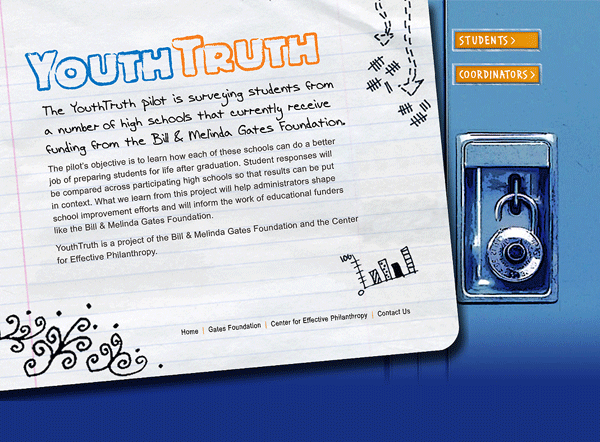
The center has also been working on a “beneficiary perception report.” Its pilot program is called YouthTruth and gathers the feedback of high-school students who attend schools supported by the Bill & Melinda Gates Foundation.
In a report published this month, the Center for Effective Philanthropy notes that few foundations collect information from beneficiaries. The fact that the intended recipients of foundation programs are rarely asked for feedback highlights how much room there is in philanthropy to deploy Ultimate Question-type measurements.
Keystone, a London charity, is also doing important work to gather and analyze the views of people a charity tries to serve.
It is now enlisting college students to gather insights from the people nonprofits serve.
Since foundations rarely serve just one group of beneficiaries, they must reach out to many kinds of people to assess their work.
The James Irvine Foundation, for instance, has been making available to the public its “grantee perception report” from the Center for Effective Philanthropy and actively seeking feedback on its annual performance. James Canales, the foundation’s president, says he is specifically looking for comments from critics.
“The power dynamic inherent in philanthropy makes it critical that we resist the temptation to talk more than listen,” Mr. Canales writes on the foundation’s Web site, “precisely because people will always listen politely to anything we have to say, regardless of its utility.”
He recognizes that nonprofits tend not to tell foundations when they’re doing a bad job, and it is the rare foundation that has ever lacked enough groups eager to take its money.
A similar dynamic exists between many beneficiaries and nonprofits, because a person in need of social services rarely is in a position to turn down subpar assistance.
Few nonprofits ask such clients what they could do to better serve them. But organizations could make more vigorous efforts to encourage such feedback.
It is with this dynamic in mind that I’m reminded of a plea by Frederick Hess, a scholar at the American Enterprise Institute, for foundations to avoid reacting defensively when criticized and in fact to seek out and encourage criticism.
“Foundations need to make it conscious policy to welcome—and even encourage—criticism,” Mr. Hess wrote in Philanthropy, the magazine published by the Philanthropy Roundtable, an association that serves donors.
Given that even tart-tongued observers will be unusually reluctant to share their thoughts, foundations need to make it extravagantly clear that they will not blacklist critics—or look kindly upon those who do. Only this kind of scrutiny will flag blind spots, wishful thinking, or ineffective spending.
Whether the foundation personnel agree with such assessments, engaging with them is essential to forestalling the plagues of hubris and groupthink that are so much a part of human nature.”
It is asking a lot of any organization to seek out criticism. But it is only by asking for constructive feedback that nonprofits and foundations can expect to improve the quality of their contributions to society.





