
New Head of Russell Sage Foundation Seeks to Raise the Visibility of the Poor

By Caroline Bermudez
Contributor
September 22, 2013 | Read Time: 4 minutes
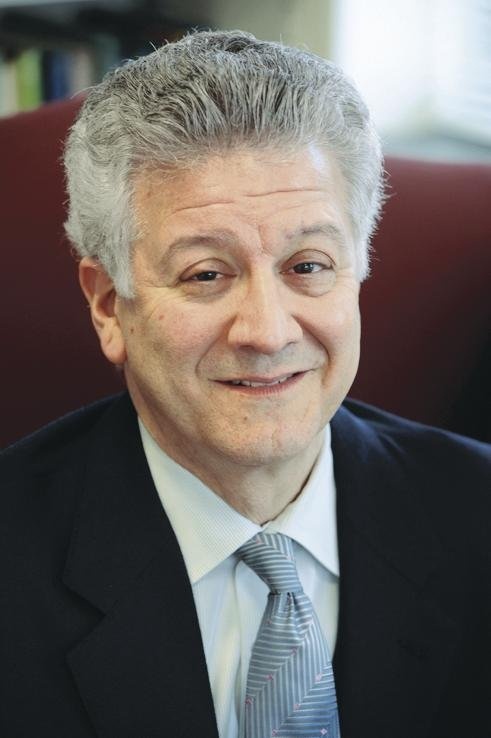
Sheldon Danziger wants more Americans to understand the plight of the nation’s poor and to support programs that are proven to help them.
As he takes the helm of the Russell Sage Foundation, he looks upon another leader as a role model: President Lyndon Johnson.
Mr. Danziger, a longtime researcher of poverty and social inequality, says President Johnson’s tenacity in placing the needy on the nation’s agenda continues to be important nearly half a century later.
Fifteen percent of Americans still live below the poverty line, according to the U.S. Census. But, says the foundation head, “the poverty situation today would be much, much worse than it is had the War on Poverty not reshaped so many social programs.”
Lifting more of those approximately 46 million Americans out of poverty, he says, will require two things: Data that show which safety-net programs work most effectively and the kind of leadership shown by President Johnson.
Constructive Critic
The Russell Sage Foundation is in a good position to become Mr. Danziger’s bully pulpit.
The institution was created in 1907 by Margaret Olivia Sage, the widow of a railroad mogul, to improve policies for impoverished Americans. It spearheaded efforts to remedy hospital and prison conditions, developed social work as a profession, and championed changes in health care, consumer credit, labor law, and safety-net programs.
The grant maker, which has an endowment of $250-million, now focuses on supporting research that identifies and alleviates social ills.
Mr. Danziger is well acquainted with the foundation’s work—he has received money for his research from the fund and served as a reviewer of the organization’s grantees for more than 25 years. He was previously a professor at the Gerald R. Ford School of Public Policy at the University of Michigan at Ann Arbor and has researched poverty for almost four decades.
Last summer Mr. Danziger and others affiliated with the foundation received an e-mail from Eric Wanner, the organization’s chief executive since 1986, announcing his retirement. Some of Sage’s trustees asked Mr. Danziger if wanted to be nominated for the position, he says.
Mary Waters, a member of the foundation’s selection committee and a professor of sociology at Harvard, says Mr. Danziger met the fund’s criteria as someone who had deep experience both studying the foundation’s areas of interest and improving other people’s research.
“He is widely known in the social sciences as being a terrific, constructive critic,” she says. “He has mentored many young scholars, and he is one of those people you always go to for advice about projects that are in development.”
‘Too Much Insecurity’
Mr. Danziger stresses the importance of the foundation as one of the few philanthropies that explicitly supports research on poverty and inequality. Increasingly, he says, grant makers bypass research to focus on direct services, a strategy he finds troubling.
“There is less funding for research related to poverty today than there was before,” he says. “By doing research, we learn what works and what doesn’t.”
He adds, “In the social-policy area, we often do things without having tested them.”
But it will be tough, he acknowledges, to focus Americans’ attention on poverty. He says polls show that public opinion ranges from apathetic to hostile. He cites the wide opposition to the federal health-care law as an example.
“We as a society don’t have much interest in reducing poverty or inequality,” he says. “We like to say we’re a compassionate people, but it’s hard to square when 50 percent of the population is against Obamacare.”
Researching the effects of the health-care law will soon be a priority for the Russell Sage Foundation.
Mr. Danziger says it is mulling support of projects that investigate the impact of the new law on Americans’ lives outside of their health, such as seeing whether children perform better in school or more people save for college or retirement when not spending money on health insurance.
Other pressing issues that the foundation will confront are determining whether soaring income inequality has eroded democracy and family stability and how financially vulnerable the next generation of retired people will be.
Mr. Danziger offers his own judgment on these matters.
“Most other advanced economies developed social-welfare policies in health, education, housing, labor, [and] retirement in which the government provided more security,” he says. “We have too much insecurity.”
Sheldon Danziger, president, Russell Sage Foundation
Education: B.A., economics, Columbia University; Ph.D., economics, Massachusetts Institute of Technology
Career highlights: Professor, Gerald R. Ford School of Public Policy, and director, National Poverty Center, both at the University of Michigan at Ann Arbor
Salary: He declined to provide it.
What he’s reading: Nudge: Improving Decisions About Health, Wealth, and Happiness, by Richard H. Thaler and Cass R. Sunstein, and After the Music Stopped: The Financial Crisis, the Response, and the Work Ahead, by Alan S. Blinder





