

February 21, 2010 | Read Time: 6 minutes
City Limits, an urban-affairs magazine, hit New York newsstands this month with a redesigned look and renewed mission to raise tough questions about issues affecting the city’s poor people.
The 34-year-old publication is under new ownership. And the change represents a new way for a charity to speak up about the causes it cares about. The Community Service Society of New York, a venerable social-service provider and public-policy research group, is now publishing the investigative magazine.
While the organization is known as a strong voice for the disadvantaged, the arrangement with City Limits does present challenges for how it balances advocacy with serving needy people.
For example, will the group jeopardize its government support by owning a magazine that frequently criticizes city agencies? And how will other nonprofit groups feel as they come under public scrutiny by one of their peers?
Despite the potentially awkward situations, David R. Jones, the Community Service Society’s chief executive, says the magazine will chart its own course independent of its parent and that the editors and reporters will keep complete control over its content.
With news coverage evaporating in New York and the nation’s economic troubles plunging more families into financial crisis, he argues that charities have to find new outlets to tell Americans about problems like inadequate housing and racial inequity.
“There’s been a real chill on advocacy, particularly among grass-roots organizations,” says Mr. Jones. “We ultimately think that if we lose that ability to do this kind of work, we really shouldn’t be around anymore.”
Won Accolades
City Limits began in 1976 as a mimeographed newsletter for housing advocates in New York. Over time, it grew into a left-leaning public-policy magazine and scored journalistic accolades for uncovering fraud in a U.S. Housing and Urban Development Program and consistently pointing out holes in the city’s welfare programs. It developed a small but dedicated audience of urban-development scholars, antipoverty activists, and others.
But when the recession hit, the publisher of City Limits, the New York think tank City Futures, ran into financial problems. The magazine’s advertising revenue fell, and the organization could not support it long-term.
“We were surviving, but the opportunity to make the kindof investment in independent media that we would’ve liked to do on our own was notforthcoming,” says Andy Breslau, executive director of City Futures. “The potential for it to slowly die on the vine was increasing every month.”
The Community Service Society stepped in, and after several months of negotiations and meetings with lawyers, the magazine, its Web site, and its staff of four people switched hands in the fall. City Futures received $225,000 for the transaction and assurances that City Limits would continue its tradition of muckraking reporting.
Ambitious Plans
With a new lease on life, City Limits has big plans, says Walter Fields, the magazine’s new publisher, who has contributed to National Public Radio and MSNBC. He formerly served as vice president of government relations and public affairs at the Community Service Society.
He says the charity will pour $1-million into the magazine over three years in an effort to expand the number of paid subscribers to more than 25,000 from the 1,500 it now has.
Mr. Fields has increased its publication frequency to bimonthly and expanded the number of newsstands it appears on to 90, including one in Washington that is often visited by members of Congress and their staff members. He has revamped its Web site, http://www.citylimits.org, created a version of it for mobile phones, and hired a former television reporter to improve its multimedia content.
As for its reporting, the magazine’s articles will be based on facts, not opinion, but “we’re going to be unapologetic about our progressive-policy outcomes,” he says.
Editorial Independence
The first issue under Mr. Fields’s leadership is a sign of the magazine’s new direction.
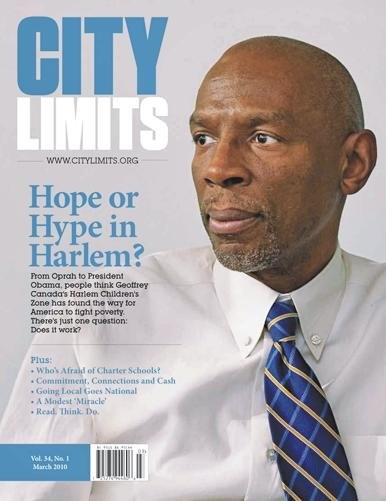
It takes a hard look at the Harlem Children’s Zone, a charity that has received a lot of national attention, including praise from President Obama. The cover features the nonprofit group’s founder, Geoffrey Canada, and the question: “Hope or Hype in Harlem?”
Mr. Fields says Community Service Society officials had no concern about criticizing another nonprofit institution in the city.
“It was understood from the outset that City Limits would have editorial independence,” he says. “To my knowledge, CSS does not compete with the Harlem Children’s Zone for any government or philanthropic funding and does not work with HCZ in any capacity.”
The Harlem’s Children Zone declined to comment on the profile or the magazine’s approach.
Alyssa Katz, who was editor of City Limits from 1999 to 2005, says she likes the new publication but hopes it will do more to cultivate a “firebrand voice.”
“The information and insights about Canada’s project were interesting, but you really had to dig deep to figure what the conclusions were,” she says. “In order to really find a bigger audience as a publication, it’s probably going to have to get a little more hard-hitting.”
No ‘Shrinking Violets’
How hard-hitting the new City Limits can be depends in part on its relationship with its parent organization.
To give it free reign journalistically and to make sure a wall separates the social-service provider from the magazine, City Limits will be established as its own nonprofit entity.
“We weren’t acquiring this to create a glorified CSS newsletter,” says Mr. Fields. The magazine is in the process of applying for tax-exempt status and recruiting new board members, he says.
Despite the change, the Community Service Society will still own it and could face a backlash for what the magazine writes.
Mr. Jones, the chief executive of the Community Service Society, doubts its revenue from government agencies, which makes up about 30 percent of its annual budget, would be cut because of the magazine’s content.
(Its previous owner, City Futures, did not receive government money, says Mr. Breslau.)
Mr. Jones also points out that even if any financial support is threatened, his group has a large endowment—$136-million as of June 30, 2009—and raises money from diverse sources.
For Mr. Jones, the foray into journalism dovetails nicely with his group’s mission. The charity offers financial-literacy services, assists the unemployed, and oversees a volunteer force of 7,500 older Americans.
People who know Mr. Jones, a lawyer who previously served as an adviser to Edward Koch when he was mayor of New York, say he and his organization are not known as shrinking violets.
“He is willing to think about what’s good and right for poor people and put aside any short-term self-interest that other leaders in the sector can’t get beyond,” says Aaron Dorfman, executive director of the National Committee for Responsive Philanthropy, a foundation watchdog group. Mr. Jones was a member of the committee’s board for 10 years.
Ms. Katz, the former editor of City Limits, says that the Community Service Society’s reputation—and its decision to spin off the magazine—is a good sign that the City Limits of the future won’t pull any punches.
“How aggressive it can be will be interesting to see,” she says, “but CSS is likely independent enough as an institution that it can pull if off.”







