
Nonprofits Should Rally Behind Efforts to Shed Light on Secret Donors

By Vince Stehle
Contributor
October 28, 2010 | Read Time: 5 minutes
Sunlight is the best disinfectant.
The Supreme Court Justice Louis Brandeis offered that famous declaration to encourage open and transparent financial markets. But it has long served as a dictum that public disclosure prevents corruption of all types, especially in government.
In recent years, this sentiment has powered a movement to open government data to public scrutiny as never before. The combined efforts of the Sunlight Foundation, a Washington nonprofit group that serves as a clearinghouse and advocate for transparency, and the increasingly transparent federal government under the Obama administration, have resulted in a significant shift toward more open government in the United States.
The Sunlight Foundation, founded by Michael Klein, a Washington philanthropist, and Ellen Miller, a veteran open-government advocate, has made the arcane inner workings of government data much easier to grasp for reporters and the public alike by creating easy-to-use technology tools and clever marketing campaigns.
Sunlight provides power tools for open government, with online efforts such as Influence Explorer and Poligraft, which make it easy for anyone to track financial contributions and political influence, and Clearspending, a scorecard that tracks federal-government spending.
At the same time, the Obama administration has issued wide-ranging directives—however modestly enforced so far—that set the federal government on a course toward much greater transparency.
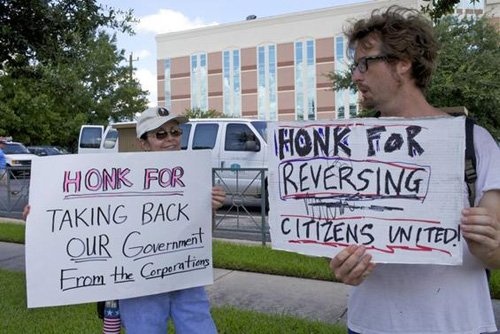
That progress was more than offset in January by the Supreme Court’s Citizens United decision, which overturned a century of settled jurisprudence on the appropriate limits of corporate contributions to political campaigns. Under the nakedly political Citizens United decision, rendered in a 5-to-4 ruling, corporations are now able to make unlimited and undisclosed contributions to independent organizations that directly call for the election or defeat of particular candidates.
More than $350-million in contributions has flowed through an array of independent groups into this year’s election campaigns, particularly the hard-fought races that will shape control of the next Congress.
What is particularly disturbing for the nonprofit world, however, is the way the new rules invite partisan political hacks to carry out their electoral attacks under the guise of nonprofit status.
For those of us who have long encouraged nonprofits to advocate for policy change and provide education on nonpartisan electoral issues, the ruling threatens to undermine the credibility and legitimacy of efforts that truly reflect the First Amendment rights of civic associations.
The response to the Supreme Court decision has also unfairly tarnished the notion of anonymous giving, which has deep roots in philanthropy. Anonymous giving is highly respected in many religious traditions, which encourage selfless acts of charity. But secret political contributions that are intended to exert undue influence and that masquerade as selfless acts of charity are harmful and disingenuous.
Among the new organizations that have touted the power of anonymity are American Crossroads and its sister organization, Crossroads GPS, which were created by Ed Gillespie, former chair of the Republican National Committee, and Karl Rove, a former Bush administration adviser.
Together, American Crossroads, organized as a political committee that is required to identify its donors, and Crossroads GPS, an advocacy organization that does not have to name its donors, have spent close to $18 million—split evenly between them—in just the first three weeks of October.
And the U.S. Chamber of Commerce, a nonprofit trade association, plans to spend $75-million to influence elections this year, more than double the amount it spent in 2008. The chamber, which chooses not to identify its donors, has spent much of its advertising on campaigns to defeat Democratic candidates.
It will take an awful lot of sunlight to clean up the mess that the Supreme Court created. What can organizations and individuals engaged in selfless acts of charity do to counteract the influence of secret money on our elections?
The first thing any charity can do is to exercise its own rights to engage in nonpartisan electoral education activities. Groups like the Nonprofit Voter Engagement Network offer guidance on what is legal and effective in seeking to promote voting among a nonprofit organization’s many constituents: employees, donors, volunteers, clients, members.
Foundations concerned about the influence of secret money on our elections can support nonprofit efforts to shed light on these activities.
And both grant makers and nonprofits, as well as the nation’s philanthropists, can take the advice of the Sunlight Foundation and urge members of Congress to require disclosure of third-party spending to prevent a repeat of this year’s secret money bazaar in the 2012 presidential election.
Among the foundation’s suggestions for what legislation should include: Disclosure requirements should be clearly defined, with little room for donors or campaigns to slip through existing loopholes. They should require that expenditures be reported within 24 hours and that all data should be delivered electronically so it will be readily accessible.
Such legislation might also send a message to the Supreme Court to show that Americans are not at all pleased by how political it has become.
Shockingly, one of the immediate beneficiaries of the Citizens United decision is a brand new group called Liberty Central, whose president is Virginia Thomas, the wife of Supreme Court Justice Clarence Thomas.
Liberty Central was started late last year, just before the Citizens United decision, with initial gifts of $500,000 from two donors, both anonymous.
Quite apart from the question of decorum, when an organization founded by a sitting justice’s spouse—who routinely rails against the “tyranny” of the current administration—benefits from the court’s ruling, it can lead to the appearance of a conflict of interest.
Among the ironies of our current circumstance, campaign-finance experts point out that the new rules make it legal to engage in practices that sent people to jail from the campaign to re-elect Richard Nixon and indeed helped to bring down his presidency. Now a secret donor can influence an election and truthfully say, “I am not a crook.”
Nobody who cares about good government wants to see that. The Citizens United decision, allowing obscene amounts of cash from secret contributors to be unleashed on the electoral system, is undermining the credibility of American democracy.
And to determine what’s obscene and what’s not when it comes to campaign spending, we need only turn to the Supreme Court.
As Justice Potter Stewart wrote in a 1964 Supreme Court decision about pornography, legal definitions may not be precise, “but I know it when I see it.”








