
Ukraine Is Facing an Education Crisis. Here’s How Philanthropy Can Help.
Investing in programs for children has immediate benefits and should be a focus of grant-making strategies in Ukraine.

By Justin van Fleet
Contributor
February 23, 2024 | Read Time: 7 minutes
Think back two years ago to February 24, 2022, and the weeks that followed. There was shock and disbelief at Russia’s invasion of Ukraine. The capital, Kyiv, was under threat. Ukrainians were being injured and killed in their homes by rockets and shells, forced to flee for their lives or stay and endure an uncertain future.
Related Content
-
Nonprofit Effectiveness
How Much Good Can $100 Million Do? Sesame Street and IRC Put a Big Bet to the Test
-
Opinion | What We’ve Learned
To Get Life-Saving Items to Ukraine, We Created Our Own Supply Chain
-
International Aid
For Donors, Wartime Ukraine Aid Creates Blurry Ethical Line
Throughout the world, people showed their sympathy by adopting Ukraine’s national colors of yellow and blue: wearing pins, flying flags, buying T-shirts, attending concerts and vigils.
Western governments stepped up with military and humanitarian assistance. Europeans opened their homes to refugees fleeing the war. And donations from foundations and companies flooded in. In the first year of the conflict, $3.1 billion in philanthropic support was offered in grants and pledges, according to Candid.
And now? After nearly two years, compassion fatigue has set in. The yellow and blue emblems of support are harder to find. As the war drags on, and domestic pressures such as inflation mount, sympathy for Ukraine is being tested.
About 72 percent of philanthropic contributions were made during the first four months of the war. Since then, funding has decreased sharply: Candid’s tracking recorded contributions in 2023 totalling just 2 percent of those in 2022. That number could go up slightly as more grants from last year are reported but it is unlikely to change significantly. At the same time, government aid is increasingly uncertain, with the U.S. Congress so far unable to reach a decision on funding for Ukraine, and the Israel-Hamas war consuming global attention.
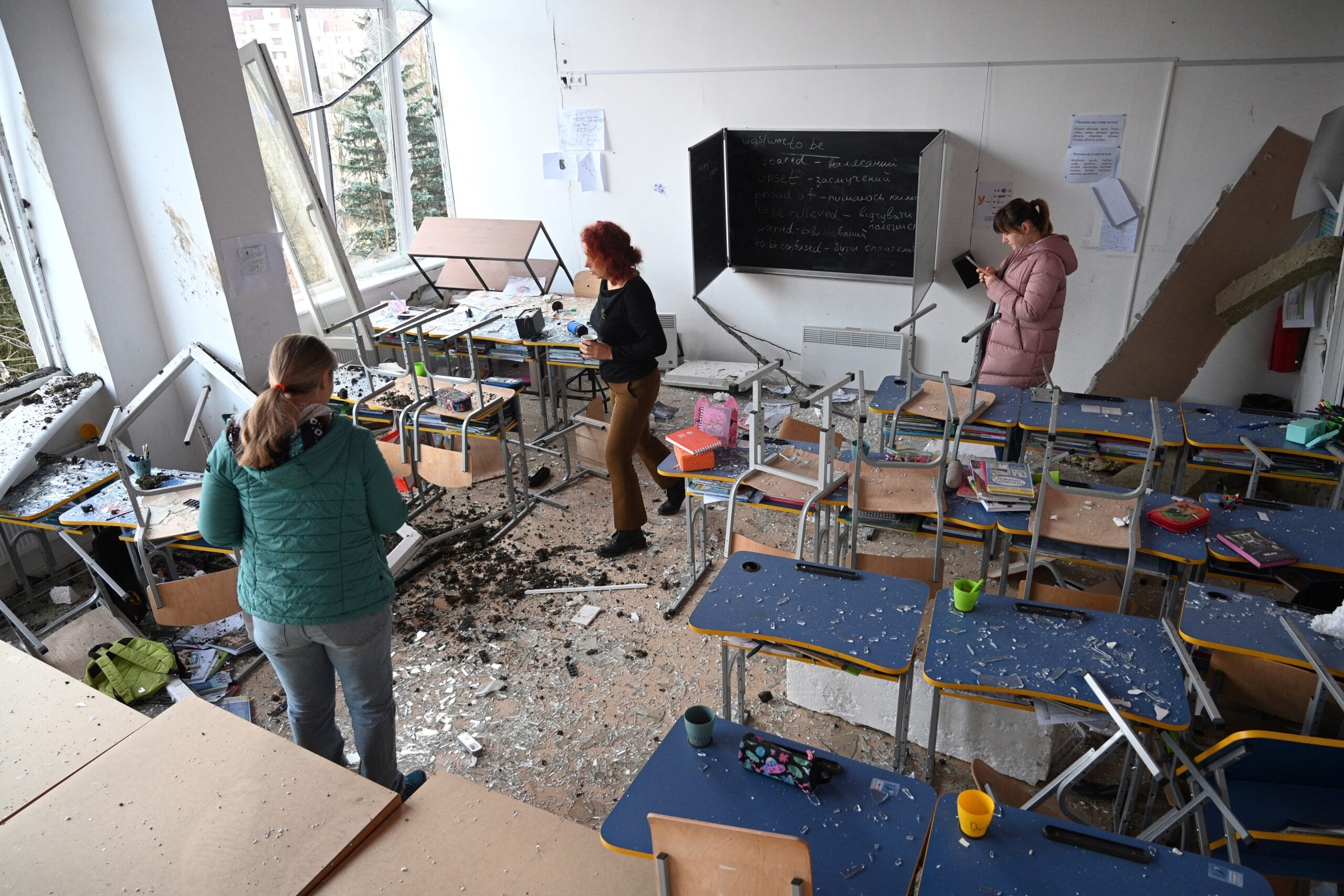
Between the political fights and waning public interest, the plight of the youngest and most vulnerable Ukrainians barely registers. Approximately one-third of Ukraine’s 6.7 million children aged three to 18 are refugees who live outside of their country, and millions more are displaced within Ukraine. Nearly two million must learn remotely or in hybrid situations, and 4,000 schools and other educational facilities have been damaged or destroyed. Hundreds of thousands of children have difficulty attending school, including more than 300,000 who lack the technology for remote learning.
Yet little education assistance is available from either government or philanthropic sources. Education amounted to just 4 percent of total humanitarian aid to Ukraine in 2023.
Investment in today’s young people will determine the ability of Ukrainians to eventually rebuild their country and form a lasting peace. Given the indecision surrounding foreign aid, and education’s low priority compared with military and security spending, philanthropy has a unique opportunity to not only support Ukraine’s education system but to shape the future of the country after the war ends.
Less Showy Philanthropy
Supporting education, particularly in the early years, is exactly the kind of less showy but highly strategic investment that philanthropy is so well suited to take on. Foundations don’t need to bow to political whims or what’s popular and have the flexibility to play the long game.
Boosting education and other programs for children during a war also has both quick and lasting results. As the war enters its third year, it’s critical to get funds to organizations that can identify and disburse the money to local nonprofits where the need is greatest. Grant makers can do this by working through groups such as Education Cannot Wait, an international education fund, and public-private partnerships such as the Global Business Coalition for Education. The latter is part of the global children’s charity I lead, Theirworld.
At Theirworld we’ve seen an immediate impact by focusing on three areas of pressing concern: early learning, education technology, and learning loss. We encourage others in philanthropy to follow a similar path.
Toxic stress on kids in the early years. Ukraine is home to 1.3 million children under the age of five, the time of life when 90 percent of brain development occurs. Grant makers can help ensure that toxic stress and other effects of war do not determine the future of this generation.
Our approach has been to partner with the Ukraine Ministry of Education and Science to develop high-quality preschool for the country’s youngest children. A growing body of evidence shows that quality early-learning programs can help kids develop the social-emotional skills needed to maintain long-term mental health, even in the face of extreme crisis. We helped bolster the Ukrainian government’s limited capacity in this area by directing funds toward a local team of consultants with the expertise to make the country’s preschool ambitions a reality.
Other recent programs in war-torn areas show the payoff of such support. This includes the MacArthur Foundation’s $100 million investment in a six-year effort by Sesame Workshop to help refugee children in Syria and throughout the Middle East cope with anger and sadness. The program’s success at reaching millions of children set the stage for recent efforts to bring the “Welcome, Sesame” program to children throughout Ukraine.
(The John D. and Catherine T. MacArthur Foundation is a financial supporter of the Chronicle of Philanthropy.)
Access to technology. All Ukrainian kids need access to the proper technology for remote learning. When the war broke out, the Global Business Coalition for Education partnered with HP and Microsoft to deliver more than 70,000 devices to children and teachers. Just last month, the Ukrainian government and the Olena Zelenska Foundation launched the Device Coalition to deliver 125,000 laptops and tablets to children, teachers, and schools by the middle of this year. These devices will target children in areas bordering the front lines, where it’s unsafe to travel to school.
My organization joined the collaboration, which also includes international agencies such as the Korean International Cooperation Agency, UNESCO, and the United Nations High Commissioner for Refugees. But other grant makers are critically needed to back this effort. For young Ukrainians, these devices are a lifeline. They provide a connection with family and friends, a sense of stability during a crisis and, most of all, a way to keep on learning.
Learning loss. Ukrainian children have suffered more than four years of disrupted education, first during the Covid-19 pandemic and now during the two years of war. But they were already behind. In 2018, the Programme for International Student Assessment ranked Ukraine 43rd in math out of 78 participating countries.
President Volodymyr Zelenskyy has identified math and science education as critical to ensuring Ukraine’s children have the skills to help rebuild the country — as the civil engineers, scientists, economists, and architects of a peaceful future. Theirworld is joining other donors, including UNICEF, and is working alongside organizations such as the Junior Academy of Sciences of Ukraine, to strengthen math and science education through accelerated teacher training programs.
A feature of these efforts is funding for a Museum of Mathematics due to open in Kyiv later this year. Designed in part to help children make up for lost time, the museum will serve as a national center of math education and research. Aiming to reach 3,000 teachers and 300,000 children every year, it will include a permanent travelling exhibition to rural and remote areas.
These are just a few examples of what’s possible if more donors join us in meeting the educational needs of Ukraine’s children. We can’t let Ukraine become the next forgotten conflict, like the Rohingya refugees in Bangladesh, or Syria, where money poured in initially, but then stopped, along with the headline-grabbing pledges to educate every single Syrian refugee child.
Investing in the education, development, and emotional health of children is an ideal use of philanthropic resources during wartime. As political leaders remain idle, it’s up to philanthropy to take a stand.





