
U.S. Must Think Bigger About Volunteers’ Role in Building a Better Future

By Shirley Sagawa
Contributor
April 18, 2010 | Read Time: 6 minutes
Our country faces no shortage of challenges, and many people look to government to solve environmental, educational, health, poverty, and other problems. But none of them can be solved by government alone. In fact, none can be solved without the committed efforts of the American people.
Unfortunately, volunteers are often left out of efforts to solve problems that are holding us back as a nation. It is time to get serious about using all the tools available to promote change, and that means we must make it possible for ordinary citizens to play a bigger part in tackling key challenges.
In the face of dire obstacles, ordinary citizens step up, and all signs show they are ready to do so again. Applications for AmeriCorps tripled in 2009. The Serve America Act, which authorized the largest expansion of national service since the Great Depression, was signed in the first 100 days of the Obama administration with strong bipartisan support. Volunteering is on the rise. The human capital we need to deploy against our biggest challenges is poised and ready.
In fact, after decades of incremental progress, the United States is at a critical juncture. We now have the skills and evidence to support large-scale efforts to enlist participants in service corps to focus on our national priorities. Service programs throughout the United States are changing lives, creating innovative solutions, and getting citizens involved in their communities.
With the Serve America Act, service is suddenly in a position to achieve a significantly greater difference—if we can take advantage of its potential and manage this human capital effectively.
Across America, organizations have made service a critical part of their efforts to solve a range of problems, such as helping prisoners re-enter society, getting children ready for elementary school, and preventing environmental destruction.
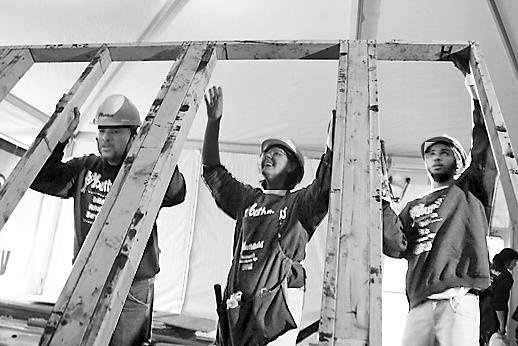
Some volunteers play traditional roles—for example, volunteers offer many pairs of hands when a large unskilled labor force is needed, and they can offer extra caring when time and compassion make a difference.
But other roles reflect an expanded understanding of how volunteers can help. For example, many organizations have increased their effectiveness by recruiting skilled volunteers from a wide range of fields to provide pro bono work. And they recruit community volunteers when knowledge of the neighborhood and local credibility will make the difference.
Volunteering creates a sense of ownership in the community where volunteers live, and that can help sustain a mentor program or keep a park or playground clean and graffiti-free.
Perhaps the most powerful way that volunteers make a difference is in building social capital—bringing a community together or building bridges to others with influence.
Today 60 million Americans volunteer each year, and tens of thousands join full-time civilian-service efforts such as City Year or Teach for America. That’s a powerful start but nowhere near the scale we could achieve.
With a million citizens in full-time national service and a hundred million more Americans each volunteering 100 hours a year in their own communities, every town could have a disaster-response team, and every struggling student a trained tutor.
Whole regions could be organized to reduce their energy consumption and improve their environment, and entire communities could be engaged in healthy behaviors.
Hundreds of thousands of older adults could live at home rather than in institutions because they have the help they need, and a similar number of immigrants could learn English and enter the mainstream economy. And much more could be achieved.
Service at this scale would change the nature of our communities.
People who give their time to solve community challenges would be less likely to turn away when help is needed, more likely to donate money, less likely to commit crimes, and less likely to neglect civic and personal responsibilities. Because of these experiences, people who know people who are different from themselves would bridge societal divides in important ways. In their jobs, they would make decisions that reflect their understanding of how their actions affect the community where they live. At home, they would know their neighbors, not fear them. More people would become involved politically, and we would see better, more ethical candidates and an improved democracy.
We could achieve this, but only if we do three things. We need to bolster the supply of people willing to step up to solve problems. But we must also increase the demand for volunteers, by spurring the public problem solvers of the nation—policymakers in government at all levels, philanthropists, and the groups that deliver services—to incorporate service into their strategies.
In addition, our systems for connecting volunteers to opportunities and supporting them must be strengthened to handle increased volume, offer better placement mechanisms, and incorporate the programs and tools needed to achieve desired results. Volunteers are not free—they come with a price tag, albeit a modest one, that makes their service effective.
To bring about these changes requires several important shifts in mind-sets.
- Leaders of nonprofit organizations need to see volunteers as important partners in achieving their missions, to go beyond stereotypes and think of volunteers as a source of skilled human resources, social capital, and credible communicators. It’s important that service be well-integrated into an organization’s work. If it is simply an “add-on,” the system for managing volunteers is unlikely to receive the resources and attention necessary for it to be effective.
- Service groups, nonprofit organizations, and policy makers must focus more on results and move beyond counting the volunteers and the hours they serve as their measure of accomplishment and start tracking whether volunteers made any progress in solving problems.
- Foundations and other big donors must make service a serious part of portfolios dedicated to key domestic issues. Most foundations don’t have programs devoted to service, but they do have money for education, environment, or other challenges that would benefit from the aid of volunteers. Grant makers can make better use of their assets by financing the organizations that deploy volunteers effectively to fight those problems.
- All Americans need to shift away from stereotypes about volunteers to believing in the words of Martin Luther King Jr. that “everyone can be great because everyone can serve”—and seeing how the act of serving others will benefit people traditionally thought of as clients, whether they are young; poor; immigrant; elderly; or struggling with physical, mental, or emotional challenges.
We must also stop thinking that volunteers are free and realize that the systems that make them effective cost something.
Those shifts focus largely on the “demand” and “systems” parts of the service equation.
If those things are done right, the “supply” of volunteers will be there. This is indeed the rare case of “if we build it, they will come.”
Virtually every study done to explore why people volunteer has included high on its list of answers “because someone asked me.” If asked, people will serve.
It’s always been a false choice: Will we rely on government to solve our problems, or should government step aside so volunteers and charitable organizations can take them on?
We need both. The American way to change America is, after all, to act together in common purpose.





