April 12, 2017 | Read Time: 3 minutes

Anticipated cuts in federal spending have many nonprofits that mostly count on government grants looking for other sources of financial support. Where to turn? Individual donors, who are the most reliable source of sustained giving.
As shown in the graph below, Wealth-X, a global research firm, estimates that the number of big donors is likely to grow 46 percent from 2015 to 2020, which could result in an additional $2.8 trillion for charities.
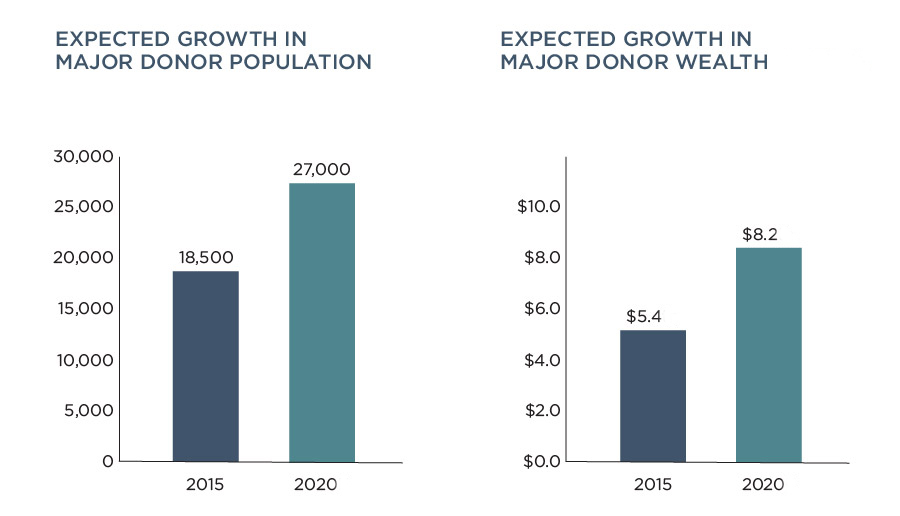
Source: WealthX
Note: “Major donors” are defined as wealthy donors who have donated at least US $1 million in their lifetime (which does not include pledges for the future). Expected growth in major donor wealth is measured in trillions.
If your organization is just beginning a major-gift programs, here’s where to start:
1. Communicate goals clearly.
Hold a kick-off campaign that communicates your need for big donors. Let volunteers know your goals and invite them to join campaign committees. Be sure each volunteer has clear and measurable goals for contacting potential donors. These committee leaders can make or break your campaign. Opt for people who are well connected, whether or not they have the potential to contribute large sums, because they will more likely bring a diverse set of potential donors and do a better job of spreading the news about your campaign.
2. Educate and expand your board.
Your trustees are your offensive line when it comes to communicating your goals. Make sure every board member understands the role of fundraising and have all trustees set their own goals and targets. Help them identify potential donors among the people they know. Look at the interests and giving patterns of individuals or the profile and mission of family foundations to identify likely donors. Think about “their decision making, what their purposes are in life,” suggests Perry Cochell, director of the office of philanthropy at Boy Scouts of America.
3. Cultivate future leaders and donors.
One of the first questions I always ask my clients is, “Do you have a “young professional board?” To raise more money, organizations should expand the pool of people who know, and believe in, your cause. A young professional board operates as a separate entity from an official board of directors and allows young people with a passion for your mission to become involved in your organization at an early age. Events are a great way for young professionals to meet and connect with like-minded individuals, and part of the young professional board members’ mandate should be to plan events for your organization that attract their peers. This gives nonprofits the chance to cultivate the next generation of major donors before they’ve even reached their full giving capacity. Xiomara Roamin, director of fund development for Mentor New York, says members of the group’s Young Professional Advisory Board are dedicated volunteers and help promote the mission – and may be big donors in the future.
4. Think globally.
Many nonprofits worry that the market for charitable giving is saturated. An ultra-high-net-worth individual in the United States who is passionate about environmental protection will likely make upwards of five medium-size donations a year to environmental groups and has been solicited by many more. The question is, how do you find one of those donors who will write one big check instead?
Consider exploring new territory. The philanthropic landscape is changing in Britain and Asia, and some philanthropists in these areas would benefit from affiliating with well-known global nonprofits, including joining their boards. The key is uncovering people internationally who care about your cause but are not continuously tapped for major gifts, by identifying individuals who have not yet aligned themselves with another organization.
5. Screen, and then screen again.
Create a regular schedule to search for potential donors who have an interest in your cause and do not need a full introduction to the value of your work. Screen your organization’s nonfundraising databases, such as ticket-sales data if your nonprofit is an arts group, or its social-media followers. These are your lowest hanging fruit.
Emily Lang is a director of Wealth-X, a global research firm.