February 26, 2019 | Read Time: 5 minutes

Many nonprofits are ramping up their efforts to attract monthly donors. And that’s smart fundraising: These contributors provide a reliable stream of income, give more on average than those who make single gifts, and tend to be more loyal, research shows. So how can you increase monthly giving and raise more money over the long term?
Charity: Water has an approach that works. The group expanded its sustainer program, called the Spring, from 6,000 members in 2016 to nearly 34,000 by the end of 2018. Last year, monthly donors gave 18 percent of the nonprofit’s total revenue, compared with 5 percent two years earlier.
To figure out how to enlist more members — and hold onto them — the group looked at subscription-driven businesses like Dropbox, an online file-sharing platform that bills customers monthly, says Jason Keramidas, Charity: Water’s chief product officer. When Dropbox started, he says, “they had an incentive structure in place to not only get you hooked into their ecosystem but also for you to act on their behalf to bring in new customers.”
Users could get free additional storage in exchange for referring friends or interacting with the product in different ways, such as adding photos to their accounts. These rewards encouraged customers to get more involved with the service, he says, and attracted new ones at no cost to Dropbox.
When Keramidas joined Charity: Water in early 2017, the group wanted to shift its focus from getting people to give once to attracting members who give monthly, keeping them engaged over time, and motivating them to recruit others. “The traditional ‘funnel model’ no longer really seemed to make sense,” Keramidas says, because that starts with trying to attract a donor’s attention and ends when someone “converts” or donates, unlike monthly giving, which requires ongoing communication and opportunities to get involved.
Keramidas, who previously worked at businesses including Audible, quickly identified a marketing strategy to help the organization reach its goals. The concept, created by venture capitalist Dave McClure for startups that offer subscription services has five objectives: acquisition, activation, revenue, retention, and referrals (sometimes called “pirate metrics” because the initials spell “AARRR.”)
Keramidas adapted this framework to fit Charity: Water’s purposes and its communication channels, which he mapped in a flowchart. The five-step strategy begins with how the group drives traffic to its website and continues with methods to inspire people to join the Spring. Retention and referrals are an ongoing process, Keramidas says.
Attracting and Retaining Monthly Donors: A 5-Step Strategy
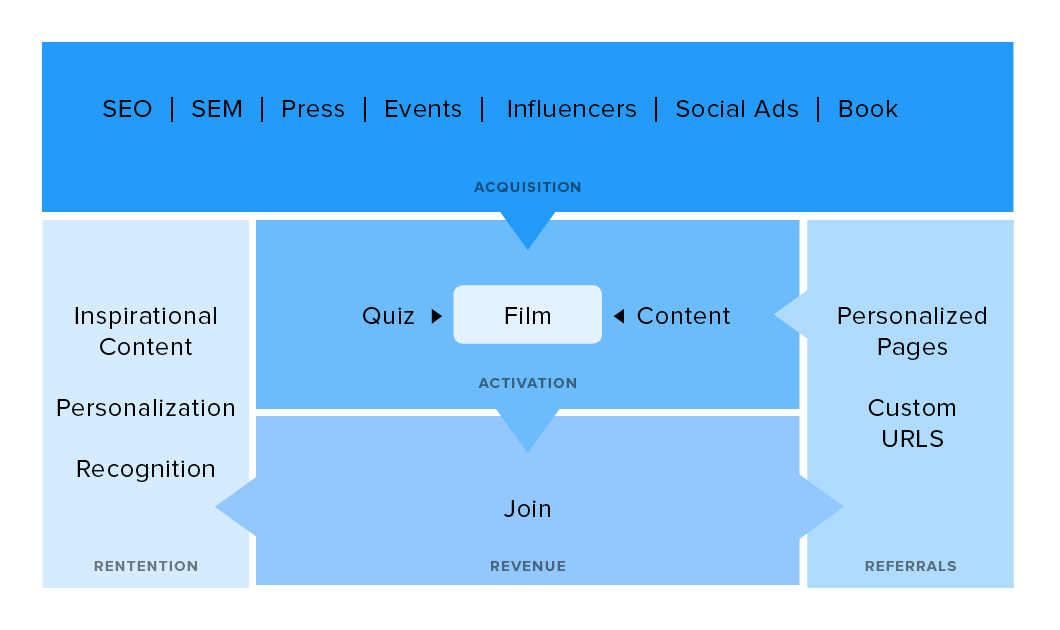
Here are the five basic activities and how Charity: Water fundraisers use them to attract and retain members, which Keramidas explains in more detail in the Chronicle webinar “Attract and Upgrade Your Monthly Donors.”
Acquisition. The group uses tactics including search-engine optimization and marketing, online advertising, social media, in-person events, and press coverage to attract visitors to its website so they can learn about its mission.
Activation. It uses compelling website content to engage people and inspire them to give. For example, it promotes a video in which founder Scott Harrison shares his personal story and offers a quiz to match donors with a beneficiary with whom they share an interest.
Revenue. Money comes into the organization from donations and memberships.
Retention: Charity: Water shares a monthly “good news” email and exclusive video content for members about the water crisis and the group’s work in the field. This helps keep members engaged and committed to monthly giving. In addition, the organization is developing online “impact profiles,” which are personalized web pages for members that show them how many people their monthly contribution helps, acknowledge milestones such as months in the Spring program or the number of beneficiaries helped, and give them a central place to access all of the Charity: Water communications and content they’ve received.
Referrals: The group motivates monthly donors to bring others on board. For instance, it gives members a personalized web page with a custom URL they can use to promote the program through their social networks. This is one area Charity: Water is looking to improve. “Our referral success is currently very top heavy, so it’s very [online] influencer-based,” Keramidas says. The organization’s challenge is how to get a larger share of members to refer others in the same way that Dropbox grew by getting those who signed up to invite their friends.
Charity: Water focuses on its website because the organization’s outreach is primarily digital. Other nonprofits can use different tactics tailored to their own organizational strengths and challenges. Here are Keramidas’s tips for getting the best results.
Use a variety of communication channels to acquire new monthly donors. Focus on optimizing those that cost the least. “Paying for acquisition is great, but, man, you don’t want to be dependent on it,” Keramidas says. You should experiment with different types of content to see what works best in each medium.
Make it easy for donors to keep giving. Offer a variety of payment options. Encourage people to sign up for direct transfers from their bank accounts, he says, but don’t force this choice.
Don’t hide from those who want to stop giving. “You leave a better taste in someone’s mouth when you understand that they may not be able to do this anymore, and make it easy for them rather than burying the cancel option somewhere and forcing them to go through hoops,” Keramidas says.
Remind people why they support your cause. Keep donors connected to your work by building on the theme that first inspired them to give. Think about which pieces of your story resonate the most and play them up.
The more thought and energy you invest in building a successful monthly giving program, the healthier your organization will be, Keramidas says. But don’t expect to get it right the first time. “This is a constant experimentation kind of thing, so don’t be frustrated if you’re not finding out what works right off the bat,” he says. “You’re going to have to keep trying.”