Catch Up on Books Recommended by Your Nonprofit Peers

By Margie Fleming Glennon
Chief Content Officer
August 28, 2019 | Read Time: 4 minutes
It’s time to create your fall reading list. The days of curling up under a blanket with a good book can’t be too far away, can they? To help you, Chronicle readers and followers on Twitter (@philanthropy) and in our LinkedIn Group recently responded to my call to share nonprofit-related books they recommend. Thanks to all of you for sharing suggestions. I’ve included names or Twitter handles for all who gave me permission to do so.
Below you will see all of the suggestions except those in which an author recommended his or her own book.
Is your favorite missing? Please share it in the comments section below.
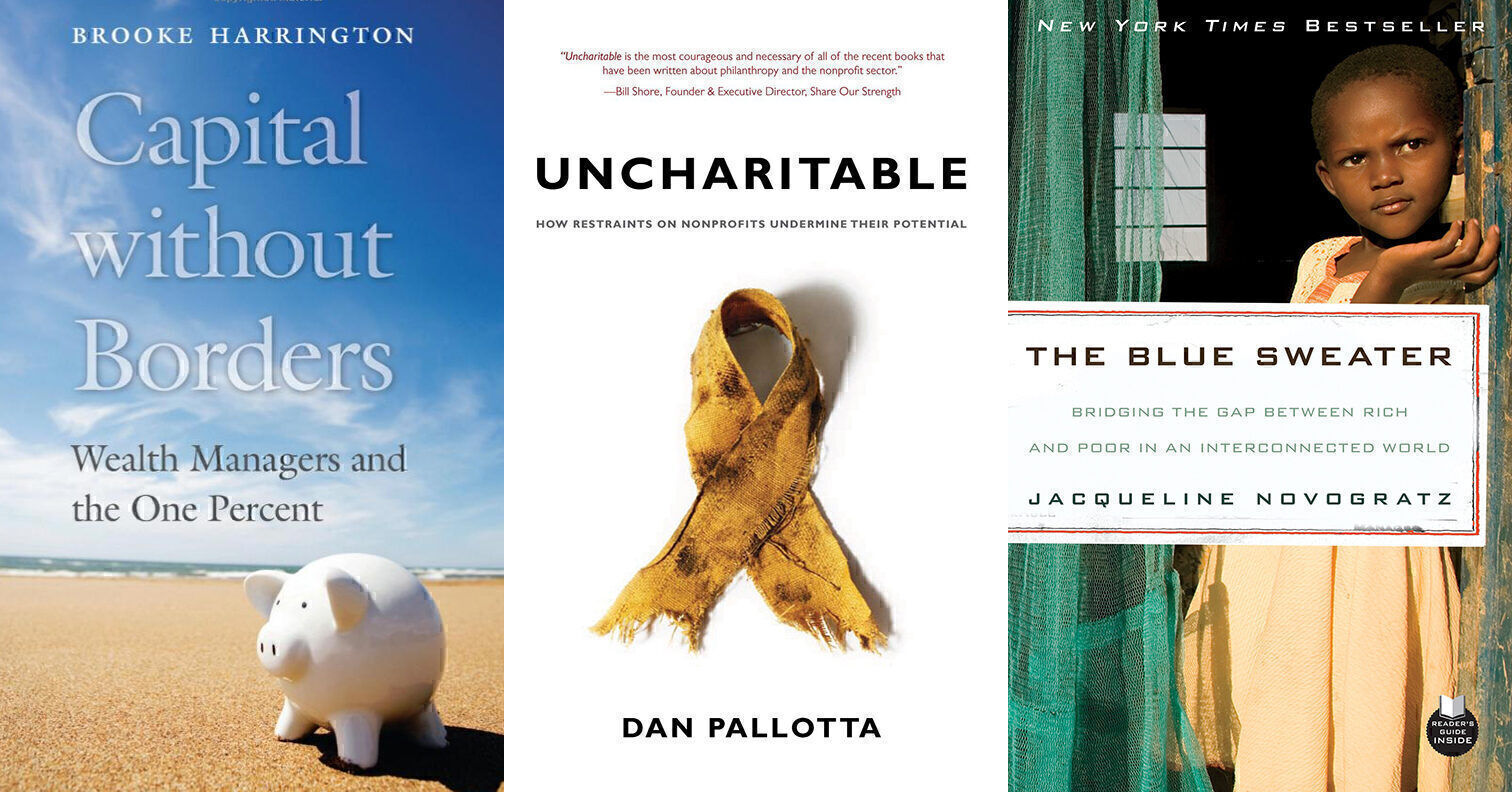
The Blue Sweater: Bridging the Gap Between Rich and Poor in an Interconnected World, by Jacqueline Novogratz. Written by the CEO of the Acumen Fund, this book explores the interconnectedness of the rich and poor and the effectiveness of global philanthropy through stories of people in the developing world who are working to bring themselves and others out of poverty.
Capital Without Borders: Wealth Managers and the One Percent, by Brooke Harrington. Based on interviews with 65 practitioners, the author examines ways that wealth managers protect their clients’ from taxation and interpret laws to maximize their financial advantage. Thanks to Jennifer Filla for recommending this.
Dare to Lead: Brave Work. Tough Conversations. Whole Hearts, by Brené Brown. The New York Times best-selling author examines how to encourage leaders to be brave and make courage part of your organizational culture. Thanks to Tracy Barron Phillips for suggesting this book.
Donor-Centered Fundraising, by Penelope Burk. In this updated and expanded edition, the author draws on numerous studies and shares her methodology for raising money using strategies that enhance donor loyalty.
Gender Norms and Intersectionality: Connecting Race, Class and Gender, by Riki Wilchins. Examines the effects of gender biases, how our society views gender norms, and how these dynamics shape policy. Thanks, @sevdakilicalp, for the suggestion.
The Givers: Wealth, Power, and Philanthropy in a New Gilded Age, by David Callahan. Examines today’s megadonors who, he posits, are reshaping philanthropy and significantly influencing public policy. Thank you, @lindsayinMPLS, for this recommendation.
Just Giving: Why Philanthropy Is Failing Democracy and How It Can Do Better, by Rob Reich. Makes the case that philanthropy is an exercise of power that converts wealth into public influence that is not accountable but benefits the donors through tax breaks and other incentives. Thanks, @vmford, for sharing this.
Keeping Faith in Fundraising, by Peter Harris and Rod Wilson. The authors examine fundraising through the lens of their Christian faith and offer insights into how to raise money with integrity. Thank you, @felixdresewski,for suggesting this.
Philanthropy: Discover Your Nonprofit’s True Potential, by Jamie Levy. A guide for nonprofits on how to achieve long-term financial stability and maximize impact. Thanks for this, @TimothyGWeir.
The Storytelling Nonprofit, by Vanessa Chase Lockshin. A practical guide to telling stories that raise money and awareness for fundraisers, communications professionals, and executive directors who want to tell compelling stories about the difference their organizations make. Thanks, @NonprofitKate.
Uncharitable: How Restraints on Nonprofits Undermine Their Potential, by Dan Pallotta. Read a summary of the book and an interview with the author.
Winners Take All: the Elite Charade of Changing the World, by Anand Giridharadas. Read a Q&A with the author written by Drew Lindsay, a former Chronicle editor. Thanks to @SimoneCyra and @vmford for recommending this book.
Editors’ Pick
Changing the World Without Losing Your Mind, by Alex Counts. The founder of the Grameen Foundation shares lessons he learned while serving as a nonprofit leader for decades; includes advice on leading and maintaining work-life balance.
Margie Fleming Glennon produces the Chronicle’s professional-development webinar series and is editor of its resource library, a collection of more than 1,000 articles and tools to help nonprofit professionals succeed on the job. She has more than 20 years of experience in nonprofit communications and public affairs including serving as communications director at national and international nonprofits. Email Margie or follow her on Twitter.