Hospital Fundraiser Knows Institution Inside Out to Help Donors Connect

By Maria Di Mento
Senior Editor
August 11, 2014 | Read Time: 8 minutes
New York
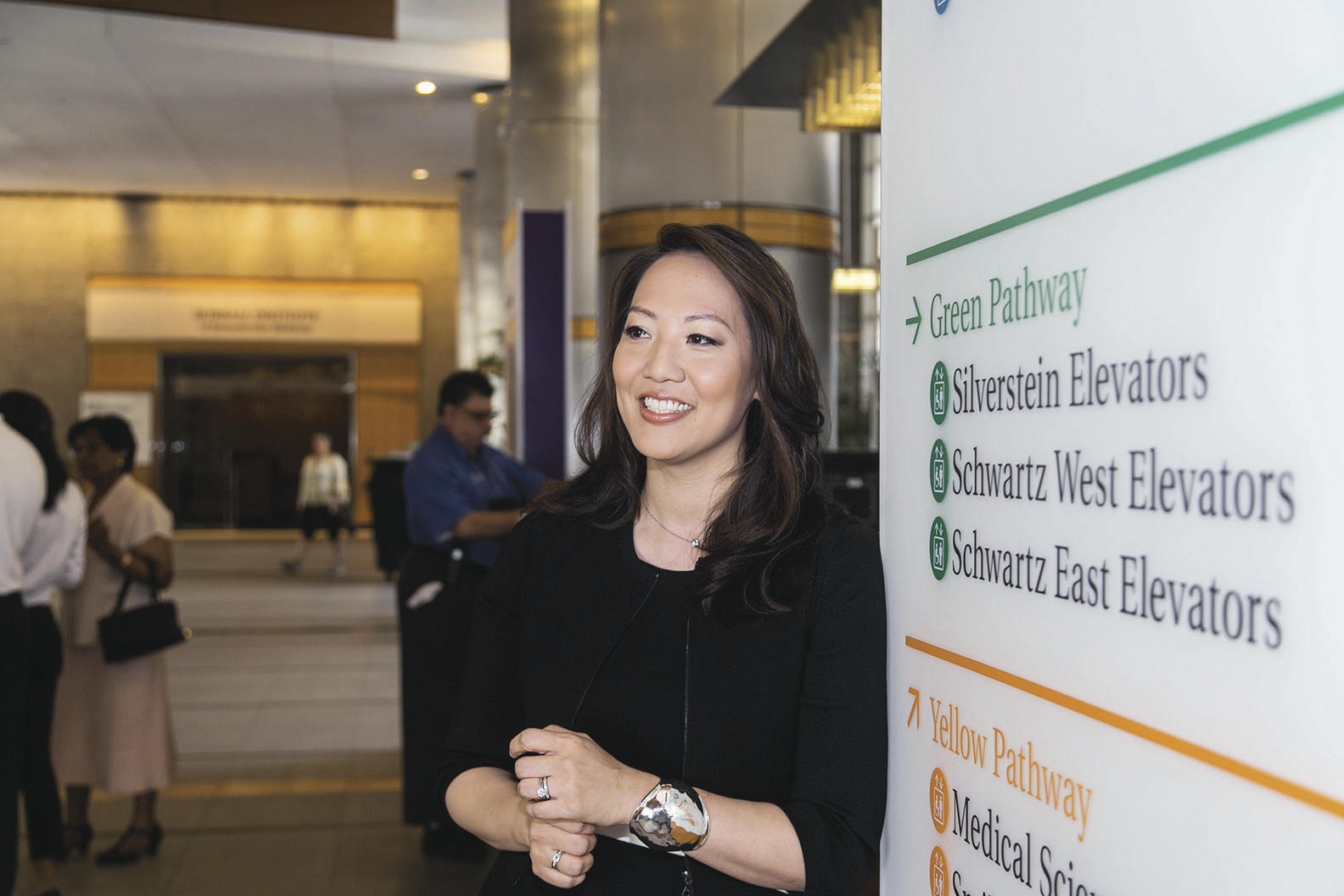
Grace Ko, the chief fundraiser of New York University Langone Medical Center, does more than raise money. She acts as a hub, linking donors and her development staff with the center’s researchers and department heads.
“Sometimes I think I’m just one giant Malcolm Gladwell connector,” she says, referring to the author of The Tipping Point, which uses the term “connector” to mean people with a talent for getting to know others.
Ms. Ko, who has helped the medical center raise $1.2-billion over six years, notes that “it’s my job to get the information out to a lot of groups of different people.”
Her skill at creating connections has boosted the 37-year-old to the top fundraising job at the institution and helped lure multimillion-dollar gifts from Ronald Perelman, Jan and Marica Vilcek, Steven and Alexandra Cohen, and other wealthy donors
As vice president for development and alumni affairs, she leads a staff of 70 and spearheads Langone’s 12-year drive to raise $2.8-billion by 2019.
Donors and colleagues say it is Ms. Ko’s innate ability to relate easily with people from all types of backgrounds and a genuine interest in others that has helped the institution attract so many large gifts in recent years.
“She has a way about her that is totally approachable,” says Laura Perlmutter, who with her husband, Isaac, a financier and head of Marvel Entertainment, gave the medical center $50-million in January. “When she’s talking to you, she’s talking only to you. She’s not scanning the room for the next target. She’s just totally involved and responsible and caring.”
Public Service Jobs
Ms. Ko may have inherited her knack for building productive relationships. She grew up in New Jersey, one of three children of Korean immigrants who came to the United States in 1970 so her father could attend business school. One grandfather, an important mentor, was a politician who once served as speaker of South Korea’s legislative body, the National Assembly.
But her own professional journey also helped shape her approach to her current job. After graduating from Barnard College in 1998, she worked for New York City’s Department of Parks & Recreation. There she developed projects, secured grant money for after-school programs, and landed corporate sponsors for the department’s large-scale events. Her boss then, Robert Garafola, says he noticed that Ms. Ko was adept at creating alliances.
“She had a very personal style about her, and she built relationships with people at all levels both inside and outside the organization,” says Mr. Garafola.
A stint in the corporate world left her longing to return to a job that focused on helping society. In 2005, she joined Community Counselling Service Company, a fundraising consultancy, where she helped raise money for the League of American Orchestras, Hunter College, and other nonprofits.
She worked with Langone first as a consultant on its capital drive and joined it full time in 2009. She was named to the top fundraising post last year by Robert Grossman, Langone’s chief executive.
Dr. Grossman, who delights in calling Ms. Ko “Amazing Grace,” says he hired her because of the same skills Mr. Garafola noticed 16 years ago: a talent for creating connections.
The medical-center chief was impressed by her ability to link different types of people all across the organization. And most important, he observed, donors liked talking to her.
“Donor negotiations are sometimes challenging,” says Dr. Grossman. “You want to make sure the donor always feels good about their gift and sometimes they’re a little persnickety. But Grace always makes them feel great.”
Building Ties to Hospital Leaders
These days, there’s more to being a top medical-center fundraiser than simply tending to donors’ needs, says William Littlejohn, chairman of the Association for Healthcare Philanthropy.
“To be successful today in health-care philanthropy, not only do you have to be donor-centric,” says Mr. Littlejohn, who also leads the Sharp HealthCare Foundation. “You have to be ally-centric and do as much relationship development with those who are engaged with the enterprise itself.”
To that end, Ms. Ko devotes time to getting to know the medical-center staff, visiting labs, touring departments, and talking to the center’s researchers frequently to learn about their latest work. As a result, says Dr. Grossman, she knows the center and its work “inside and out,” making it easier to connect donors with projects that might interest them.
Earlier this year, for example, Ms. Ko met with Edgar Bronfman Jr., an heir to the Seagram Company fortune and a longtime donor to the center. The two talked about a Bronfman family member’s experiences as a Langone patient, nutrition and diabetes, and a Langone physician’s work related to complications associated with the disease.
Mr. Bronfman asked for more information. So Ms. Ko, who believes the center’s doctors are often best at explaining their findings, connected him with the physician.
Seizing an opportunity, the researcher mentioned he wanted to hire a top scientist in endocrinology, diabetes, and metabolism but didn’t have the budget.
The result: Mr. Bronfman and his wife, Clarissa, made a gift to endow the new post. (Mr. Bronfman declined to provide an exact figure for how much he donated for this professorship, but such positions at the medical center usually run to the $3-million mark.)
In addition to making the right connections, Ms. Ko asks donors how they want to be contacted and how often. Some like face-to-face meetings, others prefer to communicate by phone or email.
Such information came in handy recently when her office sent a handful of donors invitations to a small private dinner with medical-center leaders. One of the donors who was invited, she knew, tended to ignore such event invitations.
But because she believed the donor would enjoy the dinner, Ms. Ko took a direct approach.
“Knowing his style, I just called him and said ‘Before you get bent out of shape about another dinner invitation, just let me give you the background on this.’ And he appreciated that,” says Ms. Ko. The donor and his wife came to the dinner and afterward thanked Ms. Ko for taking the time to call them.
A Patient Herself
At Langone, about 90 percent of the institution’s donors or their relatives have been patients. So has Ms. Ko, and she uses that experience to help forge connections: She delivered her first child, a daughter who is now 3, at the medical center. Ms. Ko and her husband were first-time parents and appreciated the care and instruction the hospital’s nursing staff provided.
“We just didn’t know a thing, but they really armed and prepped us with such great information,” she says. “And then there’s just little things, like being respectful of how a new mother might be feeling.”
When it came time to give birth to her son, who is now 18 months old, she again intended to deliver at Langone. But Superstorm Sandy forced the medical center to close, diverting Ms. Ko to another hospital. She cringes a little when she describes her care, saying it was a “different experience.”
“When you’re in that position and vulnerable, there’s nothing like having the kind of care and attention I had the first time,” says Ms. Ko.
When she talks to donors, she says, “I feel really proud to say, ‘I’ve had this experience. I’ve been in your position.’ ”
While most donors to Langone have been patients there, some have been involved in other ways: Ms. Perlmutter, for example, started volunteering at the medical center in 1978 and has seen it grow “from the ground up.”
While the couple had planned to make a large donation anyway early this year, Ms. Perlmutter says she was particularly impressed with Ms. Ko during the negotiations for the $50-million they gave in January.
“She became intimately involved with our needs and our desires in how this gift was to go down,” says Ms. Perlmutter.
“Giving that kind of a gift is more of a deal-making situation; it’s not just, ‘Hello, here’s my check and goodbye,’ so she really gets it.”
And while Ms. Ko refuses to take credit for it, the Perlmutters say they are planning a second, similar-size gift to Langone.
“Grace isn’t in it for the glory,” says Ms. Perlmutter. “She’s in it for the institution and for the people and the team.”
Grace Ko
vice president, development and alumni affairs, New York University Langone Medical Center
Age: 37
Education: Bachelor’s degree, English, Barnard College
Career highlights:
- Executive assistant to the deputy commissioner for management and budget, New York City Department of Parks & Recreation
- Development officer, Coalition for the International Criminal Court
- Executive director, CCS (Community Counselling Service Company), a fundraising and development firm
Success secrets:
- Builds alliances: She talks to people throughout the organization about their work and links them to donors who want to know more about it.
- Learns donors quirks: Finds out how supporters like to be contacted and tailors her overall approach to their preferences.
- Minds the details: Makes sure to consider the donor’s needs in each aspect of a final gift agreement.
Advice for fundraisers: Sometimes fundraisers focus too much on the amount of money they need to raise and disregard donors’ passion for the cause. “Never lose sight of the fact that this is not your gift. This is their gift.”