People Skills No Longer Sufficient for Fund Raisers to Thrive
Globalization, and changes in demographics and technology, will transform the profession

By Holly Hall
Contributor
April 4, 2010 | Read Time: 10 minutes
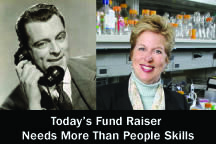
Wanted: Fund raisers whose entrepreneurial spirit, cross-cultural knowledge, and analytical abilities match their skills in building strong personal ties to donors. A good understanding of the aging process or experience in grass-roots organizing is a plus.
Such job requirements could soon become commonplace as charities seek fund raisers who possess the multiple talents needed to compete for donations in a changing marketplace.
Already, the bad economy has intensified the demand charities are placing on fund raisers who know how to screen electronic databases and use other analytical tools to increase giving in cost-efficient ways. Zachary A. Smith, who works to fill development jobs at the University of California at Irvine, says when he seeks fund raisers to solicit big gifts he now wants to see “60 per cent analytical skills, 40 percent people skills.”
“We want to know what strategy you have used to increase fund raising,” he says. “It’s not just getting out there soliciting donors.” But he laments that finding such people is difficult because analyzing and applying data are still “not a big focus among front-line fund-raising staff.
As executive recruiters and fund-raising experts look ahead to the talents more development officers will need, they point to a range of trends that could reshape the profession:
Expansion of money-making ventures. The recession’s squeeze on traditional sources of private donations, such as foundations and individuals, prompting charities to take renewed interest in starting businesses, and they need fund raisers who can help find and manage new efforts to seek revenue.
A growing pool of older donors. The number of Americans 65 and older will nearly double in the next two decades—and the number of people in their 50s, often a focus of fund-raising efforts—will dwindle. That means fund raisers of all kinds—not just those who specialize in winning bequests and other planned gifts—increasingly need to understand the differences between people in their 60s and early 70s and those who are much older. “The relentless aging of the population is the main thing driving charity,” says Robert F. Sharpe, a Memphis planned-giving expert. That, he adds, will affect “everything from the design of appeals to how loud you talk on the phone to spotting mental confusion or Alzheimer’s.”
Demand for technology savvy. The growing number of donors who use social media has intensified donors’ interest in interacting with charities. As a result, says Matt Mahan, who directs nonprofit relations at Causes on Facebook, fund raisers who understand the techniques of community organizing are likely to thrive, while those accustomed to simply sending direct marketing appeals will need to learn new skills.
Globalization. As wealth grows outside the United States, more charities will seek fund raisers who understand how to raise money across borders. Plus, groups will need people who understand the giving styles of minorities, a fast-growing multitude of potential donors in the United States.
“Development directors need to think globally in a more integrated economy, even when working in domestic activities,” says Richard O’Sullivan, author of a new report on emerging fund-raising trends published by the Association for Healthcare Philanthropy.
Following is a look at changes in the fund-raising profession:
Matchmakers and Entrepreneurs
It’s hard to tell that Janene Centurione is a fund raiser at the University of Michigan Life Sciences Institute from her title: chief of research business development.
Nor is that really how she describes her job. Ms. Centurione, who has an M.B.A. and an undergraduate degree in biology, calls herself a “matchmaker” between biomedical researchers in the institute’s laboratory and venture capitalists and philanthropists who want to help them move quickly to find treatments for life-threatening diseases.
Ms. Centurione pairs the researchers with mentors—business experts and scientists who have built successful companies and understand how to move basic research from the lab to the marketplace. Then she seeks donations to make it happen.
She has already raised $2-million to finance one round of research, and is seeking $5-million more. And after just 18 months, she says, one line of research will now be spun off into a company and another will be licensed to generate royalties for the university.
“I act as an entrepreneurial business coach,” Ms. Centurione says. “I am a strange creature in the development world.”
Entrepreneurialism among fund raisers will become increasingly important in coming years, experts say. Already there are signs that charities are actively seeking those skills in the fund raisers they hire.
“We are finding more emphasis on people who can bring strong ideas of how to raise more money by moving beyond traditional ways, thinking of public-private partnerships to generate revenue,” says Marian A. DeBerry, an executive recruiter at Campbell & Company, a Chicago fund-raising consulting firm.
Ms. DeBerry says that her company was recently approached by a human-services organization that had started a floral business and a trash-collection business. The charity wanted its new development director to help get similar enterprises off the ground.
To succeed in running such ventures, fund raisers need to be included in planning and decision-making meetings at the highest levels of an organization, says Mary Anne Chern, president of White Memorial Medical Center Charitable Foundation, in Los Angeles. That means they need to demonstrate their business savvy and problem-solving skills so that other leaders will want to keep them involved, she says.
Being at the table has enabled Ms. Chern to help hospital leaders find solutions to problems such as a lack of child-care options for employees.
Ms. Chern and other hospital administrators started a day care center on the medical center’s grounds, and found two very different types of revenue. The center is open to low-income people in the neighborhood, which makes it eligible for state subsidies. Hospital employees also pay fees to use the center.
Once fund raisers get involved in money-making ventures, some find it hard to go back to traditional ways of seeking donations.
Ms. Centurione, the University of Michigan fund raiser, is exploring ways to help her local food bank find a chef to offer cooking lessons to donors and other affluent individuals who will pay for the service. Her goal is to use donated food for the lessons, with the idea that cooking lessons would bring donors closer to the food bank and motivate more people to support its work.
“This is the way that successful organizations will have to go,” she says. “And it helps donors be more passionate.”
Cross-BorderFund Raising
As wealth grows faster and faster beyond America’s borders, charities are increasingly seeking fund raisers with the cross-cultural skills needed to woo money from a more diverse range of donors than they ever approached in the past.
Charities like United Way are now stepping up efforts to seek money abroad. They follow in the footsteps of groups like World Vision and Rotary International, which have long raised money outside the United States but are expanding those operations to finance their global work.
Adding to the need for fund raisers who are culturally sensitive to donors from different backgrounds: the growing number of blacks, Hispanics, and other minorities in the United States. By mid-century, more than half of the population will consist of people who are members of minority groups.
Even fund raisers at locally oriented institutions have begun to feel the effects of globalization in their work.
Community colleges, for example, many of which have been successful in attracting students from outside the United States, are beginning to search for overseas donations, notes Rae Goldsmith, vice president for advancement resources at the Council for Advancement and Support of Education.
Using Technology in New Ways
New online fund-raising tools are rapidly changing how organizations solicit money and the skills that nonprofit organizations will increasingly require in their fund raisers.
As charities turn to a growing number of electronic research systems to identify and shape relationships with donors—and find new ways to cut costs—executive recruiters are beginning to put more of a premium on fund raisers who have strong research and analytical skills.
Erin Hall-Westfall, director of recruitment at the University of Michigan’s development office, says she wants fund raisers who can use technology to determine where to spend scarce travel dollars, or whether attending an awards dinner prompted people to increase their giving over the following two years.
“It is more than just being able to use the donor database,” Ms. Hall-Westfall says. “It is systems thinking. The fund raiser needs to use research to drive overall donor strategy.
The explosive growth of Facebook, Twitter, YouTube, and other online social-networking sites that enable people to share information are also transforming the skills and outlook that fund raisers need.
Reaching donors who have grown up using social networks requires fund raisers to be skilled in building relationships online, not simply in finding the e-mail message that will produce the bigger return, says Allison H. Fine, a former nonprofit leader who now advises charities on communications. “Social media is about connecting. Organizations need to create friends first and funds second online.”
Fund raisers who understand grass-roots organizing could become increasingly in demand as charities experiment with new ways to reach donors in the social-media age, says Matt Mahan, who directs nonprofit relations at Causes on Facebook—an online application that allows people and organizations to share information and raise money for charities. Savvy charities have used Causes to reach out to people who express keen interest in their organizations online, and get them to represent their organizations, he says. Sometimes, in encouraging them to advocate and raise money for the group in any way they choose, says Mr. Mahan, the organization will even offer them a formal title.
Working with donors accustomed to social media will require an especially big shift in the mind-set and skills of many fund raisers who work at the nation’s biggest charities, he says.
“They are oriented to direct marketing as opposed to working through personal networks. They need to reorient themselves to a radically decentralized world.”
Understanding Older Donors
Charity fund raisers have always focused on older donors, but the graying of the baby boomers will require new skills, plus a new outlook.
As the number of people ages 65 and older nearly doubles over the next 20 years, advances in health and life expectancies mean that many fund raisers will need to understand the different stages of aging, and how it affects giving and financial decisions.
“We think of everyone over 65 as old,” says Bruce Flessner, a Minneapolis fund-raising consultant. “But people in their 60s are very different than people in their 80s and 90s.”
One fund raiser at a prominent medical institution has gone so far as to get a master’s degree with an emphasis in gerontology to better understand the people she approaches for bequests and other planned gifts.
But most fund raisers outside the planned-giving office have thought very little about how to deal with age-related concerns that can arise with donors, says Mr. Sharpe.
“You could be working with a perfectly OK older donor at age 65, then they have a mild stroke, and you notice problems with their motor skills,” he says. “Are they competent to discuss their charitable giving? Should you bring in a family member or a trusted adviser?”
Beyond being sensitive to health and ethical issues, Mr. Sharpe says fund raisers will need to do more to get to know what motivates supporters in their 70s and beyond.
Fund raisers also need to shed preconceptions about older adults. Some people believe they should be approached for bequests instead of large outright gifts of stock that a charity could receive more quickly, Mr. Sharpe says.
But, he says, IRS figures show older donors give far more stock those those under 65.
Just as important, the growing number of older people will spell a rise in demand for people who understand how to solicit bequests and other planned gifts. But so far, most charities do a very poor job of seeking bequests, says Adrian Sargeant, a researcher and professor of fund raising at Indiana University.
One reason, Mr. Sargeant says, is that charities don’t do enough to focus on what motivates a person to leave a bequest. “We need to get smarter about what donors want,” he says, “and responding where we can.”