Saving Rosie the Riveter’s Factory and Salvaging a Capital Campaign

By Avi Wolfman-Arent
Contributor
March 1, 2015 | Read Time: 2 minutes
By early 2013, the Michigan Aerospace Foundation had spent more than a decade trying to finance a new museum. After showing some initial promise, its capital campaign stagnated amid the recession and faded enthusiasm from donors.
Enter Rosie the Riveter.
Based on a real woman who worked at a wartime manufacturing plant, the character has long been an icon of female empowerment. But while Rosie endured, her former place of employment—the Willow Run Bomber Plant in Ypsilanti, Mich.—was under threat of demolition.
That threat, however, proved advantageous for the Michigan Aerospace Foundation. After consulting with the factory building’s current owners, the foundation announced it would attempt to purchase a 144,000-square-foot chunk of the doomed plant, preserve it, and convert the space into a new museum. All it needed to do was meet the asking price: $8-million.
Overnight, the foundation’s once-anonymous, long-suffering fundraising efforts became the “Save the Willow Run Bomber Plant” campaign.
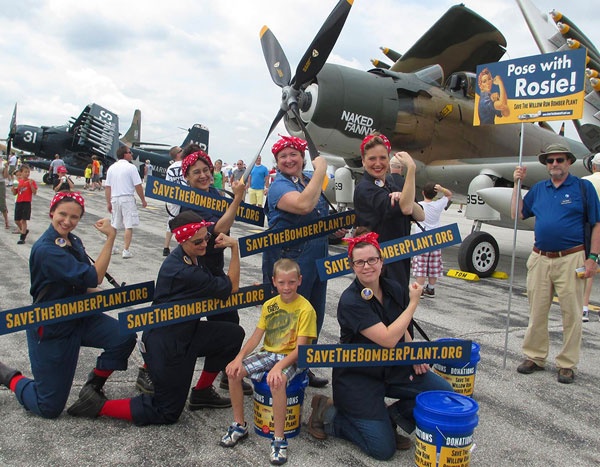
Since the new campaign began in 2013, it has been featured by NPR, the “NBC Nightly News,” and the Associated Press. The nonprofit has churned out lawn signs, distributed pins, and even helped set a record for most Rosie the Riveter impersonators in one place. As it all unfolded, the group—which is dedicated to preserving Michigan’s aviation history—received donations from World War II buffs, feminists, and well-wishers nationwide.
“There are times where this wasn’t so much an organized campaign as much as it was like we started a forest fire,” says Michael Montgomery, the foundation’s fundraising consultant for this project.
On October 30, the foundation closed a deal for its portion of the plant.
Mr. Montgomery lobbied the foundation to target Willow Run and says his efforts were as much about changing the foundation’s self-image as they were about raising its public profile.
He recalls telling the board, “Guys, if you ever want to get this thing funded, you’re either going to have to raise the money yourselves or you’re going to have stop being the old guy, old airplane club.”
Mr. Montgomery believes the Save the Willow Run Bomber Plant campaign proves that even small niche nonprofits can look for opportunities to expand their reach. That doesn’t mean a national campaign necessarily but rather establishing links between their work and the larger public.
“You’ve got to connect the work you’re trying to fund to things the larger community can understand and care about,” he says.
By the Numbers
Total Donors in 2012 (the year before the campaign): 285
Money Raised in 2012: $75,560
Total Donors in 2013: 1,844
Money Raised in 2013: $351,757
Total Donors in 2014: 3,408
Money Raised in 2014: $1,219,112