Social-Service Group Finds Ways for Donors to Give in Hard Times

By Michelle Gienow
Contributor
August 11, 2014 | Read Time: 7 minutes
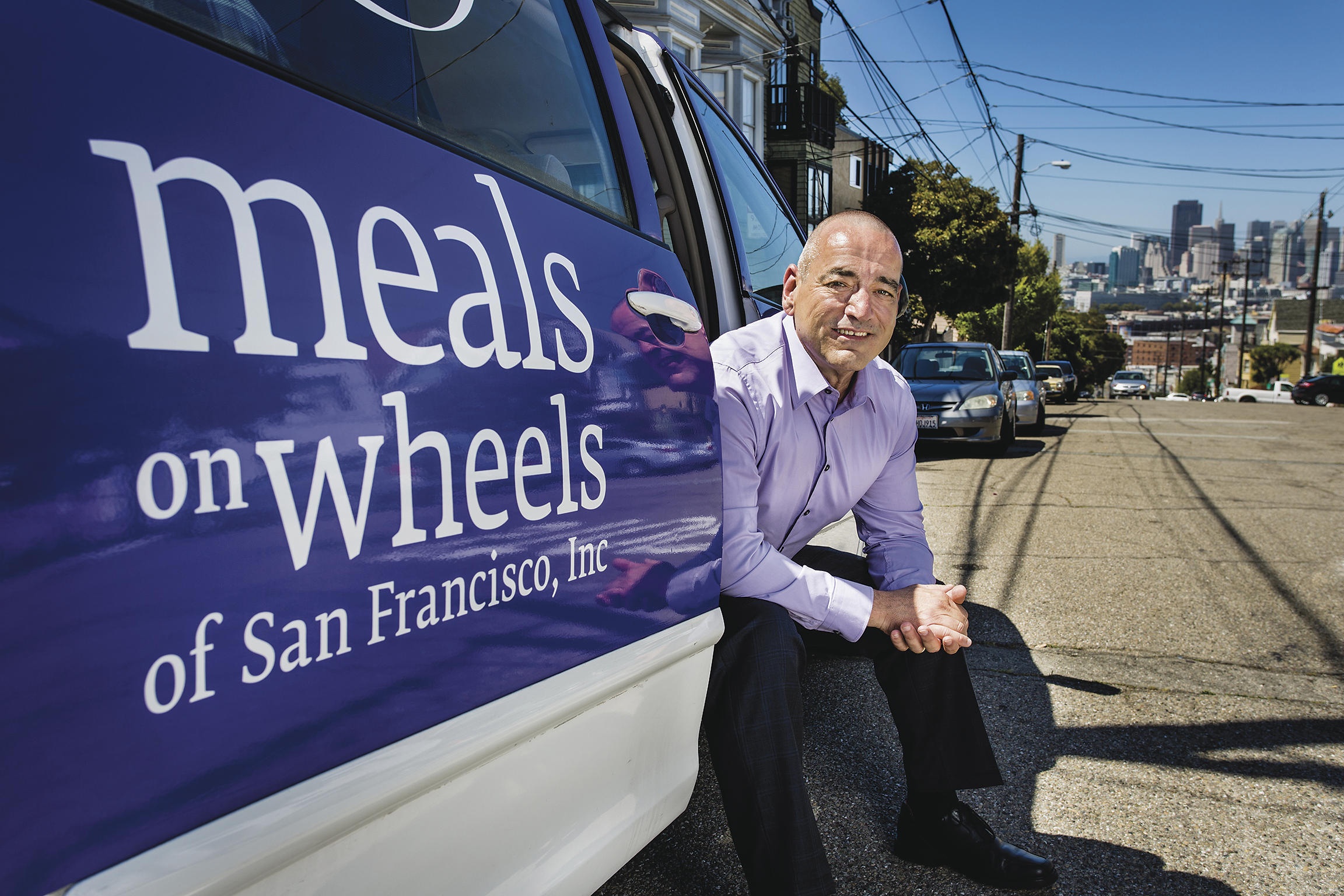
The best fundraising is like staging a house for the real-estate market, says Ashley McCumber, who leads Meals on Wheels of San Francisco. Tell donors specifically how they can help: It’s the equivalent of showing home buyers where the table should go.
He developed this theory years ago after helping a friend decorate a duplex apartment that had languished on the market for nearly a year. Once staged with furniture and accessories, the unit sold almost immediately—to a buyer who had toured it four times before, without making an offer.
“People don’t always have the greatest imaginations, so you need to show them the attractive possibilities,” says Mr. McCumber, who spends about 75 percent of his time on the job raising money.
At Meals on Wheels of San Francisco, for example, “we don’t just say we need support to provide 1,000 meals. We say we need 1,000 meals, and each one needs a meat, a vegetable, and some milk,” he says. “That way someone can say, ‘Oh, I can do the milk!’ Maybe they can’t do the whole thing, but they can do a piece of it—but only if you offer them that choice.”
Setting an Example
Over the seven years Mr. McCumber has led the group, it has doubled both the number of meals it serves each year—from 623,000 in 2007 to more than 1.2 million today—and the number of homebound older people receiving them. He has steadily expanded his organization in an era when government funding for home-delivered meal programs has been cut repeatedly, even as demand has soared. When he arrived at Meals on Wheels San Francisco in 2007, 60 percent of the organization’s annual budget came from government, with private donations making up the rest. Today, private money accounts for about 60 percent of the group’s nearly $9-million budget.
“Leadership and development are two very different competencies, but Ashley can toggle between the two almost seamlessly,” says Ellie Hollander, president of Meals on Wheels Association of America.
He gives money generously to his own group, she says, and finds time to serve on the national board of her organization, as well as on that of CalNonprofits, the umbrella group for charities in his state.
She adds, “Ashley simply never asks anyone to do anything he isn’t already doing himself.”
‘Asking Twice’
Mr. McCumber took a big step to increasing his charity’s budget by more than doubling the income from its centerpiece annual fundraising event. When he arrived in 2007, the Star Chefs and Vintners gala was in its 20th year and typically raised around $1-million annually (already an enviable amount for a charity with just 84 staff members, including kitchen workers).
“San Francisco is a food city near one of the world’s greatest wine regions, and the event had a following. Chefs saw it as a must-do event,” he says. “My challenge was to take this already amazing product and connect the right people to it to really ramp up the fundraising.”
And ramp it up he did: June’s Star Chefs and Vintners Gala raised $2.6-million by getting everybody who attended to give more. “We didn’t add more people: We just upped the result significantly,” he says,
He realized that fundraisers could essentially ask everyone who came to give twice. People have to buy tickets to get in. But when they get there, they encounter lots of ways to give. The gala features a live auction, which this year raised $600,000, and a “Fund-a-Route” challenge, in which guests bid to sponsor segments of Meals on Wheels delivery routes for the coming year, raised $810,000.
When he began running the gala, Mr. McCumber found that part of his job was soliciting donations for one of the live auction’s most popular items, a collection of a dozen rare bottles of wine. Tracking down donations was difficult and time consuming until he thought to “stage” the collection by creating a wish list of 12 vintages.
“We put out that list, and we got all 12 very quickly,” he recalls. “This is how moving from a generic request to specific helps people help you. They don’t have time to wander their collection and choose a great bottle for you, but if you tell them exactly what you need, they’re able to say, ‘Hey, I have that and you’re welcome to it.’”
Everyone Can Give
San Francisco, stocked with new technology wealth, is an unusual place to raise money. And yet opportunities exist for fundraisers in less-affluent cities and regions, too.
“It’s easier to fish a well-stocked pond, absolutely,” he acknowledges. “But the principles of raising funds—people and the investment of time—remain the same in all communities. The only difference is scale.”
People from all walks of life, even the neediest, already give, he says. Building a successful fundraising event is a matter of “starting where you are and then radiate in circles.”
This is something any organization has capacity to do, Mr. McCumber says.
“People are astounded that we raise $2.6-million from one event, but that is not where we started 27 years ago,” he says. “That happened over time, slowly and deliberately building a network of supporters who then attracted more support. ‘My community does not have the capacity to give’ is not a concept that I agree with.”
Start with today’s donors and volunteers and build out, he says. Trying to launch a big event can lose money in the first few years while draining time and resources. Instead he recommends asking board members and key volunteers to host small house parties. This can be a series of flexible, low-cost, intimate events in which supporters connect with your group and also with one another, building a sense of belonging and commitment.
“Ask your leadership volunteers, singly and in small groups, for their continued support and ideas for how to increase the impact of your mission,” he says. “Once you’ve built this base, you can then shoot for the big effort and commit to growth over time.”
Be patient with the effort needed to build, he stresses. “There is simply no substitute for this kind of groundwork,” he says. “Get people together and ask for their help: It’s effective, and it’s something everyone can do.”
Donors Recruit Donors
Mr. McCumber built his approach to fundraising itself over a 28-year career that included leading a social-service organization in Boston and holding fundraising jobs at a religious group, a health-care nonprofit, and a college.
He has become convinced of the power of what he calls the “Be one, bring one” approach: getting volunteers and donors to recruit others to support a charity at the same level or higher.
“It’s comfortable for people because they are asking someone they already know to do something they already themselves are doing. It’s an easy ask, it’s usually successful, and it ripples outward very quickly in terms of building that essential base.”
“I always ask people, when was the last time you did anything—even go to the movies—that didn’t include someone inviting you to do so?” says Mr. McCumber. “We live very busy and overly saturated lives. For many people, including for me, the difference is always the person who asks me to participate.”
Ashley McCumber
Chief executive, Meals on Wheels of San Francisco
Age: 52
Education: bachelor’s degree, speech communications, University of North Carolina at Wilmington
Career highlights:
- President, United South End Settlements, a community- service group in Boston
- Senior director for institutional advancement, Unitarian Universalist Service Committee
Board service:
- Chair, CalNonprofits, California’s association for charities
- Board member, Meals on Wheels Association of America
Success secrets:
- Makes specific requests: He shows donors exactly what needs they can fill with their support.
- Asks twice: For instance, he sells tickets to a fundraising event but then requests further support at the event through live auctions and requests to sponsor specific programs.
- Uses the buddy system: Gets donors to nudge their friends to give money or time at the same level that they do.
- Shows patience: Fundraising events and other efforts to raise money take time to grow.
Advice for fundraisers: Encourage donors and volunteers to ask one person to give. “If you give $10 each month, ask one other person to do so. One plus one times everyone in your circle is math that adds up quickly.”