October 29, 2018 | Read Time: 6 minutes
Brits know Red Nose Day well.
The weekslong fundraising drive has been held in that country every other year since 1988 and has raised more than $1 billion. The effort is a lighthearted way to raise money for people in poverty, featuring a celebrity telethon and people wearing foam red noses to raise awareness and promote giving.
Red Nose Day crossed the pond in 2015, yet Americans aren’t as familiar with it. But that’s starting to change, according to Comic Relief U.S.A., which organizes the now-annual drive in the United States.
Today, about 45 percent of Americans know the campaign helps kids in need, according to surveys conducted by the charity. That’s up from 10 percent two years ago.
The hope is that the campaign — held April through May each year — will become known broadly, says Janet Scardino, chief executive officer of Comic Relief U.S.A. “Our real objective is to engage as many Americans as possible” on the issue of child poverty, she says. The group wants to open Americans “hearts and minds,” she adds, “as well as wallets.”
As awareness has grown in America, so has revenue. The first U.S. campaign in 2015 raised $21 million for the Red Nose Day Fund, which supports charities such as Boys & Girls Clubs of America and Charity: Water. This year, it brought in double that: $42 million.
Corporate Sponsors Help Raise Profile
What’s driven that growth? For one, many American stars like Jack Black, Julia Roberts, and Jennifer Garner, have promoted it.
But just as important: Big companies, like Walgreens and Mars candy help publicize the drive and spur donations.
Walgreens stepped up as the exclusive provider of red noses when the U.S. campaign started, so many Americans learned of the campaign during visits to its stores.
In 2018, Walgreens’ total contribution to the drive was $23 million, which includes sales of red noses and other merchandise (a portion of proceeds go to the Red Nose Day Fund), employee fundraising, customer donations, and special sales.
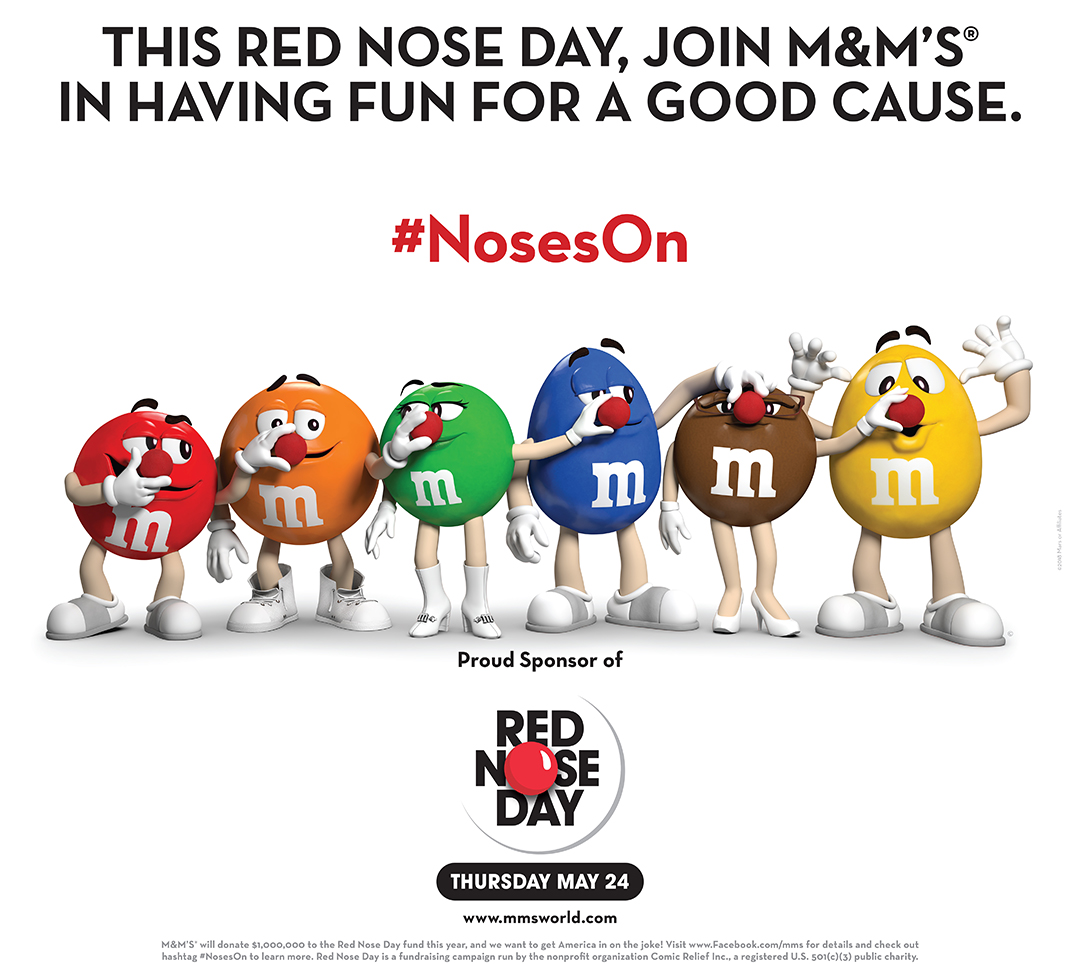
M&M’s, owned by Mars, promotes the drive on social media and works with NBC to create marketing materials for a night of shows that the television network broadcasts in May each year related to the campaign.
On May 23, one day before Red Nose Day 2018, M&M’s released a video on YouTube featuring the education-focused charity City Year Chicago, which receives support from the drive. Students from Chicago’s West Side traveled to the Second City, a renowned comedy venue, to try out some stand-up routines with Vanessa Bayer, recently of Saturday Night Live fame. “I think humor definitely helps with hard times,” one student says in the video.
This year, Mars donated $1 million to the campaign.
Lots of charities want to build the same kinds of relationships with companies, but they’re unsure how.
Tips for Successful Alliances
The Chronicle spoke with Scardino and officials at Mars and Walgreens to get their thoughts on what’s made their partnerships successful.
Know your goals. Before approaching companies, charities need to think through their objectives, Scardino says.
For Comic Relief U.S.A., its aim is to get as many Americans as possible to donate to the campaign and learn about child poverty.
Thus, its corporate partners had to be well known nationally, she says: “We needed partners that had real scale.”
Walgreens has more than 8,000 stores (including its Duane Reade locations) in all 50 states and Puerto Rico. More than 95 percent of them sell red noses during the drive. The red noses are “a gateway into the charity” for many people, Scardino says. People who buy them or see store promotions gain a greater understanding of the campaign’s aims, she says.
Find partners with common values. Companies and nonprofits must have common interests and goals for partnerships to work.
Walgreens’ “corporate social responsibility” efforts are often focused on children and families, says Linn Jordan, senior director of brand marketing for Walgreens. Boots, the company’s British brand, has raised funds for the charity BBC Children in Need in stores and through telethons for 15 years. The company also supports Vitamin Angels, a charity the helps pregnant women facing malnutrition in more than 60 nations.
Red Nose Day U.S.A.’s emphasis on kids in poverty syncs up well with that focus, Jordan says: “We share common visions and missions.” Mars, which has partnered with the Britain’s Red Nose Day for years, takes giving back seriously, says Lee Andrews, vice president for corporate affairs at Mars Wrigley Confectionery Americas. Mars already supported some of the charities aided by Red Nose Day, such as Save the Children and Feeding America. “There’s this kind of congruence of values,” he says.
Mars has a sense of humor, too, he notes, and often works with entertainers in its promotions. That made Red Nose Day — which uses “the power of humor and entertainment” to achieve its goals — a natural fit, he says.
Give companies a business win. Companies need to see that a nonprofit partnership helps its business goals.
For Walgreens, it’s able to create a holidaylike atmosphere in its stores during the drive.
Companies that support the Red Nose Day Fund — including Mars — have their products placed in special sections, complete with themed signs and displays. More than 40 different brands — including Coca Cola, Starbucks, and Duracell — participate.
With more than 95 percent of Walgreens stores taking part in the drive, companies are confident that the promotions will get attention. Over all, the campaign helps Walgreens build stronger ties with its suppliers, Jordan says.
She declined to say whether more people visit stores during the drive — though she noted that customers now appear to look forward to it each year: “Doing good is good for business.”
Give companies a way to get employees involved. The campaign allows company employees to have some fun, which builds morale. Walgreens employees are allowed to purchase and wear Red Nose Day-themed shirts; some get people in their communities involved in fundraising, too. “It’s an opportunity to do something different and unique with our team members and get them involved in being a part of something that’s bigger than themselves,” Jordan says.
Be in contact regularly. Nonprofits need to make sure that they have staff available to work closely with their corporate partners, too.
Mars and Comic Relief representatives talk regularly, perhaps once a week, Mars’s Andrews says, with visits to Mars’s offices happening closer to the start of the drive.
Jordan of Walgreens says she talks with Scardino about the drive frequently, too. “There’s text messaging between us because that’s how close the relationships is,” Jordan says. “We are very much a family when it comes to Red Nose Day.”
Encourage companies to work together. Comic Relief has smart, creative staff who pitch good ideas, Andrews says. In 2017, the charity got most of its partner companies to promote a standard slogan for the campaign: “Noses On! Let’s Come Together to End Childhood Poverty, One Nose at a Time.” That’s a challenge when coordinating with many corporate teams.
Andrews says of Comic Relief U.S.A.: “I always imagine that there’s 200 of them and I always get shocked when I go into [their] office and I find out there’s like 20,” he says. “Because I think they each punch [above] their weight ten times over.”
Correction: A previous version of this article said that Britain’s Red Nose Day raised money for children in poverty instead of people in poverty.