November 3, 2016 | Read Time: 4 minutes
When it comes to raising awareness about a social problem, data can make all the difference. Westchester Children’s Association, a century-old advocacy organization in New York, has embraced this fact. The nonprofit conducts research to find out which children in the region are struggling, and then it shares its findings with partners who work collaboratively to change policies and improve children’s lives.
Data is “a powerful tool for discussing what’s going on in our communities,” says Limarie Cabrera, director of data analysis at the organization.
The nonprofit, which has fewer than 10 staff members and a budget of less than $1 million, has gained a reputation for sharing “accurate and credible information,” says executive director Cora Greenberg. “That’s been a tremendous asset to our work.”
Here, they share their framework for gathering, analyzing, and sharing data to advance your mission.
1. Collect it.
The first step to taking advantage of data is, of course, collecting it. To gather truly useful information and not simply engage in “bean counting,” leaders at WCA recommend asking: What information would we like to know that we could glean from measuring our own services?
Some of the numbers you’re looking for may already be available from outside sources. Examples include census and survey records, or those kept by state departments of education or an office for civil rights at a federal agency. This type of data is often called administrative data (i.e., operational data, not research data). To learn more about using administrative data, check out this resource: “To Make Program Evaluation More Affordable, Start With Existing Data.”
2. Break it down.
It’s important not to rely solely on top-line data without digging deeper because “averages don’t tell the story,” Ms. Cabrera says. For instance, in a wealthy county like Westchester, high average incomes can obscure pockets of poverty if researchers don’t look closely enough.
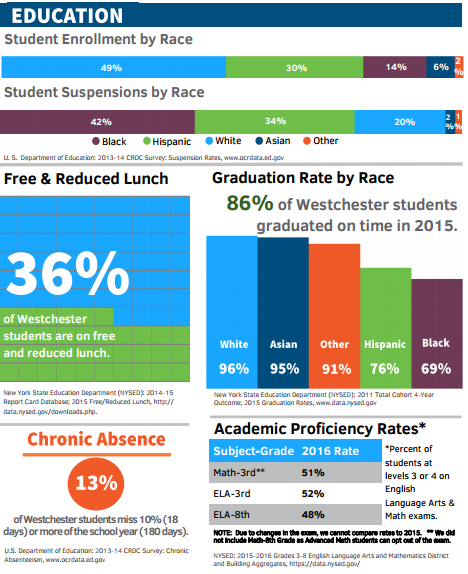
To shine a light on too-often overlooked or hidden problems, WCA publishes “community snapshots” that break information out into very specific zones to answer questions such as “What is the chronic absence rate for students in each school district?”
By zooming in on particular communities and asking detailed questions, Ms. Cabrera says, “we change data into information and into knowledge.”
For example, at a local Rotary Club, WCA gave a presentation that revealed a major discrepancy in resources available to different types of households. In the region, the median income of married couples with children under 18 is about $130,000. The median income of a single mother with children under 18 is about $30,000.
That figure got people’s attention and motivated them to take action, says Betsy Steward, development director. Although the presentation was not part of a solicitation, several club members joined the nonprofit’s mailing list, and others donated.
3. Track it — again and again.
Collecting data once is not nearly as useful as doing so over a significant period of time. Try to build data collection into your nonprofit’s systems so that the collection process becomes automatic.
D.C. Central Kitchen improved its evaluation process by teaching employees to track data on an ongoing basis. To learn more about building measurement procedures into your nonprofit’s work, check out our toolkit, “The Basics of Measurement.”
4. Share it in user-friendly ways.
Sharing data with stakeholders can be difficult; not everyone has the patience or understanding required to scroll through Excel spreadsheets. So WCA makes sure to create infographics that present findings clearly and in a compelling manner to convey its progress.
5. Use it to make your case for change.
In 1991 WCA created the Campaign for Kids, a coalition whose goal was to convince policymakers to spend tax revenue on youth-development programs. The coalition used data from the census, school districts, and the police department to demonstrate to lawmakers the needs of local kids. Three years later, the county established a line item in its budget called “Invest in Kids.” And today, Westchester County allocates roughly $2 million in programs for youth.
By making its case to policymakers, program partners, and donors using solid figures, the nonprofit has delivered on its promise to children in Westchester County.
Download the 2016 Community Snapshot here.