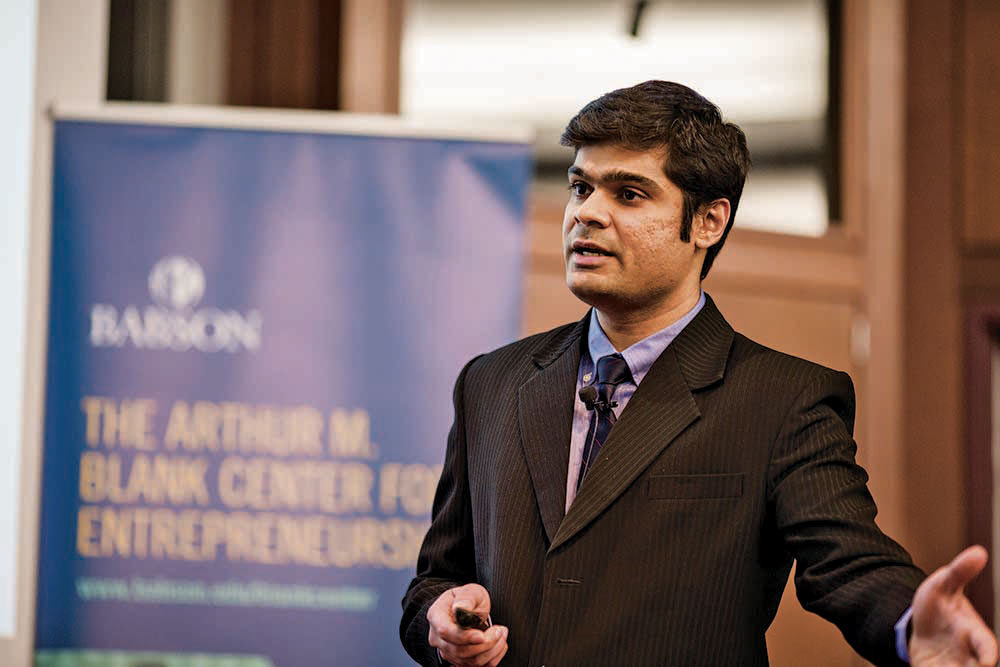
Ravish Majithia MBA’18 presents his business, Magnomer, at the Blank Center’s 2018 B.E.T.A. Challenge — Babson’s premier new-venture competition.
At The Lewis Institute, we knew students needed real-world experiences and platforms for creating social impact that would not be possible through traditional internships. We also felt that social enterprises could benefit from tackling a special project or interest with a fresh, entrepreneurial approach.
Thanks to a two-year funding commitment from The Arthur M. Blank Family Foundation, The Lewis Institute launched a first-of-its-kind program called Social Innovation Inventureships™. This new design is unique to Babson, asking students to apply Babson’s methodology of Entrepreneurial Thought & Action® to work at a strategic level with social enterprises or companies seeking to have greater social impact. With a sponsoring organization, students co-create either a semester-long or summer-long experience that addresses a real and current social-impact challenge.
Participants gain personal and professional development while initiating meaningful change in the social sector or business. They apply Babson’s action-oriented philosophy by embracing risks and integrating the theoretical with the practical. And they find the “on the ground” experiential learning critical to their success as value-driven, positively disruptive change agents. In their Inventureships, students are encouraged to catalyze unexpected collaborations and integrative designs for good business and greater impact.
Most importantly, through the Blank Foundation’s investment in this program, Babson created a portfolio of real-world experiences for our students in the domain of social impact. Research shows that when students have internships in areas of interest, they are more likely to seek positions aligned to their interest and desires. In this case, we’re inspiring leaders in social impact.
Accelerating Opportunity
Magnomer (Startup)
The Startup
When most people look to solve the problem of plastics pollution, they ask how we get people to recycle more or to use less plastic.
But that’s not the right question. Even with changing consumer behavior, less than 2 percent of all single-use plastic received by recycling facilities is turned back into a renewable product. That’s why Ravish Majithia MBA’18 started questioning how he could look at the full production cycle and redesign plastics before they get into the hands of consumers.
Majithia, an engineer with a Ph.D. in material science, came to Babson as a graduate student to turn his idea into a business.
Magnomer’s novel coating technology enables standard single-use plastics (such as cutlery and bottle caps) to be more likely to be recovered during the recycling process by adding magnetic coatings during the manufacturing stage. By automating end-of-life waste-management processes, the “design for recycling” motif works with the current single-stream recycling infrastructure (using magnets to reclaim materials) and diverts packaging away from landfills.
The Inventureship
In lieu of a traditional summer internship, Majithia took advantage of the paid Inventureship program.
As part of his Inventureship, he used Magnomer as a case study to help teach Babson first-year students about how a startup can innovate in the context of the circular economy — creating social and economic value simultaneously.
The Accelerator
The bigger opportunity that the Inventureship afforded was the ability to work full time on his startup through the Summer Venture Program.
The Summer Venture Program (SVP), offered through Babson’s Arthur M. Blank Center for Entrepreneurship, is a 10-week intensive experience that builds entrepreneurial skills and accelerates the development of the top 15 student ventures, selected from among applicants from Babson and nearby Wellesley and Olin Colleges. The award-winning program provides the teams with dedicated advisors, expert speakers and mentors, programming, free housing, downtown Boston workspace, and much more.
And accelerate Majithia did. He figured out the revenue model and pricing model, and even piloted the product with a potential customer. Debi Kleiman, executive director of the Blank Center, recalls, “He hustled and learned at an incredible pace. It seemed like he was everywhere all at once. Ravish is building a company with a big mission that could have enormous impact on the world. He is tackling a very difficult problem that requires aligning multiple large stakeholders and capital expenditure, yet he is able to enroll these organizations and people in his mission because of his passion and smarts.”
The Impact
Majithia says, “I was able to take the entire summer of 2017 to do what I came to Babson to do: explore the business viability of Magnomer, talk to a variety of stakeholders (government, trade organizations, customers), and create a product road map. The Inventureship was the start of that process for us. It was the beginning of the snowball that quickly grew through the support of the Summer Venture Program.”
Within one year, Magnomer went on to win the graduate track of the Blank Center’s 2018 Babson B.E.T.A. Challenge ($20,000 cash prize plus in-kind services), the 2018 B.E.T.A. Challenge Social Impact Award ($2,000), and the 2018 MassChallenge Gold Award ($50,000).
Majithia is quick to point out that one of the most valuable aspects of that summer was the relationships he made. “The traction and connections I made through SVP and subsequent interactions with The Lewis Institute have directly resulted in people becoming formal advisors to Magnomer in various capacities.”
Brief Stories of Big Impact
Iroquois Valley Farms (B Corp.)
Alex Mackay MBA’17 worked with Iroquois Valley Farms on a white paper outlining the financial, social, and environmental advantages of investing in organic farmland. He says, “The structure, funding, and support of The Lewis Institute made the experience one of the highlights of my second year and paved the way for a smooth transition back into the professional world. Most excitingly, what began as an Inventureship ultimately led to a job offer and my current position as director of business development and investor relations at Iroquois Valley Farmland REIT.”
Greyston Bakery (B Corp.)
Evadne Cokeh MBA’17 worked with Greyston Bakery to quantify the impacts of Open Hiring™. She explains, “My Inventureship at Greyston Bakery and Foundation helped me understand the importance of metrics and measurement for a social enterprise to communicate effectively with for-profit companies. Numbers, for better or worse, are one of the easiest languages to understand across department, industry, and culture, giving them incredible power. Greyston has used my work calculating the ROI on Open Hiring to help other companies understand the cost of Open Hiring.” This helped set the foundation for Greyston to create a more robust story and tool kit for other businesses to adopt Open Hiring.
SEEDS Vietnam (NGO)
An Inventureship provided Tien Mai ’20 with funding to successfully launch the first-ever women’s hackathon in Vietnam, furthering the mission of her nonprofit, SEEDS Vietnam, to tackle education inequality for Vietnamese youth.
The purpose of the SheCodes hackathon was to bring more women to STEM and help close the IT gender gap in Vietnam. According to Mai, “I had pitched to many who dismissed our plan because they underestimated the demand.” After working with The Lewis Institute and enrolling the right partners, her first hackathon was a success. Nearly 150 Vietnamese women gathered and formed teams to collaboratively design and code a solution to address the UN Global Goals of quality education and gender equality.