
Promoting Unusual Partnerships
Why a medical foundation chose to partner with an entrepreneurial school
February 26, 2019 | Read Time: 6 minutes
“We cannot solve our problems with the same thinking we used when we created them.” – Albert Einstein
When most people are trying to create something new or solve a problem, they tend to focus on outcomes, build alliances, and learn from the experts and practitioners who have been working in that space for a long time.
But in line with The Lewis Institute’s Uncommon Table™ methodology, we know that to solve the world’s most complex issues, we need to bring together those core stakeholders (the usual suspects) with some of the outsiders (the unusual suspects) who may have an innovative or different perspective that can move the issue in a way it’s never been moved before. We reconfigure relationships in such a way that new and expanded opportunities and innovations come about not because of the “what,” but because of the “who” and the “how.”
In this sense, the focus needs to shift from breakthrough innovation to breakthrough interactions — bringing together multiple stakeholders with the distinct purpose of catalyzing action to address a problem or social challenge. No single sector can solve any one problem, and, traditionally, sectors meet within designs based on an adversarial model — zero-sum actions, assumption of scarce resources, and established mindsets. Where true innovation takes place is in the redesign of those interactions — focusing on abundance rather than deficit — where individual sectors find their self-interests better served in a community of both the usual and unusual suspects.
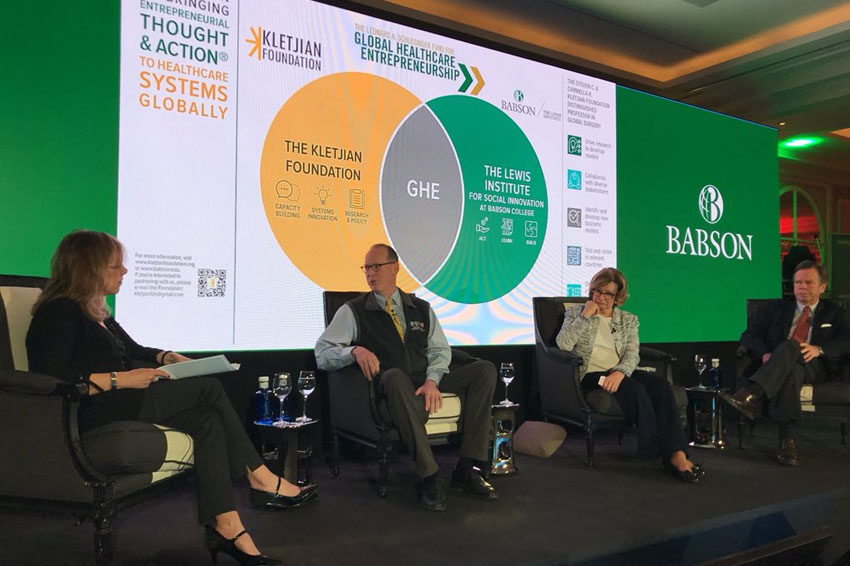
One example of a breakthrough interaction involves the gift that Babson College received in 2013 from Carmella Kletjian, founding director of the Stephen C. and Carmella R. Kletjian Foundation, which envisions a world where all people have access to safe, sustainable, and high-quality medical care. Kletjian along with her co-founder, Dr. Mack Cheney, worked with Babson’s President Emeritus Len Schlesinger to set up The Schlesinger Fund for Global Healthcare Entrepreneurship, a multifaceted initiative housed within The Lewis Institute for Social Innovation that provides opportunities for Babson faculty and students to apply Entrepreneurial Thought & Action® to global health challenges.
Entrepreneurial thought and strategic action help us reimagine the global health agenda and think differently …
So, why does this fit into the breakthrough interactions category? And why is this relationship an unusual partnership? Traditionally, a foundation focused on addressing issues of global surgery and global health would designate its philanthropic giving toward doctors, medical practitioners, researchers, and medical schools. But the Foundation’s investment in Babson was courageous and intentional in allowing for experimentation without knowing exactly what the outcomes would be. As a member of Babson’s Board of Trustees, Kletjian understood that an entrepreneurial mindset would be an important addition to the technical expertise of surgeons, doctors, and public-health professionals of all kinds. The possibility of a Babson influence became very important to the Kletjian Foundation to achieve its mission, as it recognized that an entrepreneurial approach was crucial to create greater impact and leverage its investments in global health. The investment began a chain of breakthrough interactions that have led to new and different discoveries and outcomes worldwide in just a few years.
Babson Professor Wiljeana Glover has created a new field of research and practice called global healthcare entrepreneurship that aims to activate entrepreneurial leaders and thinkers in global health. The barriers to delivering quality care are many, and they require us to think not just about one specific disease but rather about health systems overall. Entrepreneurial thought and strategic action help us reimagine the global health agenda and think differently about the paths to alleviating poverty and building a vibrant entrepreneurial ecosystem in support of local health-delivery systems.
Babson forged partnerships with other Kletjian-funded institutions, including the Program for Global Surgery and Social Change at Harvard Medical School, to publish a series of cases via The Lancet Commission highlighting examples of procedural, IT, and service model innovation. It included cases like SQUAD Uganda, a low-cost, open-source medical-record initiative, and Hôpital Universitaire de Mirebalais, which developed a new model of providing care to community members as a privately run hospital with connections to the public system.
The Schlesinger Fund has also cultivated new relationships and partners through a series of study abroad, showcase, and fellowship opportunities for students and health startups to help address the three delays to surgical care: seeking care, reaching care, and receiving care. For example, in 2016, the Babson team partnered with the Consortium for Affordable Medical Technologies (CAMTech) Uganda to host a Global Surgery Hackathon. New innovations were developed by cross-functional teams of physicians, engineers, and business students that addressed how patients reached and received care. And in 2017, we launched the Global Health Innovation Fellows program where MBAs partnered with global health innovation startups. One recent fellow, Prakash Veenam MBA’18, has gone on to become the CEO of Maternova, the company that he worked with.
Global healthcare entrepreneurship as a domain of study is thriving. A team of Babson faculty, including Wiljeana Glover, Alia Crocker, Angela Randolph, and Candy Brush, has led workshops with the Academy of Management, the largest body of business academics, to help more than 100 researchers and instructors explore opportunities in this new domain. This has sparked new collaborations between business faculty across multiple colleges and has led to more faculty teaching global health entrepreneurship to their students, thereby further linking the global-health and business-education worlds.
Everyone’s needs are better met in community and through collaboration
Strategic partnerships with leading Boston-based hospitals, global surgery groups, medical schools, and business programs enhance our mission and improve efficiency and effectiveness of global surgery initiatives.
Entrepreneurship is the most powerful force on the planet for navigating uncertainty, solving problems, and furthering new ideas
The Kletjian Foundation invests in energetic, dedicated, and high-achieving entrepreneurs. Whether they’re globally minded academics, clinicians, students, or business leaders, the foundation empowers them to excel.
The power of investing in higher education and its extended relationships and networks accelerates the impact you’re seeking
The Kletjian Foundation acknowledges the importance of quality education for the future leaders in global health. The foundation invests in institutions, research, and individuals who advance global-health education and facilitates collaboration between the likely and unlikely players in global surgery to explore areas for health system strengthening and innovation.
The Kletjian Foundation has influenced us, and we have influenced them. Babson helped to create an expanded vision for the foundation and helped reframe its mission to build collaborative networks and support entrepreneurial leaders that promote global-health innovation and equity.
Babson, through its partnerships, has discovered unmet needs and opportunities in the domain of global healthcare entrepreneurship that are fertile ground for further research and business innovation.
The ultimate return on investment was the return on engagement inside of higher education.